Author Archives: richards

Call for Proposals – STEAM into Sydney

steam-into-sydney-logo-final-fb-large

IFLA Public Libraries Section

Mid-Term Meeting 

Theme:   STEAM into SydneyScience, Technology, Engineering, Arts and Mathematics (STEaM)

Date: 16-17 March 2017

Venue:  State Library of New South Wales, Sydney, Australia

In a rapidly changing environment join us to celebrate the responsiveness of public libraries to the ever changing digital futures agenda. The conference will build on the themes of the public library as an agent for change in the digital age, in particular the public library response to digital community cultural development.

Proposals

Tell us about your library’s contribution to the creative economy, digital inclusion and jobs for the future.

The conference organisers invite proposals on the following issues:

  • STEaM : delivering community outcomes
  • The library as an economic driver.
  • Creative communities and practice
  • Community Partnerships
  • Collections – digital devices ·

15 minutes will be allowed for a presentation in the Conference followed by 5 minute discussion/question time. The full written paper is not to be read.

Proposals should include

  • Title of the presentation
  • Abstract of no more than 400 words
  • Author(s) name, professional affiliation, postal address, e-mail address
  • A brief biographical statement of no more than 50 words

The conference will be conducted in English. All proposals, papers and presentations will be required to be in English.

Preference will be given to presentations that will equip participants with ideas and skills that can be applied in their workplace.

The expected audience is likely to include public library staff, cultural workers, students and scholars, other professionals working in the information industry and government representatives.

Submission Guidelines

Proposals should be sent before 14 December 2016 via email to:

Email: [email protected]

Successful proposals will be identified and announced by 23 January 2017. The planning team reserves the right to ask applicants to make small adjustments to the shape of their papers to support the needs of the program

The Seminar is being organised by the IFLA Public Libraries Section in partnership with our hosts, the State Library of New South Wales Submissions will be reviewed by the Program


Registration:

All expenses including travel, accommodation etc., are the responsibility of the authors/presenters.

Systematic Joy of Reading Award Launched

joyofreading_text_251x273

As we all know only too well illiteracy is a global problem. The Systematic Joy of Reading Award will acknowledge projects that promote the joy of reading and address illiteracy. Applications are now open until 1 March 2017.

The award has been established by the IT-company Systematic in collaboration with Next Library. An international jury will assess the incoming applications and choose the nominees and winner. The winner will be invited to Next Library 11-14 June 2017, in Aarhus, Denmark, to receive the prize and present the winning project. HRH Princess Laurentien of the Netherlands, founder of the Reading and Writing Foundation, will present the Award  $10,000 US).

Campaign The Library Enriches You


coen


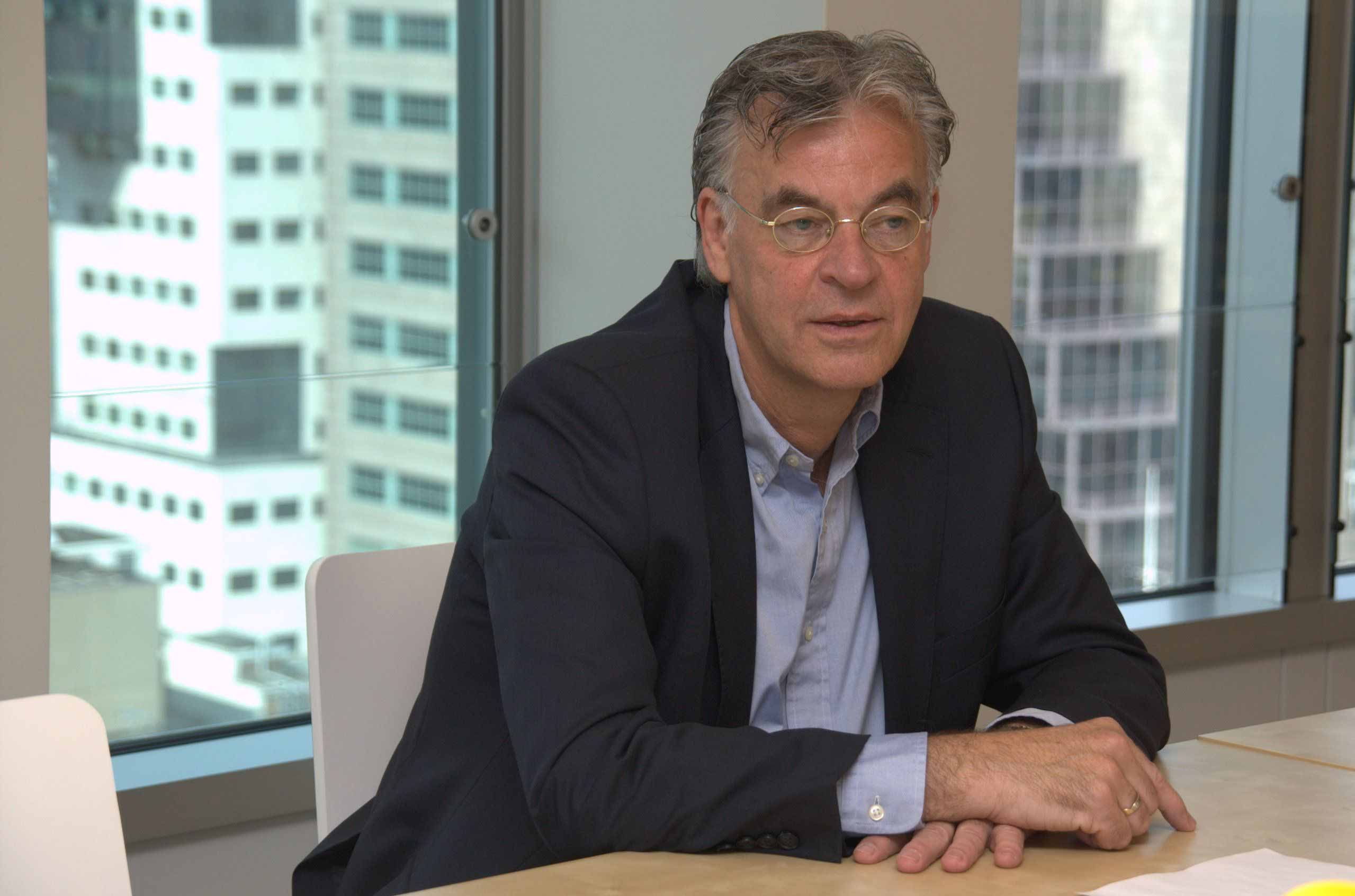
Guest Blogger: Coen van Hoogdalem, policy advisor Marketing of The Dutch Association of Public Libraries

jos

The Library® is an easy accessible public facility that helps people with their personal development. The Library intends to have every person fully and independently participate in society. Moreover, the Library wants to offer a ‘third place’ for anyone seeking to relax and find a moment of quiet (‘time-out’) to absorb information in any form. To develop, discover, encounter and relax are core features. In this way, the Library is a playground of knowledge, stimulation and experience for every individual.

coen-1

The Library operates from an independent position, is accessible to anyone and focuses in everything it does on the perspective of developing people. In doing so, the Library contributes to the welfare of all and offers added value to society. The Library is an inspiring and motivating ‘workplace’ for personal development.

Following this positioning, the campaign ‘The Library enriches you’ has been developed. This campaign aims at establishing the Library as partner in personal development and increase awareness of this with the general public.

coen-2

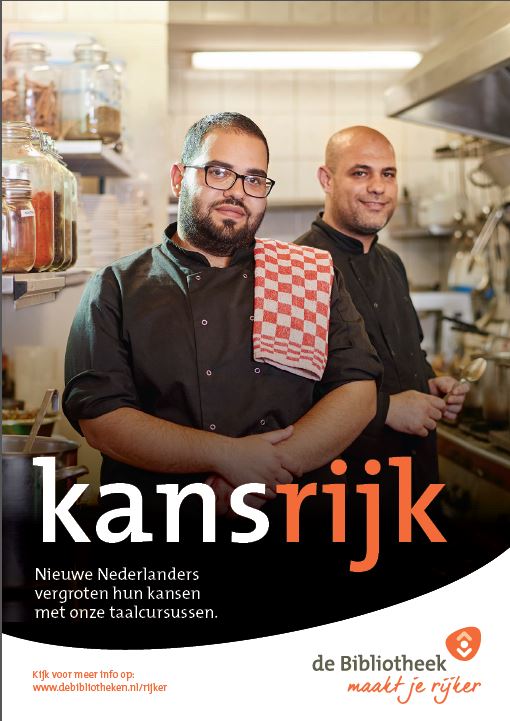
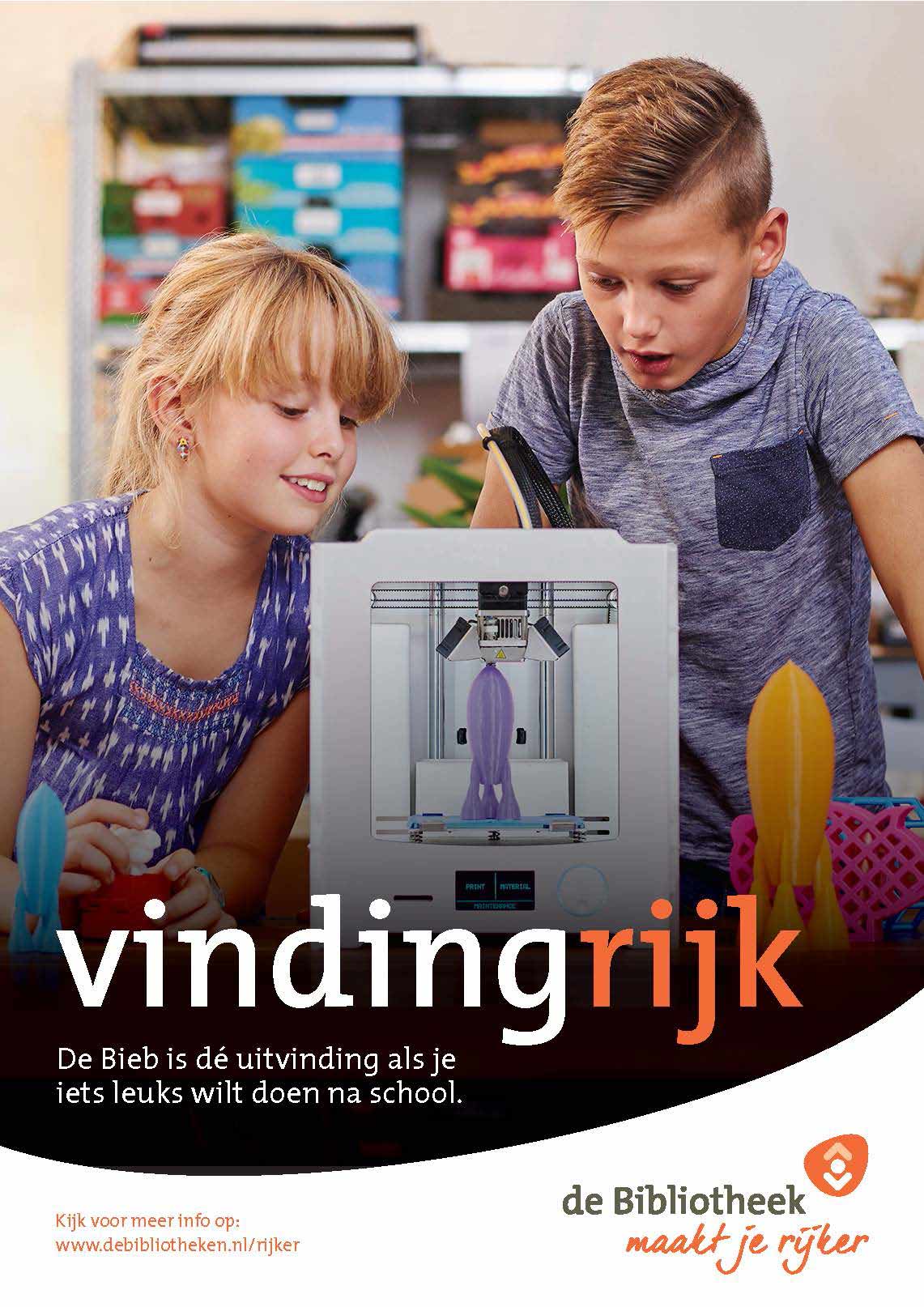
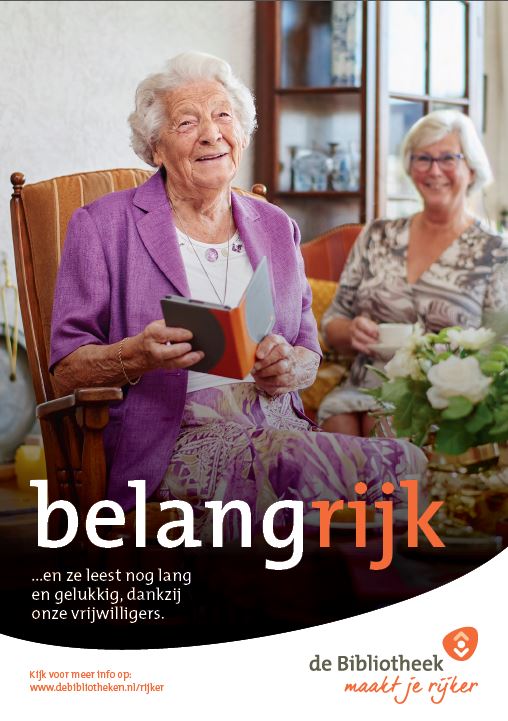
The campaign is elaborated by three examples: advantageous, resourceful, and important, and shows the versatility of the present public library.

The campaign starts on 24 October and the week of 24-31 October will feature over 1800 billboards, bus stops, subway panels, city cells and Q-Park panels showing posters with abovementioned themes. The period of 24 October to 31 December will focus attention online by means of blogs and vlogs. The campaign will continue in 2017.

Employees of public libraries have been extensively informed in advance by means of a special campaign newspaper and all libraries have received a communication toolkit to implement the campaign locally.

coen-3

On 13 October the Minister of Education launched  the campaign

Route 2020: undertake and cooperate

henriette


Guest Blogger: Henriëtte de Kok, Tour guide Route 2020.
Digital developments, cost reductions and changing usage are external developments that influence the work of public libraries. The collective libraries of the Netherlands have decided to undertake actions to anticipate these trends. A budget has been provided to this end. To focus the effort, a number of topics has been concentrated upon. The fundamental idea is: by, for and through libraries.

  • learning from each other and undertaking;
  • cooperation and network development;
  • collective positioning in relation to local financing.

Two travel teams got to work. One for the component of positioning and one for undertaking and cooperation.

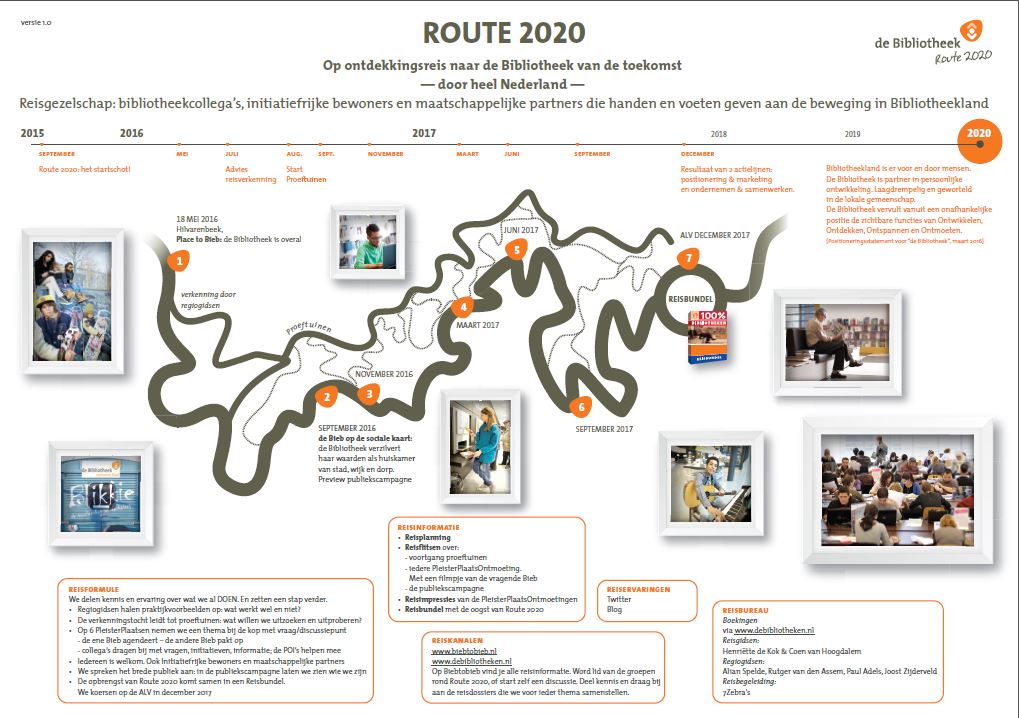
The project, running to the end of 2017, got started under the title Route 2020. We chose the metaphor of the expedition, heading for the future together, we examine and discover, we share experiences. And periodically we meet each other physically at a stopping place. At Hilvarenbeek we focused on the theme of the ‘Places to bieb’. At Assen we discussed the library as entrepreneur and the social value of libraries.

The route for Action line 2: undertaking and cooperation started with an exploration by about fifty regional guides. They collected real-life examples from the entire country. Examples that have already proven their value. There are plenty of nice plans, but we were looking mainly for successful implementations.

In experimental gardens we investigate in what way the knowledge of the various subjects can be made transferable to fellow libraries. Themes that feature in this are:

  • developing libraries into future-oriented organisations;
  • platform for communities;
  •  all under one roof, multifunctional organisations;
  • Places to bieb, the library is everywhere;
  • a lifetime of learning;
  •  the free library;
  •  this is how the library works, HRM aspects.

route-2020
Regularly we send the home front a postcard. We have found many small beautiful projects and campaigns during our exploratory phase. Too small for a substantial experimental garden, but worth the effort to share with our colleagues.
By means of biebtobieb the libraries are kept informed of our experiences and are invited to join the expedition interactively.
By the end of 2017 we will have the travel guide 100% libraries, and beyond that the expedition will surely continue.

Provincial Support Organizations

tinenke


Guest Blogger: Tineke van Ham, Manager Rijnbrink

The system of public libraries in the Netherlands consists of three layers. A national, provincial and municipal layer. The provincial layer is formed by the Provincial Support Organizations (PSOs). They play a part in the coordination between the national and municipal levels, in stimulating and facilitating the provincial network, in encouraging local innovations and in the organization of activities transcending local level that benefit from a larger scale. Their scale ensures that the PSOs for libraries are a gathering point of knowledge and a platform for expertise and knowledge sharing.

Provincial Support Organizations in the system
PSOs are non-profit social institutions . They are publicly commissioned and are partly funded by one or more provinces and partly by the libraries they support. PSOs align their range of assignments with the provincial policy and the demand of the libraries in their region. Furthermore, in CPN context (see text box) they align their activities between themselves and look for alignment with national associations. The Dutch System of Public Library Facilities Act (WSOB) appoints the provincial support organizations a number of general and specific tasks that need to be performed. Apart from that, the PSOs undertake several activities that to a certain extent have to be paid for entirely by its users.

The PSO activities on behalf of the system of public libraries comprise:

1. Network partnership (art. 6,7,8 WSOB)
PSOs are part of the network of public libraries and fulfil a role within the national system. This role is determined in the WSOB. PSOs, at the layer of the provincial network, are responsible for stimulating, facilitating and coordinating the network at the provincial level. They do so in alignment with the National Library of the Netherlands, which is responsible for the national network. In this way, the PSOs in consultation with the local libraries and the National Library accomplish the regulations on participation with the network, as mentioned in article 8 of the WSOB:
– together with the other participants it uses a collective catalogue of available volumes;
– is part of the inter-library loan system, indicated in article 15;
– performs its collection policy in accordance with the joint collection plan, indicated in article 10;
– makes use of a digital infrastructure that is aligned with the other participants;
– aligns its member administration and its general conditions with the other participants;
– supports education.

Furthermore, PSOs stimulate network cooperation by offering libraries services in the area of business management that support the business process. This concerns ICT, financial administration, employee and salary administration, and HRM. These services in all provinces constitute services that have to be paid for in part or entirely by the libraries. In its position as provincial manager of the library automation systems, the PSOs play a part in the implementation and demand settlement for the national digital infrastructure. These latter services are outside of the tasks as determined by the WSOB and have to be performed while at least covering costs. In this, the PSOs usually work together in CPN context to make arrangements with national associations.

2.  Support of the inter-library loan system (art. 16 WSOB)
– PSOs provide the transport of volumes between libraries in the provinces that subsidise them;
– the PSOs collectively provide the transport between provinces.

3.   Support of the collection policy (art. 10 WSOB)
PSOs contribute to the national collection policy which is formulated under the direction of the National Library, translate the policy in consultation with the libraries to provincial collection plans and facilitate the provincial collection formation.

4.   Developing innovations (art. 16 WSOB)
PSOs collectively and individually develop innovative service concepts for purposes of the local libraries. They align their innovation plans with each other and with national associations such as the VOB, BNL and the National Library. In this regard, they participate with the implementation of the strategic agenda of the branch of industry (The Library provides value – 2012). With this, the PSOs perform their legal innovative task. The objective is to support local libraries in the necessary transition to a crossroads of knowledge, contact and culture (report committee Cohen: Library of the future – 2014).
The innovations mainly focus on the development and implementation of service of the functions of the library: reading, learning, informing, meeting and debating, and getting acquainted with art and culture.

In the association Cooperating PSOs in the Netherlands (CPN), all PSOs are cooperating. CPN is a network cooperation par excellence: provincially where it needs, nationally where it can. All PSO managers hold a substantive portfolio, employees of the different PSOs function based on suitable abilities in collective implementation programmes. This contributes to the efficiency. CPN looks after the collective national lobby of the PSOs and after the collective implementation of programmes such as the Library in school (see blog by Adriaan Langendonk), basic skills, the digital library and the sharing of knowledge.


Dutch libraries busily in motion

IFLA_Jos-Debeij


Guest Blogger: Jos Debeij, head of staff department library system, Koninklijke Bibliotheek (Royal Library), National Library of the Netherlands.

In the month of November, a dozen library bloggers outline an image of what is taking place in the system of the Dutch public libraries. In the Netherlands as well, the past years have seen considerable cutbacks in budgets of public libraries as a result of the economic recession, the formation size has been reduced substantially and quite a few larger independent branches in neighbourhoods and towns have been closed or converted to smaller service points in schools and townhouses. It sounds contradictory, but at the same time many new library buildings are being built. There too, a large change is visible. The issues are simultaneously to economize, consolidate and renew, but to do so with less money and fewer professionals.

Another trend is the library more and more focussing on social issues and personal development. The library, rather than a ‘repository of books’, is becoming a place for meeting and working. The amount of lends has decreased significantly over the past twenty years. New activities are being taken up. Following the tradition of reading advancement, all Dutch public libraries put a lot of effort in language development and digital skills. The approach is twofold: 1. Preventive, in cooperation with intervention programmes from the National Reading Association, such as Bookstart, the Library in school and the ReadAloudExpress , to reach children from a young age and bring their language development to a higher level, and 2. Curative, with the library as a language house where anyone who has functionally insufficient language skills or digital skills is welcome to attend language cafes, workshops and schooling programmes or other support. In this, the libraries cooperate with numerous local education and social partners and with large groups of citizens, such as voluntary trainers and ‘buddies’. With the Dutch Tax Authority agreements have been made to support all libraries with the electronic filing of the digital revenue form or the digital request for grants. The renewed vision on media wisdom (link to English version) elaborates on 21st century capacities: the role of the library as signpost and workplace is being expanded: the library as knowledge workplace and as makerspace.

With the new Library Act (WSOB)  the National Library of the Netherlands has gained a new function and adjusted its policy accordingly,  and the position of the provincial support has been consolidated with focus on the innovation at local libraries. At the National Library, we continue building the national digital public library. With digital collections and services that are available to every person in the Netherlands and are part of the digital infrastructure for all members of the local libraries. The local public library and the national digital library complement each other and are connected. In searching for the public library of the future the Dutch libraries are working closely together. With a collective innovation agenda, with an exploration of the VOB called Route 2020 (see blog Henriëtte de Kok), with the knowledge sharing platform Biebtobieb (see blog Levien den Boer), with the marketing campaign The Library Enriches You (see blog Coen van Hoogdalem) and with a collective quality framework for audits and certification (see blog Willem Camphuis).

The world is changing, and so are public libraries. In the Netherlands as well, public libraries are busily working on their future. To continue bringing people and information together. In this way, libraries continue to contribute to the personal development of the Dutch people and a smarter and more creative Netherlands.


capture

Libraries and Human Rights– caring for the whole community

hands

EUROLIS (the consortium of librarians from European cultural institutes in London) and the International Library and Information Group (ILIG) of the Chartered Institute of Library and Information Professionals (CILIP) have organised a one-day seminar focusing on the role of libraries as institutions at the forefront of profound changes in society. Libraries and Human Rights – caring for the whole community .

Leading experts from Spain, Italy, France, Portugal, Germany, the UK and the USA will present current projects and share their experiences and ideas with the audience.
The seminar will be chaired by Martyn Wade, Chair of the CILIP Board and IFLA FAIFE committee.

Fri 25 Nov | 9:30am – 4:30pm| £ 60 (£50 conc.) including lunch | At the Goethe-Institut London | Tickets are available on Eventbrite