Tag Archives: access to information

How HathiTrust Emergency Temporary Access Service (ETAS) supports Libraries in pandemic times

By Sara R. Benson, Copyright Librarian, University of Illinois at Urbana Champaign. Check out Sara’s podcast titled Copyright Chat at https://go.illinois.edu/copyrightchat

It’s Fair Use/Fair Dealing week and that means it is once again time to let folks know about exciting developments with the HathiTrust Digital Library. Last year on Fair Use Week I highlighted the ability of researchers to engage with copyright protected materials for text and data mining through the HathiTrust Research Data Capsule. This year, I would like to make readers aware of the HathiTrust Emergency Temporary Access Service or ETAS.

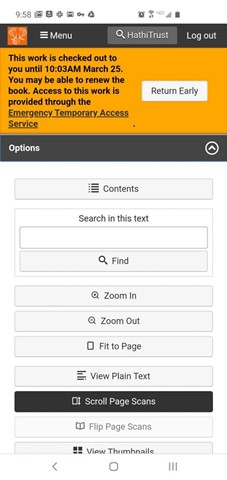
What is the ETAS? It is a portal allowing affiliated libraries to permit their patrons to access in copyright works remotely. Why is the ETAS available? COVID 19 has caused many libraries, such as my own (the University of Illinois at Urbana Champaign Library) to temporarily limit physical access to library materials. Almost half of our collection, however, has been digitized and is available in the HathiTrust corpus. Normally, users can only perform searches for how many times a given term appears in copyright protected works in the HathiTrust corpus. However, due to COVID 19, the ETAS allows users to view (but not download) entire copyright protected works remotely. Libraries participating must have the physical book in their collection and agree not to lend out the physical book. Thus, the book is being lent remotely on a one-to-one ratio to the Library’s physical collection on the basis of fair use. This type of lending is made possible because it is non-commercial, educational in purpose and justified due to the emergency nature of the pandemic virus. As noted by April Hathcock in a public statement created by copyright specialists and available at https://tinyurl.com/tvnty3a, “fair use is made for just these kinds of contingencies.”

So, as you celebrate Fair Use/Fair Dealing week this year, note that the pandemic has brought with it many challenges, but Fair Use has enabled libraries to keep lending their works digitally so that researchers and the public can continue to create, thrive, and produce . . . even during a crisis.

10-Minute International Librarian #34: Reaffirm your library values

Having a longer term strategy can be a great way of keeping yourself focused in busy times.

It can act as a reference point, and help you choose priorities.

But in times of uncertainty, long-term planning can seem ambitious.

Even setting goals for the following week can be tough when you don’t know if you will be able to open or not.

This is where values come in, helping you to stay inspired, and work out what’s the best thing to do in any situation.

So for our 34th 10-Minute International Librarian exercise, reaffirm your library values.

For IFLA, it’s a focus on the importance of access to information in supporting personal and societal development, and on how excellent library services can make this happen.

As identified in the IFLA Global Vision, our field as a whole has this same focus on providing universal and equitable access.

Share your values in the comments below.

Good luck!


This idea relates to the IFLA Strategy! Key Initiative 1.4: Shape public opinion and debate around open access and library values, including intellectual freedom and human rights.

You can view all of our ideas using the #10MinuteInternationalLibrarian tag on this blog, and of course on IFLA’s Ideas Store! Do also share your ideas in the comments box.

Was 2020 the Year we Fell out of Love with Information (and Why We Should Make Up in 2021)

2020 was a year of casualties.

Most obviously, there were the million plus people who were lost to COVID-19, and others whose lives were – or risk being – shortened by the consequences of the COVID response on other forms of healthcare.

Screening and vaccination programmes, mental health, and prevention have all suffered.

There have been the pupils and students who have lost weeks or months of formal education, with the highest costs often amongst those who rely most on education as a driver of social and economic mobility.

There has been the economic cost, playing out in businesses closed, jobs lost, and futures upended.

Beyond COVID, the death of George Floyd led to protests that met, often, with a violent response from police. Meanwhile, conflicts continued around the world, and progress towards the SDGs remained insufficient if we are to meet the Global Goals by 2030.

This blog argues that alongside the other casualties, there is a risk that our relationship with access to information may end up being damaged by the events of 2020. However, as it concludes, it is not too late to make it up.


Information as Virus

The first blow came, early on in the pandemic, when the word ‘infodemic’ started to circulate, promoted by the World Health Organization. Others, such as UNESCO, used terms such as ‘disinfodemic’.

Of course in some ways, it is positive to see the power of information recognised in a world where this is arguably all too often taken for granted.

However, the focus in the WHO definition on the idea of an ‘over-abundance’ of information is noteworthy. So too is the implication that information itself (rather than deliberate disinformation, in the case of the UNESCO definition) is a virus.

It seems unlikely that the WHO, given its own positive approach to issues such as open access and science, intended this. However, given libraries’ focus on increasing the amount of information available to people in order to be able to respond to their needs, this is potentially a cause for concern.

From here, it is only a short step to the idea that certain actors should have a monopoly on information provision, with everything else declared invalid or even illegal. This would take us back to the days of only allowing officially sanctioned printing presses – not a desirable move.

If the idea of limiting the amount of information available to people spreads – rather than a focus on providing the guidance and skills necessary to navigate the information available – there is a risk of losing momentum in the drive to bring the benefits of access to information to all.


Information as Potentially Dangerous Good

Closely linked to the concept of an ‘infodemic’ has been the growing pressure on internet platforms to intervene in the sharing of information – and their own readiness to act in response.

Twitter for example updated its policies in 2020, and proved readier to block or label tweets from President Trump. Facebook and others upped their efforts to block misleading content about COVID.

For many though, this has been nowhere near enough, and calls have grown for review of the ‘safe harbour’ provisions that have allowed internet platforms a way to escape liability for content posted by users.

The European Union itself has started the process of updating its own rules, while in the United States, calls to repeal or reform Section 230 are growing louder.

These discussions of course have two angles to them, as the European Union’s own approach recognises. One relates to how to address harmful or illegal content online. The other is a result of the desire to address concerns about unfair competition and impacts on other companies.

However, in the popular discourse, the two issues are rolled together, with changing liability rules for internet platforms seen as a way to solve competition issues. Faced with this, the platforms themselves, as suggested above, have been ready to move to show they are listening and hopefully avoid much more costly competition interventions, such as break-ups or divestments.

Why is this a concern for access to information?

Because a simple shift to increase the liability on the platforms and services that have arguably facilitated much of the explosion in access to information risks leading to the privatisation of the policing of free speech.

In effect, through their terms of use – and their application through pre-emptive filters – platforms would decide what speech is acceptable or not. Without an incentive to promote free expression, the risk of over-blocking is high. Similar rules could end up applying to upstream providers such as ISPs, or even hosting services. As private companies, there would also be fewer requirements for transparency, or opportunities to appeal.

This is indeed an issue already warned about by the former UN Special Rapporteur on Freedom of Expression in 2017. But after 2020, there seems to be a serious risk of it accelerating.


Information as Uncertainty

The final threat to our relationship with information has been the lesson that the pandemic has provided in how knowledge is created and furthered.

We have seen claims made and refuted by scientists, advice issued, changed and updated by governments, and have been faced ourselves with uncertainty in carrying out activities which we previously did unthinkingly.

The pandemic has exposed how incomplete and inconclusive information can be. While this is nothing new for those involved in science, for many, it has not been an easy or comfortable experience.

Rather, it has led to frustration, cynicism, and likely a greater tendency to grab onto the easy answers that conspiracy theories provide.

Clearly, such theories are nothing new, but the pandemic has arguably provided a fertile ground for their spread. These of course can do harm to individuals and groups, as well as to the effectiveness of efforts to tackle the pandemic.

In the longer term, there is a risk that more people are pushed into abandoning curiosity and seeking out easier and more comfortable information. In doing so, they risk falling into the trap explained by Elfreda Chapman in her work on information poverty, rejecting information from outside the group.


Conclusion

The events of 2020 have certainly had am impact on our relationship with information. The idea that there can be too much information, that it is something to be vetted before it is shared, that it is too complicated, all risk making people fall out of love with it.

Faced with this, libraries’ focus on enhancing the amount of information available to people, and focusing on building information skills, can of course risk looking naïve.

There is of course unacceptable information out there – harmful hate speech, abuse, deliberate lies and more. It is not possible to declare that all information is good, and of course, there is no such thing as perfect information literacy or skill.

The question is rather about our starting point in addressing these questions. Do we begin with the position that more information is a positive, unless identified as otherwise, or do we assume that information is bad, unless proven to be acceptable?

Do we put faith in people to be able to navigate their way around information, or do we spoon-feed them?

Do we encourage curiosity, even if it comes with complexity, or rather simply look to make things easy?

For libraries, traditionally, we advocate for the first positions.

While limitations on access and expression may be necessary, these need to be the exception, and applied only when necessary and proportionate, and in a transparent manner. While leaving people room to make up their own minds can lead to mistakes, it is ultimately more desirable than channelling them narrowly. While ready reckoners and simplicity may be attractive, they can set limits on curiosity and innovation.

However, the events of 2020 have seen increasing risks of lawmakers and societies adopting approaches less friendly to access to information. This risks dragging us back to a situation of censorship, slowing efforts to bring people online, chilling expression, and self-imposed information poverty.

As we head into 2021, we need to be able to highlight the costs of over-blocking, censorship and conspiracy theories. But just as importantly, if we want people to come to value and appreciate information, we need to be able to tell the positive stories of how the widest possible access changes lives for the better.
Celebrating the Public Domain 2021

2021 has finally arrived, and as always, the new year brings another celebration: Public Domain Day.

This is a big deal. Why? Because the public domain means that works can be used and modified by anyone without authorisation. As such, this enriches the range of books, articles, art and beyond that brings us pleasure, inspiration and insights without copyright-related restrictions.

This matters for libraries, as institutions focused on maximizing access to information, in particular of works which have been carefully preserved for years.

Why the Public Domain?

All works that reflect the original expression of the mind of an author are protected by copyright law as soon as they are created, for a long time.

Copyright protection has been regularly extended through time. The key international law on the matter – the Berne Convention – establishes protection for the life of the author plus a further 50 years. Yet countries can go further. In 1998, the United States agreed via the Copyright Term Extension Act to extend copyright protection to 70 years after the death of the author. This decision has been followed by additional countries, delaying the entry of works in the public domain, with some offering as many as 100 years of protection after death.

Until these works enter the public domain, they are still subject to restrictions on use, despite that fact that the commercial value of works is generally only in the first few years after publication. As a result, plenty of works are not easily available, and therefore subject to oblivion.
As a result, any extension of protection limits libraries’ ability to provide wide access to works.

Further risks come from the fact that the public domain too often does not exist as a concept in legislation (it is rather implicit, resulting from the lapsing of protections). This can create uncertainty, leaving open the possibility to create new restrictions.

What is Public Domain Day?

Public Domain Day falls on is the first of January of each year and is celebrated during the whole month. It is about celebrating the public domain, recognizing the importance of protecting it, and fostering the use of materials by all communities.

This date was chosen because calculating copyright protection can be complicated. As a result, many countries have decided to simplify it by choosing the 1 January following the anniversary of the death of the author as the release date for works entering the public domain.

As a result, in countries with a copyright term of life plus 70 years, the works of authors who died in 1950 are now in the public domain. Thanks to earlier reforms in US law, books and films released in 1925 have also now lost copyright protection.

What are the next steps?

Are you willing to celebrate the public domain and make the most of it with your Library?

Whether you are in an academic library, a heritage library, or a public library, this is an opportunity to showcase works newly in the public domain. The library can highlight works via a conference, communications on blogs and social media, a wiki edit-a-thon to add these new works in Wikisource or to complete Wikipedia pages.

Several approaches are available:

Pick a specific work that is now in the public domain. Who is the author? Why is this book unique and what did it tell us back in time? And now? Make a thread on social media or share it on your blog!

Build understanding about copyright: this is also a good time to share more about copyright laws, and library issues. Use Public Domain Day to discuss the public domain, common goods and the importance of unrestricted access.

If you are interested in more information, a few articles might be interesting: here, here, here (US), here and here (France), here and here (Spain), here in Colombia, here in Portugal.

Here is the Wikilist of works entering the public domain in 2021.

Get ready to start 2021 with #1Lib1Ref!

While 2020 is winding down, libraries and librarians around the world are already busy preparing for the 2021 edition of the Wikimedia Foundation’s #1Lib1Ref campaign.

Divided into two sessions, the #1Lib1Ref Campaign will take place from  15 January to 5 February 2021 and from 15 May to 5 June 2021.

The Wikimedia Foundation aims to gather and share knowledge in a simple, reliable way. In many ways, its missions can be considered as complementary to those of libraries: to provide access to information to all, foster freedom of speech, support communities, and reduce digital literacy gaps.

The #1Lib1Ref Campaign (one librarian, one reference) involves libraries and the librarian community, and focuses on ensuring that there are sources for all information included in Wikipedia. In this way, it creates an opportunity for all libraries and citizens to ensure the availability of reliable information online.

Why #1Lib1Ref continues to be a key area of engagement?

At a time that fact-checking and identifying reliable sources of information are a challenge for many, #1Lib1Ref is an opportunity for libraries to address these issues with their communities. This will contribute to providing better and more reliable information to all.

Libraries have an incredible amount of resources gathered in their collections, offering unique possibilities to provide insights on a huge variety of subjects. These resources can be key elements in structuring information on Wikipedia, yet they are not always fully used.

This matters because Wikipedia articles are sometimes the first point of entry to an unknown subject. Profiling resources on a specific topic ensures that this entry point offers a higher quality experience for readers who are looking for more information.

While some sources can be found online, many specialist articles and publications require access to broad resources, such as printed copies or e-resources, that are only available inside the libraries’ walls. This will be particularly true in the case of national and specialist libraries which hold unique collections – especially of cultural heritage – which are not available to access online.

Involving citizens and library users can also build capacities in information literacy. And, of course, given that the amount of information provided without reliable sources is so extensive, we can only hope to tackle it meaningfully with the involvement of all library users and citizens.

Where to start with #1Lib1Ref?

First of all, it is easy to participate in #1Lib1Ref, either online or in your library. Among the different possibilities, here are just a couple:

Option 1: Engage your colleagues and other libraries

First of all, you can engage librarians in your library themselves to contribute one source per day through the duration of the event. It is easy for libraries to get involved and encourage staff to edit Wikipedia (or even Wikidata, for the braver ones).

Simple instructions can be found on the #1Lib1Ref website.

Option 2: Engage with your library community

If you want to go further, you can create an event within your library! This event can be integrated into a specific theme in your cultural programming, based on your field, or a general topic.

in this case, you can communicate with your communities to invite them to join via social media, through your newsletter, or via information boards in your library or online.

Take a look at the resources on the website to find out more, and think about how you can engage your community, provide support or invite colleagues that might lead your event!

Let us know about our plans in the comments below!

European Commission releases key proposals: Digital Services Act and Digital Markets Act

On the 15th of December 2020, the European Commission launched its long-awaited reform on the regulation of major online platforms, the Digital Services Act (DSA). This comes alongside a proposal named the Digital Markets Act (DMA) which aims to address concerns about competition (or a lack thereof) in the technology sector and its impacts.

At the beginning of its mandate, the European Commission made a commitment to reform several aspects of the European market with regards to illegal online content and issues of competitiveness of major platforms online.

As part of this process, in June and September 2020, IFLA submitted suggestions and recommendations on the Digital Services Act to underline the interests of libraries as users of online services and to address their needs and expectations regarding the continuity of their core missions: provide an effective access to information and foster freedom of expression.

Initially combined within a single reform, the European Commission has finally decided to tackle these subjects independently. After several months of waiting, the European Commission launches its reform with two documents: the Digital Services Act and the Digital Markets Act.

The Digital Services Act: regulation of illegal content

The Digital Services Act reform aims to improve the single market within the European Union by developing a more coordinated response to illegal contents online. In doing so, it sets out the goals of maintaining the balance between tackling such content with protection of the fundamental rights of users, and facilitating the development of a competitive single market online.

20 years after the e-Commerce directive which established, among other things, the concept of exemption from liability of intermediary service providers, the new regulation proposes to maintain this key concept.

Online service providers will, if the proposal remains as it is, remain exempt from accountability in order to maintain and support citizens’ ability to express themselves and access information online.

This appears welcome.

To do so, they will need to make efforts to address illegal content, including efforts to prevent its reappearance. This includes violent and/or discriminatory contents relating to race, gender, age, religion.

For example, the DSA establishes due diligence obligations for flagging illegal content for all intermediary services with regards to the size and type of platforms.

The DSA also mentions that contents will not be controlled prior to publication, thus respecting the right of users to express themselves online. However, this leaves open many questions about the technical aspects that the implementation of this reform will take.

Regarding the process of takedown notices, the support of the Commission for a balanced judicial process is welcome. IFLA has strongly underlined the importance of respecting fundamental rights in the process of moderation of content, to let citizens benefit from their rights equally online and offline. Linked to this topic, the call for transparent and independent processes is also welcome.

The proposals evoke the possibility of national action in addition to European. While some issues will be developed at EU level, Member States are invited to develop national regulatory authorities for the digital space, with the power to order intermediaries to take content offline, and impose financial penalties.

Overall, the European Commission’s proposals seem welcome, given that they recall the importance of the protection of fundamental rights (e.g freedom of expression and freedom of access to information), the concept of online anonymity, and the importance of “transparency, information obligations and accountability of online service providers”.

The Digital Markets Act: competition regulation of “core platform services”

The Digital Markets Act mainly concerns major online platforms, also called “systemic stakeholders” that act as an intermediary between businesses and users, with the aim of limiting anti-competitive practices.

These include online intermediation services such as:
search engines
social networking
video sharing platforms services
number-independent interpersonal electronic communication services
operating systems
cloud services
and advertising services.

The objective is simple: to foster the emergence of new companies by addressing the harmful effects of monopolistic behaviour by major players online through measures that promote competition.

These proposed measures differentiate between two aspects of major platforms’ positions: the first one as a provider of a service to another business (for example one selling its products through an online marketplace) and the second as the provider of a service potentially in in competition with the same business , potentially enjoying an unfair advantage thanks to the data it gathers through its role as a service provider.

The views of the European Commission regarding proportionality, promoting “innovation, high quality of digital products and services, fair and competitive prices, and free choice for users in the digital sector” are welcome. A greater variety of platforms and offers of information and other services is likely to facilitate the work of libraries.

The concept of interoperability is also recognised as important and small and medium sized enterprises must be able to migrate to competing services. Nevertheless, little is said about individual users.

Good perspectives but a long way to go before a definitive document

IFLA continues to study these documents and remains aware that a deeper analysis is necessary in order to provide helpful solutions to next steps.

With the retention of the concept of exemption from the liability principle of global platforms and targeted recommendations to address a balanced EU response between user rights, respect for fundamental rights, and concepts of competitiveness, this is a welcome proposal.

We encourage the European Commission to consider in depth interoperability issues which impact on individual citizens. Libraries deeply support fundamental rights, including the ability of citizens to choose freely themselves, including online.

However, the devil always lies in the details and reflection on the technical aspects of such suggestions to achieve these objectives does not mean effective practical realisation.

Read more about it:  here, here and here, here, here

What do we talk about when we talk about access? 10 Suggestions to support library advocacy

We talk a lot about the importance of access to information in advocacy around libraries.

This access is at the heart of what libraries themselves do of course, helping users to find the information that they need to take better decisions, and participate in the life of the community.

Our institutions have been doing this for thousands of years, helping leaders, researchers, creators and other citizens to achieve their missions.

In advocating, we focus on why this matters so much, underlining how, in different policy areas – healthcare, innovation, democracy itself – access to information helps deliver goals, and in turn, how libraries deliver this access in an equitable way.

However, in doing this, it’s worth keeping in mind the different issues that access encompasses, and the different struggles this can imply, if only to be clear for ourselves.

This blogs therefore looks at just ten different aspects of access, and how this can play out in work on library advocacy.

1) Access as the possibility to find a work in the library: libraries have a key role in ensuring that ability to pay does not become a determinant of whether people can enjoy their right to information. This applies as much to those who would not be able to buy textbooks or children’s books, as to those who may only need certain parts of a book, and are not ready to pay for the whole book just to access extracts.

This is why it is so important that libraries can acquire all types of material, without barriers. Unfortunately, refusals to sell to libraries (or only to do so under very restrictive terms) make this difficult, and arguably require further investigation.

2) Access as preservation: access is an ongoing priority, and one that is threatened by the loss of materials due to decay, destruction or other reasons. It is particularly important – for researchers, for citizens – to know that todays information will be available into the future, in order to make it possible to support re-evaluation and accountability.

For example, government records need to be saved to allow for future study into decisions taken, while science itself is based heavily on the idea that research results should be reproducible – i.e. future researchers can access the same materials and reproduce the results of experiments.

3) Access as (reliable) connectivity: with so much information available online, including many materials that may previously have been produced in physical formats, internet access has become almost unavoidable as a form of wider access to information.

IFLA focuses strongly on this, underlining the need for libraries and users to benefit from high quality connections that are reliable – it is unlikely that people and businesses will be ready to invest in internet-enabled activities and approaches if they cannot be sure that it will stay on.

4) Access as a lack of barriers: access is not just about whether the library itself can add – and maintain – works in their collections, or whether they can connect meaningfully to the internet. Access is about whether library users can take advantage of this possibility. To do this, we need to work towards the absence of practical barriers to use, such as those felt by people who live far from a library, or who face challenges linked to physical mobility or other disabilities.

A number of tools can help in this regard – the internet is an important one of course – as can the sort of reforms promoted by the Marrakesh Treaty, that helps ensure that copyright does not pose an unreasonable barrier to creating and sharing accessible format works. With over 100 countries now signed up to the Treaty, we can aim for universal coverage in the coming years.

5) Access as literacies: access is also, crucially, about the skills of the person receiving information to understand and make sense of it. The skills involved can go from basic literacy to much more advanced forms, including critical thinking. Especially for those trying to work through the wealth of information online, being able to find the right knowledge is vital.

Basic literacy has long been an area of library expertise and experience, with increasing efforts to take information literacy training out of academic libraries and into public ones, to the benefit of the whole population. A priority here is to ensure that such support continues to be available to all, throughout life .

6) Access as use: access can imply a relatively narrow way of using information – for example being able to take, open and read a book. However, while for some library users this may be enough – simply taking pleasure or interest from the words on the page – for others it is not. They need to be able to quote, analyse or otherwise use works. For them, access without the possibility to use is pointless.

This is a core point around much work on copyright, with libraries arguing that once they have legally acquired a work, a core set of uses should be possible without restrictions or additional payment needed. These uses should be seen as part of the original price paid. Clearly this would not count uses that could cause unreasonable harm to rightholders, but trying to licence every single type of use is a recipe for market failure.

7) Access as the counterpart of expression: as set out in the previous point, a key ingredient of access is the possibility to use the information found in future work. As well as copyright issues, this can also implicate wider ones about freedom of speech. This is because the possibility to access and use information is less powerful if there are then limits on what can be done with it due to censorship or other controls.

It goes without saying, as well, that the fact that there is a variety of information to access in the first place depends heavily on the possibility for creators to express themselves and produce works in the first place. This is why libraries are encouraged to do what they can to champion intellectual freedom.

8) Access as relevant content: closely linked to the first point is the importance that people can find information that is relevant to them. This can be a question of finding books and other materials in the right language, and that tackle the issues that matter for the reader.

Clearly, the internet has created exciting possibilities for people without access to publishing houses, distribution networks or radio stations to share their ideas. However, it can also encourage a narrowing of horizons onto a single global set of materials. A key challenge then for libraries is to understand what materials users need, and to identify and provide access to this, including by promoting further creativity,

9) Access as feeling welcome: closely linked to the previous point, as well as those on skills and disability, the possibility to engage meaningfully with information can depend in large part on the possibility to relax and focus. This raises the question of how to ensure that people feel welcome and comfortable in libraries – and other places where information is accessed.

This can make a big difference for people who may feel otherwise excluded, For example, those with low literacy may feel intimidated by libraries, or those looking for information about very personal issues may feel awkward otherwise. It is therefore important, as part of all policies focused on access, to help people feel at ease, and avoid steps that could discourage information seekers.

10) Access as privacy: while linked to the previous point about feeling comfortable, the value of privacy in information access cannot be underestimated. Feeling that you have someone looking over your shoulder (literally or virtually, thanks to cookies or other digital tools) can have a chilling effect, limiting what a user is ready to look for.

This is why protecting privacy in the library environment, and doing what is possible to help users of third-party services to keep themselves safe, is such an important part of ensuring that access is meaningful for all.


We hope that these ideas are useful for you in thinking about the ways in which we talk about access, and welcome further ideas in the comments below!