Tag Archives: Development

Why library agencies like IMLS matter

The moves by the US federal government to shrink and potentially abolish the Institute for Museum and Library Services (IMLS) has – rightfully – led to an uprising in support for the agency, highlighting all of the positive contributions it has made.

Of course, the US does not have a monopoly on such attacks, with other countries also seeing governments reducing support to the sector in general.

IMLS was perhaps an inevitable target in the context of the wider frantic drive to cut staff and capacity at the federal level. Clearly, as in many other countries, most funding for libraries is held and controlled at the regional, local or even institutional level.

While that is unaffected (for now), the damage being done to IMLS raises a wider question about the role of agencies like IMLS in the work of library fields as a whole. This is a question that IFLA was able to explore through a report commissioned last year from David Baker Consulting and published in January, even ahead of the announcements out of Washington DC.

This blog explores the findings of the study, and how these are applicable in the current situation.

Fields and structures

While the original goal of the study was to explore the conditions that need to be in place for a library field to deliver change at scale – an issue we will come back to – the work of the researchers also highlighted that the idea of a ‘library field’ itself should not be taken for granted.

IFLA has talked about this as an idea for some time. As an organisation which brings together libraries of all types, around the world, the ‘library field’ represents a useful shorthand for our primary audience.

Yet it is also undeniable that for many professionals, their immediate community is shaped by geography (colleagues within the same city or region) and focus (public, academic or other types of library). Having more in common in terms of experience and needs means that it may be easier to define and develop action.

Nonetheless, the existence of IFLA, as well as of generalist national and regional associations, indicates that there is already recognition of the value of the concept of a wider library field.

The idea is operationalised through the work, for example, of committees addressing issues that affect different types of library (such as copyright, intellectual freedom or inclusive access), or even facilitate cooperation (for example on citizen science or access to open government data).

In effect, the existence (and acceptance) of the idea of a library field opens the door to thinking about how we can organise action at scale in order to deliver on our goals most effectively.

Certainly, the goals we look to achieve – strengthening literacy, building individual agency, supporting research, and safeguarding heritage – are national and international level policy goals.

But in order to understand how we can do this, we then need to look at how much (and what kind of) structure is needed for this.

Push and pull: getting structure right

In looking at what sort of structures can help the field deliver on its potential, we also need to balance two contrasting forces (but ones which also underpin the strength of the field).

On the one hand, there is a push to decentralisation, rooted in the fact that a key strength of libraries is their connection to their communities. We pride ourselves on our ability to assess and understand the needs of our users, and build collections, services and programming accordingly.

In this, we contrast ourselves with other actors or services which take a one-size-fits-all approach, allowing little room for adaptation to local requirements.

On the other hand, we also strongly emphasise the fact that our institutions are connected, serving as portals to a much wider network, while of course engaging with actors at a regional or national level also requires a unified voice to be effective.

There can also be economies of scale from pooling resources and acting together, as well as the capacity to innovate and take risks, and then disseminate the lessons of this.  This leads to a drive for centralisation.

The challenge is to balance these – finding structures that allow us to form partnerships and mobilise resources, as well as make the most of economies of scale, without losing our ability to adapt to local and individual needs.

Library associations of course have a major potential role to play in finding this balance and delivering on potential. Yet they also vary hugely in terms of their roles, focus and capacity.

Library agencies – be their independent ones such as IMLS, units within ministries, or teams within national libraries – are another.

Lessons from the study

Having explored the idea of a library field, the study then sets out a number of needs or functions that need to be in place for fields to be able to deliver policy outcomes at scale.

The study’s conclusions are drawn from research into examples of library fields which have formed partnerships for change at regional or national level, for example working with foundations or different government ministries.

The lessons are, nonetheless, valuable more broadly when thinking about how we can turn the latent potential of library fields into real-world action and outcomes.

The study identifies five needs: 1) the ability to articulate the role of libraries, 2) having a trained workforce, 3) a department or agency responsible for libraries, 4) a voice for libraries in partnerships, and 5) partners.

Already, the importance of an agency is clear in this, with the study underlining their role in providing leadership when exploring and taking on new roles and responsibilities.  Yet beyond this leadership, agencies can also fill some of the other functions, from supporting training, explaining the role of libraries to other stakeholders, and building partnerships with others.

Building on the strategy, an incomplete list of the roles that agencies can play could include:

  • A leader for the field (working with associations and national libraries)
  • A driver of innovation, through enabling institutions to take risks, and then sharing results.
  • A vehicle for solidarity and inclusion, through focusing resources on those institutions and professionals that need them most.
  • A representative and ambassador for libraries, demonstrating what we are capable of, both to central government and other stakeholders.
  • A means of realising economies of scale, through common programming and services.

Clearly, the specific needs of an agency are likely to vary depending on the circumstances within each country. In some, associations may play many of these roles, at least in part, although they can also need to deal with challenges such as limited resources, periodic change of personnel, and not necessarily having an official public function.

Similarly, national libraries may play some of these roles, not least given that they do at least enjoy an official status. At the same time, they also have other functions focused on building collections and safeguarding heritage.

What is clear is that if there is no agency – or at least nothing playing the role of an agency – we risk losing (mirroring the functions set out above):

  • A sense of direction and leadership for the field
  • The ability to take risks and innovate, as well as to share lessons from this
  • The means of supporting struggling institutions and professionals beyond what is possible at the local level
  • A clear voice for the field and its interests in government and beyond
  • Money and effectiveness, through the loss of economies of scale, replaced by lots of small (and likely less advantageous) deals which also risk duplicating each other.

While the results of such losses may not be immediately visible, they risk fundamentally weakening the ability of libraries to deliver effectively on their missions.

Given that these missions are also the missions of any government interested in promoting education, research, cultural participation and the protection of heritage, this impact matters.

Conclusion

As has been underlined in much of the criticism of the effective closing of IMLS, this attack on a federal agency is likely to have very real effects in local communities. There is a complementarity between work at these two levels, not an opposition, despite the discourse of small-state radicals.

The situation of IMLS also helps focus attention on the importance of the role of library agencies in general, as leaders, risk-takers, enablers of solidarity, voices and money-savers.

Through its work going forwards, IFLA will be looking further at how to ensure that library fields everywhere can benefit from the support that library agencies, or institutions/ associations taking on these functions.
A First Look at Results from IFLA’s Climate Survey – Add your input!

IFLA is working with partners to include libraries in global indicators for climate communication and education. Including libraries on this platform will be hugely beneficial for helping policymakers, researchers, and other stakeholders understand and measure the impact libraries have on empowering climate action.

To achieve this, we are building a body of evidence through surveys on ways in which libraries take part in climate communication and education.

To date, we have received several hundred responses from libraries and dozens of responses from library associations. These early results show that libraries are approaching climate communication and education in a variety of ways, the majority of which center activities which encourage community-building and learning at all ages.

It’s not too late to get involved! Keep reading for a look at the preliminary results, then follow the links below to add your input to the survey.

The Numbers at a Glance

The types of libraries participating in this survey so far include 34% public libraries (155/456), 26% academic/university libraries (117/456), and 5% national libraries (22/456).

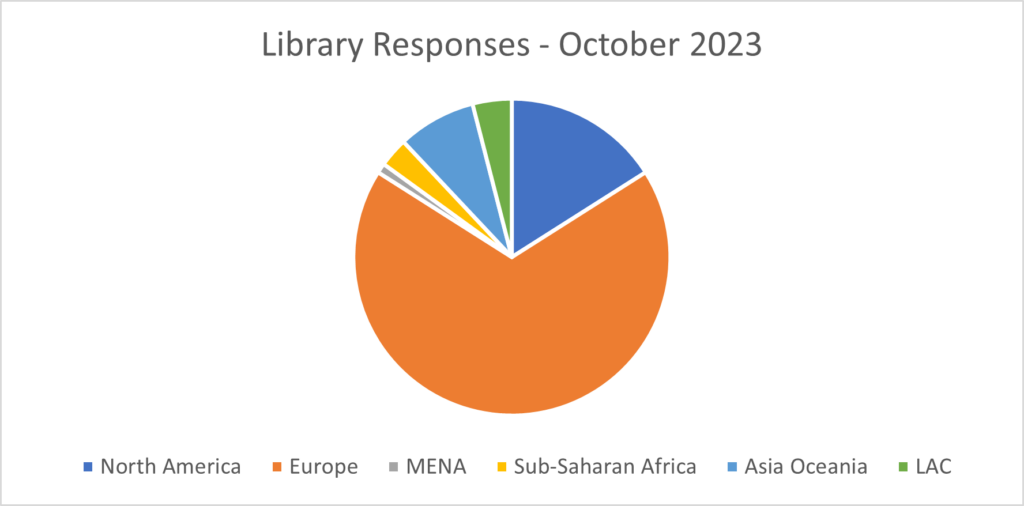
The geographic spread at the moment includes 68% from Europe, 16% from North America, 8% from Asia-Oceania, 4% from Latin America and the Caribbean, 3% from Sub-Saharan Africa, and 0.01% from MENA. From these numbers, there is clearly a need to improve geographic representation.


Library Programmes

Libraries were asked how often they offer programmes, such as special events, activities, community meetings, lectures, or outreach efforts, on climate change. Over 1/3 (145/388 responses) stated they offer such programmes either frequently or occasionally.

Just about half of respondents (191/387) reported to offer programmes on sustainability issues like the environment, biodiversity and recycling either frequently or occasionally.

Engaging with Others

1/3 of respondents (118/365) either frequently or occasionally engage with students from primary and secondary schools on issues related to climate change and the environment. About 1/4 (99/367) engage to that same level with university students or researchers.

30% have established relationships with external partners to engage in cooperative initiatives or public dialogues on climate issues, with the most common of these partners being local government agencies or municipal services.

Library Resources

43% offer book recommendation lists, library guides and/or book exhibitions on climate issues for children and youth, while 46% offer similar resources for adults. Half of respondents make an effort to draw attention to online resources on climate issues via their library’s communication channels.

The majority of climate action in responding libraries has focussed on outreach and activities. A smaller percentage (30%) have constructed new buildings, renovated existing ones, or purchased new equipment which was specifically intended to reduce the institution’s impact on the climate. A slightly higher percentage (45%) have changed internal operations, such as putting new policies in place in order to promote sustainability.

The majority of responding libraries (60%) feel they have adequate resources on climate change, biodiversity and sustainability to offer their users given current public demand. However, half (50%) of respondents feels that their resources would be inadequate if public demand for these resources was to increase.

Community-based Climate Action

Survey participants were invited to share examples of their activities to promote climate action and awareness.

There were many examples of libraries partnering with local government agencies and municipal services to jointly provide opportunities for climate action. Recycling schemes set up with local waste collection services, hosting town information sessions on sustainability, arranging community seed libraries with the local farmers market, and holding cooperative programmes with local nature reserves, parks, and forestry services are some examples of outreach efforts with community partners.

Libraries also reported on positioning themselves as community hubs for sustainable practices. There were many examples of libraries providing services like food-sharing refrigerators, communal meals, bicycle rentals, mend clubs, community gardening, and film screenings.

“At the current time we have just finished a sustainable food resource management project for community strengthening via learning to cook sustainable dishes and use the resources sustainably. The project has invited community members to sit around the table, build connections and thus, learn to preserve food resources, lead sustainable households. The outcome of the project was not only a build stronger community, developed platform for sharing of the excess food but also a strong food club of 70 members”.

(Example shared from Lithuania) 

Lifelong learning played a large role in the activities reported by libraries as well. There were many examples of programmes aimed at school-aged children and young learners, from clubs and hands-on workshops to story-times. There were more adult-focussed educational activities as well, such as budget cooking and food waste classes, beekeeping and gardening lessons, hosting climate change conferences, showcasing new research in lecture series and panel discussions, holding intergenerational sustainability programmes, and establishing climate groups for seniors.

We were excited to see that these results also included stories of libraries helping their communities engage in citizen science. Some examples included library-led activities in which young people or university students helped document pollution in local waterways and record the diversity of plants and animals in their community.

***

These surveys are beginning to provide a look into how libraries empower climate action through climate education and communication. With more input, we can create an even clearer and more diverse picture of how libraries can help every person understand and act in support of the climate, sustainability, and biodiversity.

Add your voice today! Surveys are available in English, Spanish, French, and Chinese.

Contact us: [email protected]


Education for Peace and Development: Highlighting key moments and resources from 2022

The UN International Day of Education (24 January) celebrates the importance of education for peace and development. Libraries have a critical role in ensuring all members of society, of all ages, have access to quality education. To mark this day, this article revisits key moments, shares resources, and summarises IFLA’s activities in the field of education over the past year.

To fuel your advocacy, we invite you to take a look back and consider how your library is helping transform education and bring opportunities to learners of all ages.

Transforming Education

Following the publication of its report, Reimagining our Futures Together: A new social contract for education (2021), UNESCO has been leading a worldwide initiative to transform education to address the challenges of our time. Re-visit IFLA’s brief on this report here: Libraries Contributing to a New Social Contract for Education.

At the centre of this initiative was the Transforming Education Summit, which was held at the UN Headquarters in New York City in September 2022. Ahead of the Summit, UNESCO hosted the Transforming Education Pre-Summit at its headquarters in Paris.

During the Transforming Education Summit, IFLA participated in a side event to discuss the role of access to information and open education resources in making education available to all learners.

In this context, IFLA highlighted the IFLA-UNESCO Public Library Manifesto and School Library Manifesto on the floor of the United Nations.

The Vision Statement released during the Summit by the UN Secretary-General offers a roadmap for education in the 21st century. It is grounded in the principle that the right to quality education should be ensured throughout life, while also including explicit mention of the importance of non-formal education.

This statement will inform further negotiations at the upcoming Summit of the Future, which will be held in 2024.

Resources

Lifelong Learning

The 7th meeting of the International Conference on Adult Education (CONFINTEA) took place in June 2022 in Marrakesh. It brought together ministers, mayors, officials and experts in the field of lifelong learning from around the world. IFLA organised a Side Event on delivering the SDGs through adult learning in libraries.

Key outcomes from this conference include the Marrakesh Framework for Action, which outlines  a roadmap of priorities and actions to be taken before the next conference (2033/2034).

In addition to this, UNESCO published two key reports at the time of the Conference – the 5th Global Report on Adult Learning and Education (GRALE 5), and a Handbook on Lifelong Learning Policies.

All three of these key documents include affirmation of the place of libraries within adult and lifelong learning strategies. These can be helpful references for libraries and library associations in calling for stronger recognition at the national level.

Resources

Linking Culture and Education

UNESCO asserts that culture and education make up the backbone of sustainable development. They call for a cultural sector supported by quality education, which in turn is grounded in respect for cultural diversity and human rights.

IFLA affirms that libraries sit at the intersection of education and culture. This was IFLA’s key message during the World Conference on Cultural Policy for Sustainable Development (Mondiacult 2022), hosted in Mexico City in September 2022.

Ahead of the conference, IFLA’s ResiliArt x Mondiacult event, Library Voices Joining the Global Conversation on Cultural Rights, explored this topic in depth. A panel of experts discussed how libraries enable inclusive and meaningful access to culture and create synergies between culture and education.

During Mondiacult 2022, IFLA was delighted to organise the side event, “Accelerating Education-Culture Linkages through Collaboration: Exploring partnerships with libraries and other cultural institutions”.

The resulting Mondiacult Declaration acknowledges the essential role of libraries in underlining the importance of enhancing synergies between culture and education – strengthening appreciation for cultural diversity, multilingualism, arts education and digital literacy for learners of all ages.

Looking ahead at 2023, IFLA will be involved in UNESCO’s continuing initiative to link culture and education through the renewal of the framework for culture and arts education. Learn more here: UNESCO Culture and Education.

Resources

Climate Empowerment

Another key topic in the discussion on education for sustainable development is climate education.

The UN Framework Convention on Climate Action and the Paris Agreement include education as an aspect of Action for Climate Empowerment, alongside climate training, public awareness, public participation, public access to information, and international cooperation.

IFLA participated in the 27th United Nations Climate Change Conference (COP27) in November 2022. We took part in discussions on the role of libraries in empowering climate action through education and access to information.

There is a lot of scope to highlight the role of libraries in supporting climate action through education – both among children and youth as well as learners of all ages.

Resources

***

Where do you see your library, or libraries in your country or region, having an impact in transforming education and linking it to other sustainable development goals? How can you make your impact known among decisionmakers?

Share your thoughts and ideas!

Questions and comments: [email protected]

Strengthening Relationships, Empowering Communities: Library Reflections on International Day of the World’s Indigenous Peoples

On 9 August, we mark the International Day of the World’s Indigenous Peoples.

Through the 2021 theme: Leaving no one behind: Indigenous peoples and the call for a new social contract, the UN calls for a new approach “based on genuine participation and partnership that fosters equal opportunities and respects the rights, dignity and freedoms of all”. Learn more about this year’s theme here [link].

Of course, meaningful change must come at every level, including in policies. However, creating community by fostering learning and partnership can be an important driver of positive change. Libraries are spaces for such participatory processes to happen. They can be nodes for education and conversation, for ensuring that voices are heard and that the lived experiences of marginalised peoples are centred in the narrative.

Engagement with Cultural Heritage

Access to knowledge, information, and resources are central to the mission of the library and information field. Critically, access includes access to cultural-relevant materials. This includes materials in a diverse range of languages and concerning the cultural expressions and life of the community of one’s choosing.

Accessing and interacting with cultural heritage and expressions are essential for the passing-down of knowledge within a community. They also enable meaningful encounters across cultures in the spirit of fostering multiculturalism.

We saw examples when IFLA’s Cultural Heritage Programme Advisory Committee organised the virtual event, Libraries Inspire Engagement with Cultural Heritage. This webinar invited speakers working with their institutions’ collections, visitors, community groups, and the larger public to help people experience, appreciate, learn from, and share cultural heritage.

Some perspectives shared centred on an Indigenous view of cultural heritage librarianship, and highlighted examples of how memory institutions can work on engagement with collections in partnership with concerned communities.

Here is a look at highlights from these conversations.

Indigenous Worldviews in Libraries

Camille Callison, chair of the IFLA Indigenous Matters Section and Librarian at the University of the Fraser Valley, Canada spoke about steps libraries can take to create relationship with Indigenous communities, towards building a cultural hub and a heart within our institutions.

An important step is including Indigenous worldviews in libraries and acknowledging the Indigenous communities who are the traditional stewards of the land.

The land itself can be a library – telling the story of the community’s creation and linage and the origin of nations. Community elders, the keepers and tellers of stories, are themselves living libraries and archives.

Translating this knowledge into library institutions can be done through building relationships with the communities. This can include inviting elders to give story-times and making opportunities for Indigenous artists to display, share and speak about the art they create. It also includes using appropriate terminologies in classification systems and subject headings, and by respecting the ownership of knowledge by Indigenous peoples, such as by correctly citing Indigenous knowledge – including knowledge transmitted orally by Indigenous storytellers.

She stresses the importance of training – both aimed at encouraging Indigenous peoples to enter the library profession, and through cross-cultural learning to enable library and information professionals of all backgrounds to work together to create more inclusive systems. These efforts are critical to ensuring the cultural relevance of libraries for Indigenous communities.

Watch Camille’s full address online here: LINK

Community-Driven Collections Engagement

Heidi Swierenga, Senior Conservator and Head of the Collections Care and Access Department at the Museum of Anthropology, University of British Columbia, Canada, shared several examples of how the institution enables Indigenous communities to access collections in a way that values the intangible heritage of community knowledge and tradition.

An important aspect of this work are the three types of access visits that the museum has developed. The first invites community groups or individuals to interact with collections at the museum itself, offsetting the costs of their visits through a granting programme. The museum also carries out study visits, in which collections of material are brought directly to communities. She highlights that these are reciprocal learning exchanges, where museum conservation staff enhance their own understanding about the objects, their creation and their meaning, from the community members.

The third type of access she detailed is loaning for activation. In this programme, objects from the museum collection that serve, for example, as traditional evidence of important rites and privileges are brought to communities to fulfil the function for which they were created.

These loans push hard again the traditional view of museum collection standards, as the usual requirements around environmental control and handling procedures of the objects are dropped to allow meaningful engagement with the object. This is made possible by aligning institutional practices with the key principle that Indigenous peoples have the right to manage and control their own material culture and information about that material culture.

We encourage you to find out more and see examples of these access programmes in action here: LINK

Leave No One Behind

Libraries are spaces for community, education, storytelling, cultural transmission and sharing. They are spaces where the narrative of our communities can be revisited, revised, and made more inclusive. They are hubs for community activation and participatory processes that push for meaningful legislative change.

Ensuring libraries are culturally relevant for Indigenous communities, creating connections that centre Indigenous worldviews and perspectives, and empowering Indigenous librarians, community leaders, artists and storytellers are all important aspects in ensuring libraries are active champions of development that leaves no one behind.

We encourage the international library community to work in partnership with Indigenous communities to create this space together.

Follow IFLA’s Indigenous Matters Section for more information about their work towards supporting the provision of culturally responsive and effective services to Indigenous communities throughout the world.

Mobilising the resources to sustain libraries: why the G7 tax agreement matters for our field

Last week, a big story in many media outlets was the agreement between finance ministers of G7 countries to act to counter tax avoidance by major multinational companies. When this issue comes to the G20 later this year, it will be a truly global concern.

This blog looks a little further at the issues, why fighting tax avoidance could be part of library advocacy work, and why there is a particularly strong argument for multinational digital companies to pay their share.

Mobilising resources to pay for development

Tax avoidance is not a new issue of course. For years, there have been concerns about the ability of firms to exploit loopholes and inconsistencies between corporation tax (i.e. taxes on profits, rather than taxes on sales or turnover) rules in different jurisdictions to limit how much they need to pay.

By (nominally) locating key assets such as intellectual property in low-tax countries, or using complicated systems of loans or holding companies, highly profitable companies can make much of their fiscal liabilities disappear.

A lot of the focus has been on the practices of major internet companies, but they are not alone. Any company operating in different jurisdictions may be able to benefit, with Starbucks, care home operators, and even publishers such as Pearson being accused of this.

While, to some extent, it may be a question of political choice how much a country wants to rely on tax-funded public services or rather leave things to the market, it is undeniable that such decisions, when they affect corporate taxation, do have effects on others.

As such, it is a key part of ‘resource mobilisation’, the term used in the context of the Sustainable Development Goals to describe efforts to ensure efficient and effective taxation systems. Getting an international agreement is particularly important, given that while governments are responsible for tackling corruption or other failures to ensure that domestic actors contribute to public services and investments, they can do little once profits are ‘moved’ abroad.

The 2008 crisis intensified focus on these issues, as governments faced the question of how to pay the cost of the financial crisis. Useful work was done around tax transparency and combatting tax havens. In the wake of the pandemic, this focus seems likely only to intensify, and perhaps explains the G7 announcements themselves.

A pre-condition for sustaining library budgets

It’s not hard to imagine why this matters for libraries, at least those which rely to a greater or lesser degree on central government funding. It also matters for the achievement of many of the goals that libraries seek to support, such as education, connectivity or research.

For example, in the education sector, the Global Partnership for Education places a strong emphasis on resource mobilisation as the one sustainable way to support education funding sustainably into the future. Education International has explicitly called for stronger efforts against tax avoidance.

Similarly, the World Health Organization, back in 2018, also highlighted the importance of action on tax to support the delivery of global health goals. Organisations working on broader development, such as Oxfam, have also been strong on the topic.

Clearly, campaigning for more effective taxation is a less direct means of ensuring that libraries have adequate resources than working directly to influence how spending is structured, although it would be an area where libraries would find allies.

Moreover, the availability of funds to spend on libraries depends on funds being there in the first place, which is a tax question. In short, it becomes easier to call for stable, or increased spending on libraries when overall budgets are healthier.

Digital dividends

The argument is particularly strong in the case of libraries and digital companies, given the strong role of libraries in helping people to get online in the first place.

In the case of internet service providers, including phone companies, there are sometimes even dedicated taxes which feed into universal service and access funds. These can be (but are not always) used to help libraries provide wider connectivity.

As such, they help deliver what is increasingly recognised as the human right to connectivity, while also, arguably, helping to create new customers in the future for these same firms.

Yet digital content companies arguably benefit even more directly from when more people are brought online, along with anyone involved in eCommerce. You cannot buy things online, use social media for whatever reason, host websites, use cloud services or whatever else without being connected.

This makes it all the more relevant to argue that they should be paying their part, as much out of enlightened self-interest as because of a wider duty to support public services.

A long way to go

The welcome for the G7 announcements from organisations campaigning for effective action on tax avoidance has been lukewarm. The minimum tax rate set out has been seen as lacking ambition, and of course the deal only covers a few countries, even if they are rich.

Nonetheless, it is arguably a step in a positive direction, even if the final destination is unclear. As such, there is still plenty to do, both when the question comes to the G20, and beyond.

Clearly libraries must make choices about how to allocate time and effort around advocacy. The nature of our institutions mean that we have arguments to make across a wide range of policy fields – many more than we can feasible engage in.

Nonetheless, calling for action on tax avoidance in order to support libraries and other public services – especially those supporting connectivity, and alongside partners – is certainly worth thinking about as part of our advocacy work.

Girls in ICT Day: Towards a more fair and equal digital future

This year, 22 April marks the 10th anniversary of the International Girls in ICT Day. First Introduced by the International Telecommunication Union, on every fourth Thursday in April it draws attention to the need to bring more girls and young women into tech, ICT and STEM sectors.

Over the past years, libraries in different parts of the world have taken part in the Girls in ICT Day celebrations – for example, in Kenya and Suriname. These activities build on a natural alignment between the goals of the Day, and libraries’ experiences with supporting digital literacy and equitable access to knowledge.

So, what do gender digital divides look like in 2021, and what can libraries do to help?

“Connected Girls, Creating Brighter Futures”

Estimates suggest that less than 35% of positions in the tech industry and related professions are taken by women; including only 24% of leadership positions. More broadly, there are gender inequalities in internet access and device ownership, and social and cultural norms which may still restrict meaningful access and use of ICT for women.

A recent World Wide Web Foundation report offers a more in-depth exploration of these gender digital divides. Drawing on the experiences of women in four countries in the LAC region, Africa and Asia, it highlights that:

–  Data affordability is an important barrier: particularly in rural areas, women were more likely than men to say that costs limited their internet use;

–   Similarly, women in rural areas more frequently cited a lack of digital skills as a reason for not going online;

–   Women were less likely to create content online;

–   And finally, they also expressed more concern about their privacy, and had less trust in how tech companies use their data.

These inequalities can manifest themselves early in life. Focusing on the experiences of girls and young women, another important piece of the puzzle lies in the recently released General Comment on children’s rights in relation to the digital environment by the UN Committee on the Rights of the Child. One of the key overarching principles it sets out to help realise children’s rights in digital environments is non-discrimination. This includes overcoming digital exclusion, particularly the gender-related digital divide.

Girls can, for example, face more restrictions in accessing online environments, be less likely to own a phone; or face disadvantages in developing digital skills. An accompanying explanatory note points out that, while universal personal and individual access to ICT and the internet is the preferred long-term outcome, in situations where children are unlikely to have it, states should work to expand public access offerings.

Naturally, offering this kind of shared and equitable access had long been one of the key priorities for the global library field. Overcoming gender inequalities in access to digital technologies and the internet is certainly an important step to realising the goals emphasised by the Girls in ICT Day (as reflected in the first part of its motto this year – “connected girls”). The next step, however, is going beyond connectivity and empowering more women to pursue education, learning, and careers in STEM.

How can libraries help realise this?

Overcoming gender inequalities in this field certainly requires a comprehensive response from many stakeholders. This includes, for example, making the internet a safer space for girls, creating more opportunities and incentives for young women’s participation in the private tech sector, encouraging them to follow STEM higher education tracks, and more.

As community and lifelong learning centers, libraries have been gaining experience in this field. Both before and during the pandemic, we see examples of libraries encouraging and supporting girls and women to pursue their interest in tech in many different ways. For example:

– In Singapore, the Jurong Regional Library hosted an exhibition exploring the nexus of art and technology by an all-women arts collective – with the National Library Board’s MakeIT space helping artists pick up new digital skills;

– In India, the Technology Empowering Girls program was launched to offer young women learning opportunities to develop both digital and soft skills, to help boost their career opportunities;

–  In Canada, the Vancouver Island Regional Library ran a coding competition for young women and girls;

–  And in several countries, libraries worked together with civil society and tech sector partners to deliver events (e.g. CoderDojo4Divas in Belgium) and clubs and courses (e.g. GirlsWhoCode in the US, UK, India and Canada), which cater specifically to girls or young women.

Inclusive and reflexive practices

Because of the multiple and structural gender digital divides, it is also important to learn from the initiatives aiming to encourage girls and women pursue their interest in IT. What works, and why? What can help overcome the different barriers girls and women may be facing?

For example, a recent article in Hello World talks about a coding club for adults in a public library in Almere, the Netherlands. The club succeeded in engaging women, who made up more than half of the participants. Mindful of the existing gender stereotypes around coding, the founder asked what they found attractive about this offer. The women pointed out that the club being run by a woman was a draw, since it offered positive social proof. Another draw was the fairly low-pressure nature of the club – prioritising fun and engagement, rather than the pressure to get things just right, helped overcome some participants’ hesitation.

Another example is the work of Libraries Without Borders on their project IdeasBox4Women. When BSF noticed lower attendance among women to their Ideas Box project, which offers access to technology and learning opportunities, they ran a diagnosis and designed an intervention specifically for women and girls.

This includes concrete measures, like setting aside women-only timeslots and organising gender-mixed activities; as well as making sure that women and girls have access to female facilitators. Another key element are activities which raise awareness about local gender inequalities and dynamics. They help draw attention to existing challenges, while fully giving local communities the space to address and act on this awareness in ways which best suit their customs and culture.

These examples show how reflexivity and mindfulness towards women’s needs can help create more inclusive spaces.

As we continue to learn from such initiatives and interventions, libraries and their partners can help create a more fair and equal digital future!

Fostering creation of Open Educational Resources

From 1 to 5 March 2021, libraries take part in Open Education Week alongside educational stakeholders.

In November 2019, UNESCO adopted a recommendation on Open Educational Resources (OER). This recommendation, a result of a consensus among 193 Member States, recognises the importance of supporting the development, sharing and use of openly licenced educational materials to improve access to education for all.

Libraries, as a driving force in educational issues through their missions of access to information and education, have a role to play in fostering the development of OER and thus in advancing this work.

The UNESCO recommendation is divided into five areas of action:

Building the capacity of stakeholders to create, access, re-use, adapt and redistribute OER;
Developing supportive policy for OER;
Encouraging inclusive and equitable quality OER;
Nurturing the creation of sustainability models for OER; and
Promoting and reinforcing international cooperation in OER.

These 5 areas of action make it possible to identify areas for action by all educational actors, including libraries. They include two levels of action, at the structural level and at the practical level. Libraries can engage in both.

At the structural, or policy level, libraries can work to influence the development of favourable open educational resource policies (many of which will be supportive of wider library missions). Crucially, the Recommendation represents an acknowledgement from countries that education is key and should be open to everyone without regard to their wealth, where they are born, the colour of their skins, their gender, their religion, age or abilities. Knowledge must be open and freely accessible. This is a powerful message.

At the practical level, libraries can also contribute to building a stronger Open Educational Resource chain. This chain involves the creation, access, re-use, adaptation and distribution of OERs, but also the development of institutional policies needed to structure these resources, including national and international platforms.

Here are some suggestions:

  • Identify the different actors that can play a role in the development of open educational resources, including the library team, the educational team, teachers, researchers.
  • Mobilise these actors through different actions: presentation of the objectives of the development of open educational resources, why it is important to tackle these issues of openness and the benefits this can bring to the library, the university and users in general.
  • Create opportunities to raise awareness of these issues or develop resources: webinars, meetings, design workshops,
  • Create opportunities to start creating OERs together: design templates, provide workshops to take the time to focus on the creation of OER but also how to re-use and distribute them.
  • Identify resources or professionals working on the same topic and contact them to exchange practices. Become part of a network or set up a discussion group to exchange good practices or existing structural elements that will enable you to move forward.
  • Identify internal or external platforms that could bring together your institution’s resources in order to facilitate their discovery by users.
  • Draw on the potential of open educational resources to fulfil the primary mission of libraries and knowledge dissemination centres: to build a sustainable means of providing quality open educational resources.
  • Bear in mind the reputational dividends: the constitution of quality open educational resources (materials or courses) by recognised organisations can give considerable visibility to the institution, especially if we consider the impact on the visibility of open access items.
  • Invite external professionals to raise awareness on this issue within your institution: working with an external contact person allows you to combine neutrality but also a national or international perspective.

Discover the document of SPARC Europe on Open Education in European Libraries of High Education.