Tag Archives: Development

European Commission releases key proposals: Digital Services Act and Digital Markets Act

On the 15th of December 2020, the European Commission launched its long-awaited reform on the regulation of major online platforms, the Digital Services Act (DSA). This comes alongside a proposal named the Digital Markets Act (DMA) which aims to address concerns about competition (or a lack thereof) in the technology sector and its impacts.

At the beginning of its mandate, the European Commission made a commitment to reform several aspects of the European market with regards to illegal online content and issues of competitiveness of major platforms online.

As part of this process, in June and September 2020, IFLA submitted suggestions and recommendations on the Digital Services Act to underline the interests of libraries as users of online services and to address their needs and expectations regarding the continuity of their core missions: provide an effective access to information and foster freedom of expression.

Initially combined within a single reform, the European Commission has finally decided to tackle these subjects independently. After several months of waiting, the European Commission launches its reform with two documents: the Digital Services Act and the Digital Markets Act.

The Digital Services Act: regulation of illegal content

The Digital Services Act reform aims to improve the single market within the European Union by developing a more coordinated response to illegal contents online. In doing so, it sets out the goals of maintaining the balance between tackling such content with protection of the fundamental rights of users, and facilitating the development of a competitive single market online.

20 years after the e-Commerce directive which established, among other things, the concept of exemption from liability of intermediary service providers, the new regulation proposes to maintain this key concept.

Online service providers will, if the proposal remains as it is, remain exempt from accountability in order to maintain and support citizens’ ability to express themselves and access information online.

This appears welcome.

To do so, they will need to make efforts to address illegal content, including efforts to prevent its reappearance. This includes violent and/or discriminatory contents relating to race, gender, age, religion.

For example, the DSA establishes due diligence obligations for flagging illegal content for all intermediary services with regards to the size and type of platforms.

The DSA also mentions that contents will not be controlled prior to publication, thus respecting the right of users to express themselves online. However, this leaves open many questions about the technical aspects that the implementation of this reform will take.

Regarding the process of takedown notices, the support of the Commission for a balanced judicial process is welcome. IFLA has strongly underlined the importance of respecting fundamental rights in the process of moderation of content, to let citizens benefit from their rights equally online and offline. Linked to this topic, the call for transparent and independent processes is also welcome.

The proposals evoke the possibility of national action in addition to European. While some issues will be developed at EU level, Member States are invited to develop national regulatory authorities for the digital space, with the power to order intermediaries to take content offline, and impose financial penalties.

Overall, the European Commission’s proposals seem welcome, given that they recall the importance of the protection of fundamental rights (e.g freedom of expression and freedom of access to information), the concept of online anonymity, and the importance of “transparency, information obligations and accountability of online service providers”.

The Digital Markets Act: competition regulation of “core platform services”

The Digital Markets Act mainly concerns major online platforms, also called “systemic stakeholders” that act as an intermediary between businesses and users, with the aim of limiting anti-competitive practices.

These include online intermediation services such as:
search engines
social networking
video sharing platforms services
number-independent interpersonal electronic communication services
operating systems
cloud services
and advertising services.

The objective is simple: to foster the emergence of new companies by addressing the harmful effects of monopolistic behaviour by major players online through measures that promote competition.

These proposed measures differentiate between two aspects of major platforms’ positions: the first one as a provider of a service to another business (for example one selling its products through an online marketplace) and the second as the provider of a service potentially in in competition with the same business , potentially enjoying an unfair advantage thanks to the data it gathers through its role as a service provider.

The views of the European Commission regarding proportionality, promoting “innovation, high quality of digital products and services, fair and competitive prices, and free choice for users in the digital sector” are welcome. A greater variety of platforms and offers of information and other services is likely to facilitate the work of libraries.

The concept of interoperability is also recognised as important and small and medium sized enterprises must be able to migrate to competing services. Nevertheless, little is said about individual users.

Good perspectives but a long way to go before a definitive document

IFLA continues to study these documents and remains aware that a deeper analysis is necessary in order to provide helpful solutions to next steps.

With the retention of the concept of exemption from the liability principle of global platforms and targeted recommendations to address a balanced EU response between user rights, respect for fundamental rights, and concepts of competitiveness, this is a welcome proposal.

We encourage the European Commission to consider in depth interoperability issues which impact on individual citizens. Libraries deeply support fundamental rights, including the ability of citizens to choose freely themselves, including online.

However, the devil always lies in the details and reflection on the technical aspects of such suggestions to achieve these objectives does not mean effective practical realisation.

Read more about it:  here, here and here, here, here

Libraries: Culture, Connection and Transition

When cities leverage their heritage for development, there is the possibility of gaining their investment back in social and economic dividends. Investing in cultural heritage can make a location more attractive for tourism, new residential growth and business investment – changing the landscape of a community and the way people interact with it.

I recently attended a webinar on this topic offered by EUROCITIES, an economic, political and social development network connecting many of Europe’s major cities.

Experts spoke to their experience of social and economic returns on cultural heritage investment, including finding balance between social and economic benefits of urban renewal and the negative effects of gentrification and over-tourism.

When considering cultural heritage as a tool for development, this was a very interesting concept and it got me thinking – as memory institutions, where do libraries fit into this?

Urban Transition in Bakklandet  

This discussion focussed on heritage and social and economic valorisation – that is, the process of creating social and economic value from cultural heritage resources.

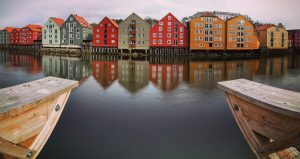
The example I’d like to focus on is from the Bakklandet neighbourhood of Trondheim, Norway. Today this area is a must-see for tourists in the city, who enjoy the traditional wooden architecture, colourful buildings, and plentiful cafes.

Colourful buildings in Bakklandet

Colourful buildings in Bakklandet (photo by darolti dan on Unsplash http://bit.ly/3bc3xVI)

However, this was historically a working-class area, which in the 1960s faced the threat of being demolished to make room for a highway. The neighbourhood was saved by locals, whose grassroot campaigning successfully opposed the demolition plans. Given this history, the area for a long time has been home to a deeply engaged local population.

Bakklandet is now in a period of urban transition – valued by tourists for its cultural capital, and therefore valued by investors and businesses for its economic potential.

How does a city in transition balance the benefits that economic returns on heritage can bring while preserving authenticity and social capital for residents?

I would argue one answer lies in libraries, as memory institutions and as public spaces.

Third-Party Preservation of Memory

I wondered if there was any information in this case study on the role of libraries and archives in keeping local’s connection to culture at the heart of Bakklandet’s transition.

The speaker from the Norwegian University of Science and Technology who presented this case study informed me that residents themselves have taken action to record the history of their community.

Locals have created an online archive, rich with historic photos and stories about the neighbourhood’s long history, alongside current news and events connecting residents to one another.

The speaker referred to this repository as a third-party preservation of memory. It is a wonderful blend of memory, history and social connection. It is a community centered around a deep connection to its neighbourhood, preserving its memory and building social capital among its residents.

Check it out here (in Norwegian): https://blvel.wordpress.com/hjem/bilder/

The Role of the Library

What if a physical library could function the same way?

Could it become a hub for local history, preservation and social connection to balance the changing landscape that comes with urban transition?

Could it itself be an attractive stop for visitors, which helps connect them to the local heritage through exhibitions, public events and cultural expressions?

What could libraries do to build up their role as providers of connection and social capital, while balancing the negative effects that a changing city can face?

Like the example of Bakklandet, the answer could come from the bottom up. Engaging the local population, especially in areas of urban renewal and transition, could be a valuable first step towards reimagining the library as a hub of culture and connection.

 What can be done?

Are there local stories in your archives waiting to be told? Are there grassroots preservation initiatives that could benefit from a physical space? Could cultural heritage be a method by which to engage both locals and tourists?

Many libraries have already taken note of the value they can bring their communities in this way. From community archiving initiatives to IFLA’s own Local History and Genealogy Section, we are certainly seeing these suggestions in practice within the library profession.

Collecting best practices, sharing evidence of the impact of such programmes, and cooperating with other sectors within cultural heritage and development are positive steps that can be taken to advocate for libraries in this space.

We encourage you to consider these questions, then share your thoughts and ideas!

Human Development Report 2019: What Libraries Should Know

In December 2019, the United Nations Development Programme launched a new instalment of the Human Development Report. This year, the report focuses on inequalities in human capabilities – freedoms and abilities to choose “what to be and do”, from meeting basic needs in shelter and nutrition to accessing high-quality education.

Libraries have an important role to play in aiding and accelerating development – particularly in supporting vulnerable and marginalised populations. That is why several messages and suggestions laid out in the 2019 report are relevant for the work libraries around the world are doing today.

1. The crisis in learning: advances in access to education (especially primary school education) have not seen a corresponding progress in learning. More needs to be done to address the learning crisis and improve literacy and numeracy

While marked inequalities in access to education remain, more than 90% of children do receive some schooling today. Yet, by the end of primary school, less than 50% of students worldwide develop appropriate literacy and numeracy skills. Children from disadvantaged backgrounds can be affected the most by this learning crisis: they can receive fewer years of schooling and learn less during those years. This can profoundly impact their future opportunities and prospects.

As such, the report highlights that focusing on educational and learning outcomes requires, among others, “investing in children’s mastery of basic concept” and “combining overall improvements with targeted interventions for groups that are especially disadvantaged”.

What does this mean for libraries? Accessible and well-sourced libraries can be a powerful tool in promoting reading and literacy among school children, especially from marginalised and vulnerable backgrounds. They already feature in a number of national literacy strategies – and more information can be collected on what roles libraries can take on and how to best realise their full potential.

Libraries also often offer early childhood (pre-school) and lifelong learning opportunities, both of which the report highlights as powerful ways to promote equitable learning outcomes and reduce inequalities.

2. There are substantial gaps in access to empowering technologies such as computers and broadband. Public access in libraries and similar facilities can enhance connectivity and help more people access the internet effectively.

Technological development has the potential to reduce or deepen inequalities in human development, with access to technologies – alongside such factors as skills, use, and inclusivity in the tech development process – a crucial part of the picture.

While inequalities in access to basic technologies (e.g. mobile phones) are shrinking, there are much larger gaps in access to those technologies which can enable people to create more advanced digital content and access more information. The report discusses the potential of public to broaden connectivity:

“Connectivity can also be enhanced through public Wi-Fi services offered in public facilities such as libraries and community centres.”

Alongside connectivity costs, the report mentions digital literacy as one of the key barriers to internet use – and highlights that ICT skills education for people of all ages will be key to overcoming this barrier.

This draws attention to the point that digital literacy initiatives need to be inclusive and accessible to people from different backgrounds. The non-formal digital literacy education programmes and on-site support for non-digital natives that many libraries offer are an example of the shape such initiatives can take.

3. There are fundamental links between social cohesion and inequality: facilitating social interaction can increase solidarity and trust.

The report shows how existing inequalities can damage social cohesion, and reduce social interaction and solidarity. Lower willingness to help others can erode support for redistributive policies that aim to address inequalities in human development and capabilities.

Creating incentives for interaction and promoting diversity can help build trust and social cohesion; the report offers a number of ways to achieve this, including subsidies for cultural activities.

Libraries’ experiences in this area show how such interventions can work. As one of the key public cultural institutions, libraries promote social cohesion by bringing together multi-cultural and multi-lingual communities through library services and activities, supporting inclusion of vulnerable or marginalised groups, and offering a way for anyone to participate in cultural and public life.

The report also points out the importance of dignity; this very opportunity to participate in cultural, public and scientific life could be a powerful way to deliver on this dimension.

The chapter also highlights the role information inequality plays in political participation and power dynamics. Today, a lot of information is easily accessible – and yet biased sources and information poverty (reliance on just one or zero news sources) mean that not everyone is equally well-informed. This highlights the importance of libraries’ efforts to equip people with information literacy – the skills necessary to find, evaluate and use the information they need.

4. Progress on gender equality is slowing, and the world is not on course to achieve equality targets by 2030. Awareness-raising and educational interventions can help address discriminatory beliefs and values.

The remaining gender disparities are becoming increasingly difficult to address. As we move from basic political and legal rights and social participation to areas that involve greater power and responsibility, the gaps and resistance to their elimination are more intense. One of the key barriers is persistent discriminatory biases and practices – in fact, less than 15% of men and women today were shown to have no gender social norm biases.

Education and awareness can help overcome these biases by providing new information to “foster different values and behaviours”. While the report points to formal or workplace education and media campaigns, libraries too can play an important role.

From hosting girls’ coding classes to reproductive health education campaigns or skills training for women, many libraries around the world already work to promote gender equality. Crucially, the report highlights the importance of norm-aware interventions. Library embeddedness in their communities and larger societies can help them develop initiatives and interventions that work in the local context.


In all these areas, libraries can contribute to human development and help reduce inequalities. Looking across different spheres, the report concludes that disparities in some basic capabilities which allow people to escape serious and extreme deprivations have shrunk. And yet, inequalities remain wide – and as circumstances and aspirations evolve, capabilities above the basic ones become more and more important.

These advanced capabilities (e.g. pre-primary and tertiary as opposed to primary education, broadband as opposed to mobile service) are likely to impact profoundly people’s ability to function and thrive in the 21st century. Here, inequalities are substantially larger, growing, or both. That is why it is important to address both persistent and emerging inequalities – and libraries can contribute to interventions aiming to reduce both.

Choosing to Celebrate Rather than Tolerate

As 16 November is the International Day for Tolerance, we pose a simple question:

What, exactly, is tolerance?

Is it a passive acceptance for the practices of other cultures, or rather, can it be an active celebration?

Perhaps everyone can choose for his or herself.

Let’s choose then to celebrate rather than tolerate.

Building Connections

Tolerance is strengthened through building mutual understanding between different cultures and peoples. Therefore, a celebration can be created through deepening this understanding.

Libraries, museums and other memory institutions have a unique role, not only in providing access to culture, but in defining the narratives that helps people connect with it.

This act of storytelling allows for engagement – connecting on a deeper level with other voices, other perspectives and the human-side of our interconnected histories.

Celebrating our differences, what makes us unique, and the stories we have to tell – this is more than tolerance. It is the connection we want to build in the world.

Building Peace in the Minds of Men

The Preamble to the Constitution of UNESCO (the United Nations Educational, Scientific and Cultural Organisation) states:

Since wars begin in the minds of men, it is in the minds of men that the defences of peace must be constructed.

Education and exposure to culture builds tolerance by providing opportunities for people to connect, share and learn from one another. A library, an archive, a museum or exhibition can be the medium through which these connections are nurtured.

IFLA’s mission to inspire, engage, enable and connect the Library field helps empower all libraries to be this connection-builder in their own communities.

The Human Library

IFLA’s SDG Stories are rich with examples of libraries being spaces for building connections. The “Human Library” in Kazakhstan is one such example.

In this programme, participants from often discriminated-against groups acted as “human books”, allowing others to ask questions to learn about their experiences. The goal is to use storytelling and connection-building to address the issue of discrimination based on religion, ethnicity, political opinion, gender, sexual orientation and disability.

In the end, there was a sense of community and support created, and participants felt heard and empowered to continue sharing their perspectives.

No matter their resources, libraries can use their institutions to be the driver in bringing people together to share their stories and build mutual respect.

Four participants and Organisers from the Human Library Pose together

“Human Books and Organizers ” by Marina Poyarkova is licensed under CC BY 4.0

Take Action

We challenge our network not just to tolerate, but to celebrate, share and nurture our diversity, building a stronger and more connected world.

IFLA will continue supporting UNESCO’s mission to build peace through education, science and culture during the 40th Session of the General Conference. Read more about our participation here: Key Issues for Libraries at the UNESCO General Conference.

What Makes Libraries Unique in Achieving… SDG 8

DA2I means being able to find – and seize – new opportunities for work and entrepreneurshipSustainable Development Goal 8 is the second of the SDGs to be explored this year. It focuses on promoting sustained, inclusive and sustainable economic growth, full and productive employment and decent work for all.

Through their work to provide access to information in communities, including to some of their most vulnerable members, libraries can be a gateway to opportunity. Both indirectly – through promoting inclusion and wellbeing – and directly through training and job-search support – our institutions can make a real contribution to delivering on SDG 8.

Labour and employment ministries therefore have an interest in effective libraries.

But what arguments can you use to convince them?

Here are three ideas showing why libraries have a unique role in achieving SDG 8:

  • Because employment schemes only work if people know about them: like any market, the job market only works when people know about the opportunities out there. Yet half the world’s population does not have internet access or aren’t confident online. Libraries are not only places where people can connect, but also can receive support and guidance on where to find possibilities to help them find jobs.
  • Because those who need support most can be the hardest to reach: for many, going to a job centre is associated with stigma. Others, especially those from marginalised groups, feel uneasy going into official buildings, or even are not entitled to formal support. Libraries are often seen differently, with people readier to use them. As such, they can provide an excellent place to provide services to many of the most vulnerable in society.
  • Because skills matter: developing new and more advanced skills is a necessity for everyone, not only in order to respond to technological and economic change, but also to find better quality, more fulfilling work. Yet those who have left school risk can risk struggling to reconnect to education. Libraries not only offer training themselves, but can be a gateway to other forms of adult and non-formal education.

For more see the chapter on SDG 8 in the 2019 Development and Access to Information (DA2I) Report by Stefania Lapolla Cantoni, Researcher at cetic.br.

What Makes Libraries Unique in Achieving… SDG 4

This is the first of a series of blogs for the 2019 High Level Political Forum, looking at the different SDGs in focus this year.

Sustainable Development Goal 4DA2I means being able to learn, grow and develop, wherever you are, whatever your age is the first of the SDGs to be explored this year. It focuses on ensuring inclusive and equitable quality education and promoting lifelong learning opportunities for all.

For many libraries – not least school and university ones – it is the basis for all of their work, from story time to advanced information literacy. Libraries play a vital role, either within institutions, or in complement to them.

But how to explain this role to policy-makers and others?

Here are three ideas for arguments that you can use to show why libraries are unique in achieving SDG4:

1) Because literacy is a gateway to learning: reading a blog like this, it can be difficult to imagine what it’s like not to be literate. Without literacy, so many means of learning, earning, and accessing information are closed. Libraries have a very strong track record in this area, through supporting literacy (even from the youngest age) and encouraging a love of reading which has proven impacts on overall academic performance.

2) Because learning doesn’t stop when you leave school: while basic education is an essential step, everyone needs to keep on learning throughout their lives. Changes in the wider world may force them to find a new job or adapt to new technologies. Changes in their own lives mean that their needs and priorities change. Libraries provide a place where anyone, at any age, can learn for themselves, and often get involved in or access wider training opportunities.

3) Because spaces matter: the internet has opened up great new possibilities for people to access learning, with new content and applications developed all the time. Yet it is undeniable that people also benefit from having dedicated spaces and staff to help them develop new skills. Libraries are ideal spaces for this, given their historic focus on popular education, and their familiarity to communities.

For more see the chapter on SDG4 in the 2019 Development and Access to Information Report (DA2I) by Dr Katarina Popovic, Secretary-General of the International Council on Adult Education (ICAE).

Professional Units and the SDGs – How IFLA’s Committees are Contributing to Work on the 2030 Agenda

Professional Practice and Sustainable Development: How IFLA’s committees support engagement on the Global Goals

IFLA has placed the United Nations Sustainable Development Goals at the centre of much of its work.

They are a regular reference in our advocacy for libraries, and have provided a great way of structuring our thinking about the role of our institutions in the world today.

At the national level, many library associations and library and information workers have taken up the resources provided through IFLA’s International Advocacy Programme to launch their own work.

This makes sense. The SDGs – and the wider 2030 Agenda that contains them – are the most comprehensive, ambitious policy agenda out there.

Many governments and development agencies have explicitly made them a key pillar of their activities. Others may not refer to them so openly, but will not disagree with the framework they set out, and the subjects they highlight.

But what can cross-border professional communities – IFLA’s professional units – do? There are already some great examples here as well! This blog offers some general themes, building on work already done in 2015.


Spreading the Word

A number of IFLA’s sections have embraced the Sustainable Development Goals in sessions at the World Library and Information Congress. This has provided a great opportunity to explain the Goals and their relevance to different parts of the global library field.

Taking the perspective of a specific type of library, a specific service, or a specific user group can be a means of making the SDGs relevant. At the same time, this provides an opportunity to show how the SDGs can be used by library and information workers in the area to advocate for the work they do.

Talking about the SDGs is important – indeed, it is a key UN objective. The more libraries can show that we are using our potential to spread the word, the stronger a partner we become.


Building the Evidence

In our work at the global, regional and national levels, real-life examples of how libraries deliver on the SDGs (and other policy objectives) play a key role. They appeal to decision-makers, given their human aspect. When accompanied by evaluation, they are even stronger.

Individual professional communities within IFLA can be excellent sources of these examples, given that they bring together some of the most knowledgeable people about particular library types or services, from different parts of the world (or something like that).

Already, a number of the stories featured on IFLA’s Library Map of the World SDG Stories page are based on examples from papers submitted to sessions at WLIC. But there is lots of potential for sections to use the rest of the year to find more , for example among nominees for prizes or awards!


Driving Delivery

As highlighted in IFLA’s Core Values, access to information, guaranteed by high quality library services, is a key means of improving lives and promoting equality.

It follows that the work done by IFLA’s sections to enhance professional practice also enhances the capacity of libraries to support users. This is central to fulfilling the role given to all stakeholders in the 2030 Agenda to do their bit to deliver on the SDGs.

Standards, guidelines, toolkits and collections of best practices help the field to achieve Goals, from safeguarding cultural heritage (SDG 11.4) through preservation standards to reducing inequalities through guidelines for services to people with special needs (SDG 10).


We’d love to hear your ideas about how different sections are working with the SDGs, or of course to answer any questions.