Tag Archives: Library advocacy

How HathiTrust Emergency Temporary Access Service (ETAS) supports Libraries in pandemic times

By Sara R. Benson, Copyright Librarian, University of Illinois at Urbana Champaign. Check out Sara’s podcast titled Copyright Chat at https://go.illinois.edu/copyrightchat

It’s Fair Use/Fair Dealing week and that means it is once again time to let folks know about exciting developments with the HathiTrust Digital Library. Last year on Fair Use Week I highlighted the ability of researchers to engage with copyright protected materials for text and data mining through the HathiTrust Research Data Capsule. This year, I would like to make readers aware of the HathiTrust Emergency Temporary Access Service or ETAS.

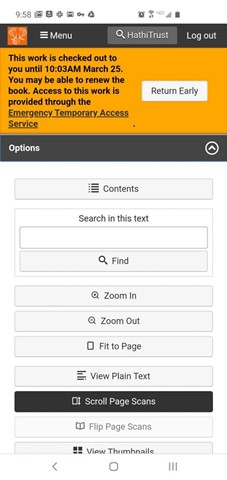
What is the ETAS? It is a portal allowing affiliated libraries to permit their patrons to access in copyright works remotely. Why is the ETAS available? COVID 19 has caused many libraries, such as my own (the University of Illinois at Urbana Champaign Library) to temporarily limit physical access to library materials. Almost half of our collection, however, has been digitized and is available in the HathiTrust corpus. Normally, users can only perform searches for how many times a given term appears in copyright protected works in the HathiTrust corpus. However, due to COVID 19, the ETAS allows users to view (but not download) entire copyright protected works remotely. Libraries participating must have the physical book in their collection and agree not to lend out the physical book. Thus, the book is being lent remotely on a one-to-one ratio to the Library’s physical collection on the basis of fair use. This type of lending is made possible because it is non-commercial, educational in purpose and justified due to the emergency nature of the pandemic virus. As noted by April Hathcock in a public statement created by copyright specialists and available at https://tinyurl.com/tvnty3a, “fair use is made for just these kinds of contingencies.”

So, as you celebrate Fair Use/Fair Dealing week this year, note that the pandemic has brought with it many challenges, but Fair Use has enabled libraries to keep lending their works digitally so that researchers and the public can continue to create, thrive, and produce . . . even during a crisis.

(Pre)Conditions for Success: What Governments Need to Do to Fulfil Libraries’ Potential

Much library advocacy at the moment is focused on how libraries can contribute to the response to, and recovery from, the COVID-19 pandemic.

In previous blogs here, and from libraries and library organisations around the world, there has been a focus on what our institutions can do to build back better – through wider and more meaningful access to information, stronger connectivity, better competences, more rapid innovation, and making the most of culture and heritage.

We promote the importance of school and public libraries in building foundational literacy skills from a young age. Of public and community libraries in promoting inclusion, offering internet access and training, and providing a portal to new opportunities for those at risk of being left out or left behind. Of academic and research libraries in supporting more open science and scholarship, and helping the researchers of tomorrow. Of national and heritage libraries in ensuring that documentary heritage can both inform decision-making today and build identity and community cohesion.

In short, the library vision of the future is of more literate and better informed people, and fairer, more inclusive and more engaged societies.

As before, our staff, services and spaces will be at the heart of this.

Yet these are things that cannot be taken for granted. While libraries and library staff – with the support of organisations like IFLA and other library associations – work to deliver the best possible support in the circumstances, they also rely on the actions of governments and other decision-makers – policies, laws and funding – to fulfil their potential.

This blog sets out five ways in which governments and other decision-makers can support libraries:

1. Ensure that librarians working in frontline roles should benefit from the same vaccine priority as other frontline workers: there is a clear value in ensuring that if libraries are to re-open to provide in-person services, staff should be able to benefit from the protection that vaccination can offer. Of course, this also is a plus for users, who will be able to make use of better staffed institutions, although precautions seem likely to remain necessary until a much larger share of the population is vaccinated.

2. Ensure that libraries benefit from adequate internet connections and hardware: the pandemic has made clear the importance of connectivity in enabling at least some elements of life to continue despite lockdowns, accelerating an existing trend towards digital tools and services. With the need for continued care to limit infections, the ability of libraries to make full use of the internet will remain important for some time to come. Stronger connectivity also opens up possibilities for extending internet access out into communities, for example through TV Whitespace technologies or community networks, allowing users to make more use of library content and beyond, helping to combat digital exclusion.

3. Ensure that libraries are involved in planning: as governments and other decision-makers look to define plans for ongoing response and future recovery, we cannot take for granted that they will understand the specific nature of libraries and the services they offer. Outdated perceptions of our institutions can make things worse, often ignoring the rich programmes of activities and support offered by libraries of all types in the pursuit of their missions. The best solution to this is to make the case to be part of committees or groups which are planning ahead. This can help not just ensure that the rules applying to libraries are relevant, but also open up possibilities to engage in wider programmes and projects.

4. Ensure that libraries are funded and staffed to offer support: while the need for adequate funding to support the work of libraries is nothing new, it is likely to be necessary to make the case as strongly as ever now. This is both because of the pressure on funding that is likely to result from the economic consequences of the pandemic, but also because providing services in a pandemic may simply be more expensive. For example, digital resources can cost a multiple of the price of their physical equivalents, while implementing services under restrictions can prove more staff-intensive. In such situations, innovation and efficiencies alone are unlikely to be enough if a good level of service is to be maintained.

5. Ensure that libraries benefit from flexibilities to carry out their missions: connected to the question of resources is that of what libraries can do with them. It is essential that the public or institutional funding that goes into libraries is not made less effective because of laws and regulation. A key example is around copyright, which determines what uses libraries – and their patrons – can make of works they have acquired or accessed. But other restrictions may also limit what libraries can do, for example by preventing the extension of library card privileges to refugees or others in the community, or by preventing the formation of partnerships.

The subject of how libraries can realise their potential in the context of the response to, and recovery from, COVID-19 will be at the heart of a series of side-events organised at UN regional sustainable development fora in the coming months – watch our website for more, and share your own ideas below!

The costs of non-access: why we should talk about the impacts of not investing in libraries

A lot of advocacy for libraries focuses on showing the return that our institutions provide on investment. Through this, we work to demonstrate that however much governments or other funders spend, the value created by the presence and work of libraries is more.

These arguments can be very helpful at times when governments need to take decisions, by building the case for choosing a new, renovated, expanded or enhanced library.

What we tend to do less is explore what are the costs of not acting. In other words, what are government and societies missing out on, if they do not allocate resources to the library? What harms can this cause to the achievement of wider social, economic and cultural goals?

This reflection is likely to help in developing arguments in the coming months and years. We have difficult times ahead – and already with us in many cases. Those who are currently not facing challenges are likely to do so when stimulus packages come to an end, and austerity hits, at least in many countries.

It seems more likely that the choice facing funders will not be where to spend new money, but rather how to allocate reductions in budgets. In this situation, the goal then is how to cause the least pain.

From the point of view of our institutions, it will be necessary to be able to show that cuts to library staff and services should never be an easy option.

Fortunately, a lot of the time, this can simply require ‘flipping’ existing arguments for libraries.

A case for a literacy programme that increases reading confidence and performance can also be presented as an avoidance of cost – without the library’s intervention, participants would be less likely to read, both reducing demand for books, and leaving them less able to cope with information around them.

In this situation, there would be harm both to the individual, who would be deprived of possibilities to discover new opportunities, participate in the cultural life of the community or engage in civic and political life. This community in turn loses out by having members who are less able to become involved and active. And the economy loses out when people are not able to realise their potential, with bookshops and others in particular suffering from a smaller reading population.

Similarly, an argument for having a space to welcome local community groups can also be phrased in terms of the cost of not having such a space. Forcing groups to meet in private or commercial spaces may exclude individuals, or simply make these sorts of meetings impractical.

This would have a negative effect on community cohesion and civic engagement. When not all people feel comfortable joining groups, then opportunities to build social cohesion and inclusion are lost. Local civil society does not reflect the wider population, and so loses impact. And of course, if groups which may not be able to afford private space are unable to meet, the community as a whole risks being poorer.

Provision of internet access and internet-enabled devices offers another example. The costs of non-access to the internet through public centres such as libraries will, for some people, mean significantly reduced possibilities to get online, for others it may mean none at all. There are also impacts in terms of losing a key part of the digital skills infrastructure.

For individuals, the negative effects include a lack of access to eGovernment services, to information about jobs and business opportunities, and to a growing share of culture and information in general. When skills cannot be provided, the risks of under-use (and even mis-use) of the internet grow. eCommerce also suffers from there being fewer customers.

So many other library activities can also be argued for in this way. In doing so, it is important to make sure you are working on the basis of reasonable evidence, for example surveys of what users would miss.

Clearly, such arguments should be used carefully. It is important not to end up looking excessively negative, or ‘crying wolf’ – i.e. claiming things that are unlikely or hard to believe. Furthermore, while concern about harm is a powerful motivator, so too is a friendly face and a positive approach.

Nonetheless, an ability to talk about the harm caused by not investing in libraries is an important part of any advocacy toolkit.

The 10-Minute International Librarian #28: Find Out Which International Organisations are Present in Your Country

The work of international organisations can sometimes seem very distant.

But it doesn’t need to be!

Rather than the big meetings and conferences, the main work of these organisations is often rather what happens on the ground, through support to governments, projects, and outreach.

All of the biggest organisations tend to have regional structures, in order better to manage this work. They are often present on the ground through regional and even national offices.

These can be useful potential contacts. IFLA has done a lot of work to support libraries to engage around the Sustainable Development Goals. Regional and national offices of UN institutions will likely be interested in forming partnerships around this.

But there can be many other areas where there can be interest in working with libraries.

So for our 28th 10-Minute International Librarian exercise, find out which international organisations are present in your country.

Many countries have a United Nations office (see the list of UN country teams), which can also host other organisations, such as UNESCO or the United Nations Development Programme.

Most countries also have UNESCO National Commissions, which provide a liaison between UNESCO as a whole and the national context.  And there are 59 UN Information Centres around the world.

Collect this information, together with information you can gather about the priorities of each of these offices. It can be a great contact list for your work, as we will discuss in next week’s post.

Share your stories of successful collaborations with national or regional offices of international organisations in the chat below.

Good luck!


This idea relates to the IFLA Strategy! 1.2 Build a strong presence in international organizations and meetings as a valued partner.

You can view all of our ideas using the #10MinuteInternationalLibrarian tag on this blog, and of course on IFLA’s Ideas Store! Do also share your ideas in the comments box.

The IFLA-UNESCO Public Library Manifesto: Past and Future Action

This month, we are celebrating the 26th Anniversary of the IFLA-UNESCO Public Library Manifesto. Since 1994, the Manifesto has been at the heart of public library advocacy – declaring UNESCO’s belief in the public library as a living force for education, culture and information, and its essential role in the promotion of peace and well-being.

Here is a look back at how librarians around the world have used the Manifesto, and a glimpse into what is coming next for this important document.

The Manifesto at Work

Earlier in 2020, IFLA’s Public Library Section launched a global survey to gather feedback from public libraries on the Manifesto, and how they have used it in their advocacy.

With over 600 responses, this was an extremely insightful look into how libraries around the world apply the Manifesto to their work.

39% of respondents said they have actively used the Manifesto to advocate and lobby for their library.

Of those who responded in the negative, the most prevalent reason given was that they have not yet had an opportunity or were not included in relevant conversations with decision-makers.

Survey participants were asked to share examples of the Manifesto being used in their library’s advocacy or operations.

Some excellent examples include:

  • using the Manifesto to power campaigns during National Library Week
  • referring to the Manifesto in strategic materials and in lobbying
  • featuring the Manifesto in negotiations with local city council and elected officials
  • using the Manifesto as a basis to create library activities
  • guiding funding decisions and budget
  • informing the selection of books and services provided by the library

IFLA would like to help public libraries around the world better use the Public Library Manifesto in advocacy. From this survey, we have learned that increased awareness-raising about the Manifesto in the future may help empower more librarians to put it to use in their advocacy.

For more on how the Manifesto has been put into action, refer to the IFLA Research Paper: Inspire, Inform, Indicate: How the UNESCO-IFLA Public Library Manifesto Makes a Difference.

For more ideas on how the Public Library Manifesto can be used in advocacy, please see our Advocacy Pack for Libraries and Library Associations.

The Manifesto in the Future

Another key development towards increasing the impact of the Public Library Manifesto is ensuring that it remains relevant to the work of libraries today.

Therefore, UNESCO, with the help of IFLA’s Public Library Section, is planning to update the Public Library Manifesto in the coming year. The goal of this revision will be to address the ever-evolving role of public libraries in their communities, while also acknowledging the substantial technological advances that have changed how many people access, create, and consume information.

The survey also plays a major role in this work – ensuring that the voice of the global library field is considered in the review process.

Here is a look at some ideas submitted by librarians on how to improve the UNESCO Public Library Manifesto for the future.

How can the Manifesto better reflect the missions of public libraries today?

  • Emphasize the role of libraries in the information society, such as highlighting the importance of Media and Information Literacy skills.
  • Expand the definition of lifelong learning
  • Reinforce the relationship between the library and the community
  • Increase mention of the importance of inclusivity, especially relating to marginalized communities

How can the Manifesto provide better guidance to decision-makers?

  • Highlight the importance of local knowledge
  • Promote participatory decision-making, both with library professionals and with communities
  • Appeal for sufficient human and material resources, which are required for libraries to fulfil their mission.
  • Link culture to the social and economic life of the community
  • Emphasize social impacts, and the fact that they are usually seen most clearly in subsequent generations

Next Steps

These suggestions, and all the others received during the surveying process, will be taken into consideration by the Public Library Section during the drafting of the Manifesto update. This is projected to be completed in 2021.

The significance of the Public Library Manifesto is that it has codified the exceptional value that public libraries have in their communities. By working to keep it relevant, reflecting the mission of public libraries today, we can ensure it remains a powerful tool for advocacy.

Together with UNESCO, IFLA is looking forward to delivering an updated Manifesto that can continue to support public librarians the world over in their essential work.

The 10-Minute International Librarian #24: Think of an advocate for libraries

A big focus of IFLA’s Strategy is building the ability of libraries to advocate.

Wherever decisions are being made about library budgets, or the laws that affect them, there is space for advocacy.

By building understanding of, support for, and commitment to libraries, you can shape these decisions.

Yet sometimes, your message can be even more powerful when it doesn’t come from you.

It can be expected that librarians will support libraries, but you may get more attention when someone else does it.

So for our 24th 10-Minute International Librarian exercise, think of an advocate for libraries.

Ideally, it should be someone who is well known, or who has great advocacy skills, or ideally both. This can help at all levels, from the local to the global.

Finding an advocate can also help bring others to support libraries, prove that people outside of the profession care, and strengthen partnerships.

Let us know who the most effective advocate for libraries from outside of the library field is, in the chat below.

Good luck!


This idea relates to the IFLA Strategy! 1.1 Show the power of libraries in achieving the Sustainable Development Goals .

You can view all of our ideas using the #10MinuteInternationalLibrarian tag on this blog, and of course on IFLA’s Ideas Store! Do also share your ideas in the comments box.

Copyrights and Library Resources: Two Sides of the Same Coin

So much library advocacy is about funding – ensuring that our institutions have the support necessary to carry out their missions. This can be more or less explicit, from directly campaigning for stable or increased budgets, to working to ensure libraries are featured in wider policy plans which provide the basis for allocating resources later.

This work is vital. Its impact is also relatively simple to demonstrate. Without funding, there cannot be professional librarians, equipment, adequate buildings or collections. With it, there can be longer opening hours, new computers and books, more staff.

Compare this with advocacy around copyright. This can immediately seem like a much more complicated goal, involving concepts and terminology which are some way away from the everyday life not only of the targets of advocacy, but also of librarians themselves. Decisions are taken at the national level – often in a faraway capital – or beyond, not in local town and city halls.

Even outside of advocacy, copyright as an issue is often simply left to the experts. In libraries, often enough, one person (if anyone at all) ends up with the responsibility of answering questions, while in government, it is a subject for the lawyers, unlikely ever to win or lose elections. It can feel like a minority concern.

So far, so far apart. But as this blog argues, these two subjects for advocacy are in fact not so distant from each other, but, as the title suggests, are rather two sides of the same coin.


It’s not (just) what you’ve got, it’s what you can do with it that counts

This is because, in short, copyright laws can have a major impact both on libraries’ spending power, and on the ‘return’ on the investments they make.

Clearly, using such economic vocabulary may feel a little odd, as of course libraries do not make a financial return on their acquisitions. However, thinking more broadly about the impact that libraries aim to deliver – stronger education, research and access to culture – we can still think about how much progress they can make towards these goals for every dollar, euro or yen spent.

One of the most direct examples is around eBooks, where the lack of regulation means that rather than buying eBooks at a consumer rate, libraries are often obliged to buy more expensive copies. There can also be limits on the number of times a library can lend a single book out, or the length of time for which it can lend it.

These facts combine to risk meaning that libraries end up paying much more for every single loan of an eBook than they would for a physical book, or, in other words, get far fewer loans of a book for every dollar, euro or yen spent. This obviously limits the possibility for libraries to deliver on their missions to support literacy and a love of reading, as well as to give access to a diverse range of content.

Copyright can also affect libraries’ ability to give access to other types of work. A key issue during the Pandemic has been the barrier copyright represents for libraries in many countries to digitise the physical works in their collection and give access to them remotely. In effect, during the pandemic, this leaves libraries unable to realise the potential of their collections to support education, research and access to culture.

Outside of the pandemic, these same restrictions on digitisation and remote access mean that libraries cannot realise their potential to give access to people who may not be able to travel to visit collections in person. In effect, out-of-date or overly restrictive copyright laws mean that libraries cannot realise their mission to reach out to all members of the communities they serve.

Similarly, in the research space, text and data mining (TDM) offers strong possibilities to accelerate research and scientific progress. Once again, however, the ability of libraries to allow researchers to carry out TDM will depend on whether copyright law allows this, and subsequent activities, such as sharing results. Without the right laws, libraries can offer less for the money invested in them.

A final example – libraries invest considerable effort in the preservation of works in their collections. Yet this, like many other aspects of library work, faces pressure to demonstrate impact. Being able to make preserved works available online can be a great way of doing this. Yet again, copyright can stand in the way, reducing the ability of libraries to show their own value, and so potentially risking funding.

As set out above, in short, library funding and copyright are two sides of the same coin – a library with a generous budget still risks having less reach and impact (putting this budget at risk) if copyright laws do not allow it to make full use of works.


Complementary Advocacy Strategies

It follows from the above that a comprehensive library advocacy strategy needs to include both advocacy for funding and, where laws are creating problems, advocacy on copyright.

Clearly these can require different sets of knowledge, and work at different levels. Clearly, the atmosphere can also sometimes be different, with copyright reform discussions sometimes more adversarial, although with the right people and a readiness to talk and find areas of agreement. Moreover, it can be uncomfortable for those opposing you to be seen as ‘anti-library’.

However, there is also much in common. Writing to a local government councillor to ask for sustained or increased funding is just as simple as writing to a national senator, deputy or member of parliament. Both require the ability to build up links with decision-makers, creating confidence and understanding.

Crucially, the goal is the same – effective library services in a position to support education, research and access to culture for all of their communities. The same materials, and often the same arguments can be used for both.

It is therefore important for libraries to ensure that, in evaluating their current situation and determining advocacy priorities lie, to think about both funding and laws in order to make the best case for libraries.