Tag Archives: UNESCO

The 10-Minute International Librarian: #29: Think how you can work with local representatives of international organisations

A key focus of our 10-Minute International Librarian series is the idea that you do not need to leave home to be active internationally.

This is true for work with IFLA, but can also be for cooperation with other international organisations, including intergovernmental ones.

This can be a really exciting way to strengthen the work of your national library field through accessing new resources and expertise, as well as increasing the status of libraries.

International organisations can also benefit a lot from working with our institutions.

Alongside the positive reputation of libraries, we can offer great opportunities to display information to the public, as well as reach into communities.

There’s a lot to gain from cooperation!

So for our 29th 10-Minute International Librarian exercise, think about how you can work with local representatives of international organisations.

Use the list prepared in last week’s post as a starting point. Do you have projects or activities around heritage where you could work with local UNESCO commission?

Could you invite the local UN Information Centre or representation to a meeting to talk about the SDGs?

Are there local projects of UN HABITAT or others which could benefit from engaging with libraries?

Have a think about what you could do, and then use this list when setting out your future plans.

Share your ideas in the chat below.

Good luck!


This idea relates to the IFLA Strategy! 1.2 Build a strong presence in international organizations and meetings as a valued partner.

You can view all of our ideas using the #10MinuteInternationalLibrarian tag on this blog, and of course on IFLA’s Ideas Store! Do also share your ideas in the comments box.

The IFLA-UNESCO Public Library Manifesto: Past and Future Action

This month, we are celebrating the 26th Anniversary of the IFLA-UNESCO Public Library Manifesto. Since 1994, the Manifesto has been at the heart of public library advocacy – declaring UNESCO’s belief in the public library as a living force for education, culture and information, and its essential role in the promotion of peace and well-being.

Here is a look back at how librarians around the world have used the Manifesto, and a glimpse into what is coming next for this important document.

The Manifesto at Work

Earlier in 2020, IFLA’s Public Library Section launched a global survey to gather feedback from public libraries on the Manifesto, and how they have used it in their advocacy.

With over 600 responses, this was an extremely insightful look into how libraries around the world apply the Manifesto to their work.

39% of respondents said they have actively used the Manifesto to advocate and lobby for their library.

Of those who responded in the negative, the most prevalent reason given was that they have not yet had an opportunity or were not included in relevant conversations with decision-makers.

Survey participants were asked to share examples of the Manifesto being used in their library’s advocacy or operations.

Some excellent examples include:

  • using the Manifesto to power campaigns during National Library Week
  • referring to the Manifesto in strategic materials and in lobbying
  • featuring the Manifesto in negotiations with local city council and elected officials
  • using the Manifesto as a basis to create library activities
  • guiding funding decisions and budget
  • informing the selection of books and services provided by the library

IFLA would like to help public libraries around the world better use the Public Library Manifesto in advocacy. From this survey, we have learned that increased awareness-raising about the Manifesto in the future may help empower more librarians to put it to use in their advocacy.

For more on how the Manifesto has been put into action, refer to the IFLA Research Paper: Inspire, Inform, Indicate: How the UNESCO-IFLA Public Library Manifesto Makes a Difference.

For more ideas on how the Public Library Manifesto can be used in advocacy, please see our Advocacy Pack for Libraries and Library Associations.

The Manifesto in the Future

Another key development towards increasing the impact of the Public Library Manifesto is ensuring that it remains relevant to the work of libraries today.

Therefore, UNESCO, with the help of IFLA’s Public Library Section, is planning to update the Public Library Manifesto in the coming year. The goal of this revision will be to address the ever-evolving role of public libraries in their communities, while also acknowledging the substantial technological advances that have changed how many people access, create, and consume information.

The survey also plays a major role in this work – ensuring that the voice of the global library field is considered in the review process.

Here is a look at some ideas submitted by librarians on how to improve the UNESCO Public Library Manifesto for the future.

How can the Manifesto better reflect the missions of public libraries today?

  • Emphasize the role of libraries in the information society, such as highlighting the importance of Media and Information Literacy skills.
  • Expand the definition of lifelong learning
  • Reinforce the relationship between the library and the community
  • Increase mention of the importance of inclusivity, especially relating to marginalized communities

How can the Manifesto provide better guidance to decision-makers?

  • Highlight the importance of local knowledge
  • Promote participatory decision-making, both with library professionals and with communities
  • Appeal for sufficient human and material resources, which are required for libraries to fulfil their mission.
  • Link culture to the social and economic life of the community
  • Emphasize social impacts, and the fact that they are usually seen most clearly in subsequent generations

Next Steps

These suggestions, and all the others received during the surveying process, will be taken into consideration by the Public Library Section during the drafting of the Manifesto update. This is projected to be completed in 2021.

The significance of the Public Library Manifesto is that it has codified the exceptional value that public libraries have in their communities. By working to keep it relevant, reflecting the mission of public libraries today, we can ensure it remains a powerful tool for advocacy.

Together with UNESCO, IFLA is looking forward to delivering an updated Manifesto that can continue to support public librarians the world over in their essential work.

Access to Information, Access to Connection: libraries countering intolerance

Our world is faced with a range of challenges linked to intolerance, and its consequences. These have dominated the headlines in 2020: large-scale demonstrations demanding racial justice, inequalities facing the LGBTQ+ community around the world, terrorist activity, the rise of nationalist groups, and the ongoing xenophobia that threatens the livelihood of the world’s most vulnerable communities. Existing tensions have been compounded in 2020 as the world grapples with the COVID-19 pandemic.

There is a great deal of progress that must be made in order to create a world where every person’s human rights are upheld – despite differences between us.

What can libraries do to help counteract these challenges that feed a climate of intolerance?

For UN International Day of Tolerance (16 November) let’s take a look at the role of libraries in countering intolerance, and discuss how library professionals can advocate for their role in building tolerance within individuals and communities.

Countering Intolerance: The UN’s Perspective

The UN outlines the following key areas for countering intolerance:

  • Laws: Governments are responsible for enforcing human rights laws, for banning and punishing hate crimes and discrimination and for ensuring equal access to dispute settlement.
  • Education: Laws are necessary but not sufficient for countering intolerance, greater emphasis needs to be placed on educating more and better.
  • Access to information: The most efficient way to limit the influence of hatemongers is to promote press freedom and press pluralism, in order to allow the public to differentiate between facts and opinions.
  • Individual awareness: Intolerance breeds intolerance. In order to fight intolerance individuals should become aware of the link between their behaviour and the vicious cycle of mistrust and violence in society.
  • Local solutions: When confronted with an escalation of intolerance around us, we must not wait for governments and institutions to act alone. We are all part of the solution.

Libraries are champions of access to information and life-long learning, as well as being community gathering places.

Therefore, if education and access to information can counter the fear of the “other” that drives intolerance, then we – the global library community – have a vital role to play.

Read on for some advocacy tips on how libraries can make a difference in several of these key areas.

Education

Over the past five years, there has been a troubling rise in xenophobic sentiment. Gallup’s 2020 update of its Migrant Acceptance Index found that the world has become less tolerant of migrants since the Index was launched in 2015.

As worrying as this trend is, it is important to remember that no one is born harbouring feelings of intolerance. This behaviour is learned, and therefore, it can be unlearned, or at least countered, through education.

In 2020, the IEA (International Association for the Evaluation of Educational Achievement) reiterated results from their International Civic and Citizenship Education Study (ICCS) carried out in 2016. These results show a positive correlation between the civic knowledge of young people and their level of tolerance towards immigrants in Europe [Source, page 1].

As young people with higher levels of civic knowledge tend to be more tolerant, the IEA urges policymakers and educators to strengthen efforts to provide learning opportunities that focus on building this understanding. Key competencies include the importance of ensuring equal rights for different groups in a democracy, as well the ability to identify potential threats to democracy [Source, page 8].

Although focussed on migrant acceptance, it follows that these lessons are also relevant in terms of marginalised groups within an existing population.

Advocacy point:

Libraries provide learning opportunities outside of the formal education system. They can build on the skills students learn in the classroom, enhancing them with a variety of materials, resources, and opportunities to engage with others in the learning process.

Libraries also provide lifelong learning opportunities – which can be a vital way to deliver civic knowledge to adults who may not have had access to these lessons in their schooling.

If education on civic participation and democratic society is essential for social cohesion, then library educators can help these learning opportunities reach people at all ages.

Access to Information

We live in an information society. On average, people have access to more information than at any other point of human civilization. However, the past years have seen a growing trend of “fake news”, conspiracy theories, distrust in the media, and a rise in disinformation campaigns that erode the foundations of democracy. Many of these campaigns gain power by capitalising on people’s fear of the “other”, deepening mistrust and intolerance.

In 2020, we have seen the impact that misinformation can have towards people’s health and livelihoods, and the dangerously powerful effect it has on public opinion. UNESCO has dubbed this the “disinfodemic”.

Beyond personal health choices, misinformation around the Coronavirus also has an impact on rising intolerance. For example, it has caused an increase of anti-Chinese sentiment [source] and hate-speech directed at Asian people [source]. This reflects trends of past health emergencies, such as the association of homophobic sentiment with the emergence of HIV/AIDS in the 1980s [source].

Accessing health information, as well as information about other cultures, beliefs, and world events is vital to a society that is equipped to handle the challenges of today. However, this access to information also comes with a responsibility to learn to navigate the current climate of misinformation that seeks to deepen societal divides.

UNESCO’s Media and Information Literacy Programme seeks to fight the trend of misinformation by helping communities engage with media in a ways that promotes equality, intercultural and interreligious dialogue, peace, and freedom of expression.

See the Five Laws of Media and Information Literacy for more background on UNESCO’s position.

Advocacy Point:

The importance of critical thinking in regard to the media we consume is more important than ever. A tolerant information society cannot be achieved without it.

Note Law #5 from UNESCO: “Media and information literacy is not acquired at once. It is a lived and dynamic experience and process.”

Libraries play a vital role not only in access to information, but in building media and information literacy skills. Libraries enable media and information literacy to be a lived experience for learners at all levels, providing tools, resources, and assistance in accessing information, thinking critically about sources, and using it ethically.

For more resources, start with the IFLA Media and Information Literacy Recommendations.

For countering Fake News, see IFLA’s How to Spot Fake News – COVID-19 Edition

Local Solutions

The UN stresses that every individual has a role to play in building tolerant societies.

Although complex, global issues can seem insurmountable, change begins at the local level. Libraries are welcoming public spaces – free of charge – that in some parts of the world, have seen a marked social turn, “changing focus from collections to connections” [source].

In this unique role in society, libraries can be on the front lines in promoting not just tolerance, but an appreciation for multiculturalism. The IFLA/UNESCO Multicultural Library Manifesto reiterates the role that libraries can have in promoting cultural and linguistic diversity at the international, national, and local levels.

IFLA has also stressed that racism has no place in the society libraries are working to build. Libraries reject discrimination and actively promote inclusion, working at all levels to provide everyone a meaningful opportunity to realise their rights to information, culture, information and science.

Advocacy Point:

IFLA has found that countries with more public and community librarians tend to have higher levels of social cohesion.  By crossing statistics from IFLA’s Library Map of the World with those from the OECD’s Society at a Glance 2016 publication, we can begin to visualize the role that libraries have in building social cohesion through general societal trust in one another.
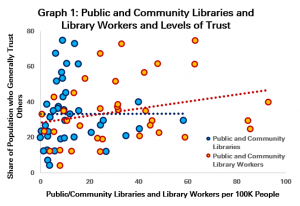
Graph: libraries and tolerance

For more, see Library Stat of the Week #26: Countries with more public and community librarians tend to have higher levels of social cohesion

What can you do?

For librarians working at the local level, here are some ideas of steps you can take to help combat intolerance within your community.

  • Share resources on tolerance and anti-racism
  • Help raise awareness within your community on world events, discuss reasons for migration and immigration from a global perspective.
  • Ensure your collection features a wide variety of stories, and storytellers of different backgrounds
  • Offer programmes targeted at reducing inequalities in your community. See IFLA’s SDG Stories on Goal 10: Reduced Inequalities for inspiration.
  • Engage with local NGOs, citizen movements, and educational institutions to celebrate the diversity of communities and promote positive, inclusive discussion.
  • Enhance your library’s offering of media and information literacy resources. See this guide for low/no-cost ideas.

Do you have other ideas on how libraries can help their communities fight intolerance and build social cohesion? We’d love to hear from you! Share your thoughts below.
Restitution with a Catch? The Copyright Perspective on the Sarr-Savoy Report

The Sarr-Savoy report on the restitution of African cultural heritage, published in November 2018, proposes to recontextualise the presence of African artefacts in French heritage collections.

The objective of this report is to develop, in view of the role of the French state in colonisation, recommendations to update relevant laws around restitutions, as well as to encourage bilateral agreements with countries following requests for restitution.

Among its recommendations, the report suggests that collections which are returned should be subject to digitisation beforehand, with the digitised files then made available for use under free and open access to everyone.

This recommendation is easy to miss in the report, as the paragraphs which concern it are discreet. Nonetheless, it raises questions on two essential questions:

Who owns the physical and digital collections and who has the right to choose the policy of digitisation and openness of these artefacts?

This blog looks at the report’s approach, and presents some of the concerns expressed by this, in particular through a letter drafted by Mathilde Parvis and Andrea Wallace.

First of all, the suggestion to digitise and make collections accessible may seem an interesting initiative in the context of outreach by heritage institutions. For a number of years now, it has been clear that giving access to digital collections is a key mission for cultural institutions, as the report mentions briefly.

However, there are questions about whether this should be subject to the decision of the French state, or be a pre-condition for restitution. The term ‘restitution’, as defined in the report, is strongly connected to the question of legitimate ownership of the object. This cannot be brushed aside when it comes to digital collections.

Arguably, the legitimate ownership by African governments of returned items should give them the right to take decisions regarding the appropriate policy to be put in place on digital collections. Can it be appropriate for the government of a former colonial power to set out such demands in a restitution agreement when talking about heritage that arguably should never have been in its possession in the first place?

Indeed, as Mathilde Parvis and Andrea Wallace’s response perfectly underlines: it should rather be up to the communities to make decisions concerning the artefacts of their heritage. Indeed, suggesting or imposing in bilateral agreements a policy of digitisation and open access to collections appears to be at odds with the principle of recognition of spoliation.

Moreover, the report’s proposals concerning free and open access to and use of images does not seem to match the policy around images in French collections. Indeed, French policy on openGLAM is not based on a centralized ministerial incentive but on the will of cities and organisations independently of each other (whereas German GLAM institutions are far more organised and supported).

The request made to African governments regarding the opening of access to digital collections of collections seems, therefore, to be antithetical with the policy it applies to the digital collections of France’s own institutions.

Clearly, openness is to be welcomed in general as the best way of giving the biggest number of people possible the opportunity to engage with heritage, where other concerns (privacy or indigenous rights for example) do not stand in the way. Nonetheless, in these conditions, it risks being seen as an imposition, not a virtue.

Therefore, Parvis and Wallace’s reply defines several ways to reframe the recommendations of the Sarr-Savoy report, such as:

– Clearly define the scope of Open Access – commercial, non-commercial, public domain, possibility of reuse.
– Clearly define who owns the digital image reproductions.
– Carry out research on the conformity of these recommendations concerning the laws of African countries.
– Do not separate digital reproductions from returned objects because the reproductions are also subject to cultural appropriation.

With plans now underway to reform France’s Heritage Code, we will follow closely how this debate is reflected in any proposed amendments.

The Power of the Narrative: African World Heritage Day

[Today] there is a growing understanding that human diversity is both the reality that makes dialogue necessary, and the very basis for that dialogue… We recognize that we are the products of many cultures, traditions and memories; that mutual respect allows us to study and learn from other cultures; and that we gain strength by combining the foreign with the familiar.

Kofi Annan (Secretary-General of the United Nations, 1997-2006)


The goal of preserving world heritage – that is, heritage deemed to be of “outstanding universal value” – is to ensure a legacy from the past is passed on to future generations. This legacy belongs to all humankind, it is quite literally the heritage of the world.

Through international cooperation for world heritage preservation, we are able to access and explore the most outstanding natural, cultural, and mixed sites offered by each country around the world. It is a doorway to learning about peoples’ values, histories, cross-border exchanges, and riches of natural and cultural diversity.

It is through learning about and celebrating this diversity that mutual respect grows.

African World Heritage Day

African World Heritage Day on 5 May is an opportunity for people around the world, and particularly Africans and those of African descent, to celebrate Africa’s vibrant and unique cultural and natural heritage.

Unfortunately, while African heritage is underrepresented on the World Heritage List (only 12% of all sites), it features disproportionally highly on the List of World Heritage in Danger (39% of all sites in danger).  Civil unrest and instability, uncontrolled development, lack of investment in its safeguarding, and threats of climate change are all factors in the endangerment of world heritage in this region.

As the Ngorongoro Declaration (2016) affirms, safeguarding African World Heritage is a central driver for sustainable development, and so there is an urgent need to build capacity for heritage conservation and management in the region.

This will take international cooperation, overwriting the long-standing effects of colonial inequalities in heritage conservation, and ensuring that a narrative of diversity, dignity, and solidarity is established.

More than World Heritage

Yet maintaining a dialogue on cultural diversity takes more than the preservation of heritage sites. Looking to the historical record and personal accounts can bring these sites to life, by describing their value to the people and societies who created and lived in these places, often in their own words.

There is much power to be found in stories, archives, and records. They help us recognise that we are the “products of many cultures, traditions and memories” – they give context to the heritage of the world. UNESCO’s Memory of the World programme promotes the preservation of, and access to, documentary heritage, which are key resources for telling these stories.

In Africa, tapping into the power of these resources can be a central part in rewriting the narrative of the region’s cultural heritage, raising awareness of its rich traditions, building pride in one’s cultural identity, and educating on the value of cultural diversity.

Through this, heritage can spark a dialogue of mutual respect, which hopefully will play a role in counteracting the threats of extremism, helping to heal inequalities, and contributing to sustainable development.

Manuscripts of the Sahel

Let’s explore an example of the power of the narrative in this context.

In early 2020, IFLA was represented at an international consultation on documentary heritage in the Sahel, organised by UNESCO and held in the Malian capital, Bamako.

The meeting aimed to contribute to strengthening the preservation, accessibility and enhancement of ancient manuscripts from the Sahel region, in order to “improve universal access to knowledge on the written history of Africa”. Read more about this event here.

Containing a range of topics from mathematics to science, philosophy, grammar and theology, the manuscripts comprise a narrative that might not be widely known – depicting this region as a hub for knowledge exchange and intercultural discussion, and providing a rich African history of the written word.

Over the past years, manuscripts in the Sahel region have been notoriously targeted for destruction by those trying to silence this narrative. This destruction was mirrored in the context of built heritage with the targeted destruction of mausoleums in Timbuktu in 2012.

However, preserving and utilising the Sahelian ancient manuscripts to promote public access to the information and knowledge contained within can strengthen national cohesion, tolerance and dialogue. Experts maintain that the “protection, accessibility and promotion of ancient manuscripts can serve as a basis for building just, inclusive and peaceful societies in the Sahel”.

IFLA continues to support this project, and those who are working for the preservation of documentary heritage.

****

Ensuring the continuity of this shared narrative has the power to make a positive difference in a region that still faces many challenges.

Strengthening the preservation, accessibility and enhancement of such examples of heritage can not only strengthen respect for built heritage, it can bring forgotten pieces of history back to life – sparking dialogue, countering preconceived notions, and promoting respect.

On this African World Heritage Day, let’s celebrate the power of the narrative.

World Press Freedom Day: libraries supporting intellectual freedom during the pandemic and beyond

May 3rd marks the annual World Press Freedom Day, and this year’s dedicated campaign launched by UNESCO focuses on the theme “journalism without fear or favour”. This day puts the spotlight on challenges to press freedom and independence, safety of journalists, and gender equality in media. For libraries, these issues are of course deeply connected to their core mission and values of access to information and intellectual freedom.

Where does news media stand in 2020?

On World Press Freedom Day 2020, journalism and news media are facing new and remerging challenges, even as the COVID-19 pandemic continues. A recent statement by the Council of Europe, for example, highlights that some legislative initiatives against disinformation can have significant and disproportionate impacts on press freedom and people’s right to receive information. The International Press Institute points out the different challenges that have emerged or intensified: from increasing restrictions on ‘fake’ news, to limits on journalists’ access to information, financial or accreditation challenges, and more.

On a larger scale, the newly released 2020 World Press Freedom Index by Reporters Without Borders (RWB) highlights the key pressures that impact the future of free, independent and diverse journalism. These include: geopolitical and economic crises, the evolution of digital informational ecosystems where journalism and advertising, political, economic and editorial materials coexist and compete, and hostility and mistrust towards journalists.

The good news is that the overall global indicator does register a small overall improvement of press freedom in the world since last year. That being said, the RWB report emphasises that the coming decade will have a profound impact on the future of freedom of information and media.

 What is the role of libraries?

Naturally, there is a significant degree of affinity between journalistic and library values – as a 2019 Nieman Foundation Report points out, both fundamentally work to inform and empower communities. This can work as a powerful starting point for collaboration – so can libraries help address some of the key challenges the RWB report outlined?

The economic crisis: hybrid models and partnerships

One of the big impacts of the economic crisis in news media is arguably the financial sustainability challenges that local news faces. One possible solution to this challenge that is being discussed over the last few years is providing support to local newsrooms, for example by providing space in such public facilities as libraries or post offices – or even libraries delivering local news directly.

While this is still an emerging idea, libraries and local news organisations continue to explore ways to cooperate. Some collaborations are a continuous arrangement – like a grassroots local online news organisation NOWCastSA housed inside the San Antonio’s Central Library in the United States. As a Nieman report points out, this partnership also allowed them to team up and carry out joint events, and to highlight some of the library’s programming in NOWCastSA’s reporting.

Some initiatives have even evolved to adapt to the difficult COVID situation. For example, in New York, an independent news outlet THE CITY launched a joint project with the Brooklyn Public Library called “The Open Newsroom”. Already in 2019, they had started hosted public meetings in library branches to identify key neighbourhood concerns and see how the local news can be more collaborative and better serve the needs of the community. Now, in the face of the pandemic, the plans for a second round of meetings have been adjusted, and the public meetings will be organised filly online, allowing the project to continue!

Tackling the crisis of trust and technology

If a lack of trust and confidence in news and media – especially in the hyper-dense online environment – is one of the pressing challenges to journalism, media literacy can definitely be an important part of the solution.

A draft Council of Europe study on “Supporting Quality Journalism through Media and Information Literacy” identified five main models of MIL activities; and libraries and community media play a key role in the “training model”. Reports drawing on Swedish and Finnish approaches to MIL, for example, also show how libraries can be actively engaged in delivering MIL training to their communities.

Partnerships in the area are also common: for example, NewsGuard – a company developing “nutritional labels” for popular news sites to mark how correct the information is – has a partnership program for libraries in Europe and the US.

Advocacy: together for Intellectual Freedom

Naturally, libraries and library institutions are often actively engaged in promoting and standing up for Intellectual Freedom. The Canadian Federation of Library Association, the Canadian Urban Libraries Council, and several library associations, for example, recently celebrated the Freedom to Read week, a campaign focusing on promoting freedom of expression, freedom to read and report the news. Such library initiatives clearly show the significant overlap between libraries’ Intellectual Freedom values and the freedom of press.

Drawing on library expertise – news media digitisation and preservation

Even though perhaps less relevant for current day-to-day journalism but rather for historic records, libraries can also help preserve the news that has been published. News archiving and preservation in the digital age can be a challenge: a recent Columbia Journalism Review report, for instance, points out that many news agencies they had interviewed don’t see the value in preserving their output, or do not have established preservation policies and practices.

This is also a prospective area for collaboration. The University of Missouri Donald W. Reynolds Journalism Institute and University Libraries, for example, have received a grant for a joint project to explore ways to preserve today’s digital news. They plan to set up visits with US and European news agencies to see how their policies, equipment and operations impact their preservation processes.

Another example is a web archive launched by several Ivy Plus Libraries Confederation librarians,  aimed at preserving some specific areas of at-risk online news web content. These are a few examples of how libraries can help make sure the valuable work of journalists is preserved.

Similarly, libraries have been clear in underlining that applications of the principle of the ‘Right to be Forgotten’ should respect press freedom. In a recent joint statement with the International Council on Archives, IFLA stressed also that broader privacy legislation should not lead to the deletion of news articles in collections, and so their non-availability for future generations.

All these and other areas show the connection between libraries and journalism – and their shared values. World Press Freedom Day is the opportunity for us to celebrate intellectual freedom, freedom of expression and access to information – and see what can be done to uphold these.

Education: our Greatest Renewable Resource

Think of a renewable resource.

Was the first image that came to your mind of wind turbines in the distance, glittering solar panels, or a great, churning waterfall? You certainly wouldn’t be wrong. We often look to our natural environment for resources that drive our ways of life and fuel our future. But what if we look more inward?

What if we look to people?

Education is humanity’s greatest renewable resource, according to the United Nations Education Science and Culture Organisation (UNESCO).  The UN has marked 24 January as the International Day of Education in order to re-affirm its importance in creating both human well-being and sustainable development.

This is captured in the theme for the International Day of Education 2020: Learning for people, planet, prosperity, and peace.

If education is a valuable resource for the well-being of our planet and its inhabitants, we look to teachers, schools, libraries, information specialists and memory institutions as the infrastructure needed to access it.

A Goldmine of Information

Education and learning go beyond the classroom. Education is both formal and informal, from early childhood to post-doctorate, at all stages of life and for all people.

Libraries are “education for all” institutions, built through their strong, fundamental belief in universal and equitable access to information.

IFLA’s core values include:

  •  The belief that people, communities and organisations need universal and equitable access to information, ideas and works of imagination for their social, educational, cultural, democratic and economic well-being
  • The conviction that delivery of high-quality library and information services helps guarantee that access

To extend this metaphor even further: libraries are mines of information, and the library professional is the guide to help one discover gold.

Learning to be a Global Citizen

Global Citizenship is an identity born through education, story and knowledge sharing, cultural expressions, mutual respect and solidarity.

IFLA believes that freedom of expression, access to information, preservation and access to cultural heritage, and information literacy are central in developing societies where people can identify as global citizens. This is reflected in our vision of a strong and united library field powering literate, informed and participative societies.

If global citizenship is identity based on a connection to humanity that transcends borders, then the access to that humanity, through education and access to information, is paramount.

Growing global citizens means providing the resources, opportunities and platforms for education, and empowering individuals to use them to take action for people, planet, prosperity and peace.  As a provider of these resources, opportunities and platforms, libraries are a rich vein in which to cultivate our most valuable renewable resource.

 We invite our members to think about how they can grow their potential as providers of information, education and lifelong learning. 

For more, take a look at IFLA’s Brief on Open Educational Resources.  It underlines the role that librarians can play in creating, curating and ensuring access to these materials, and key issues surrounding Open Educational Resources.