
Category Archives: General

The four spaces of the public library

image

Recently, my staff and I embarked on a journey with the goal to redesign our library space to meet future needs. In this process, we made extensive use of the so-called four space model, which offers a framework for discussions of new values of the public library and as a tool for designing, developing, and redesigning the library.

Danish LIS-scientists Dorte Skot-Hansen, Henrik Jochumsen and Casper Hvenegaard Hansen introduced the model to describe the transformation of the public library from a passive collection based space to a more active space for experience and inspiration and a local meeting point.

The four space-model plays a significant role in ‘The Model Programme for Public Libraries’ that I described in my last blogpost.

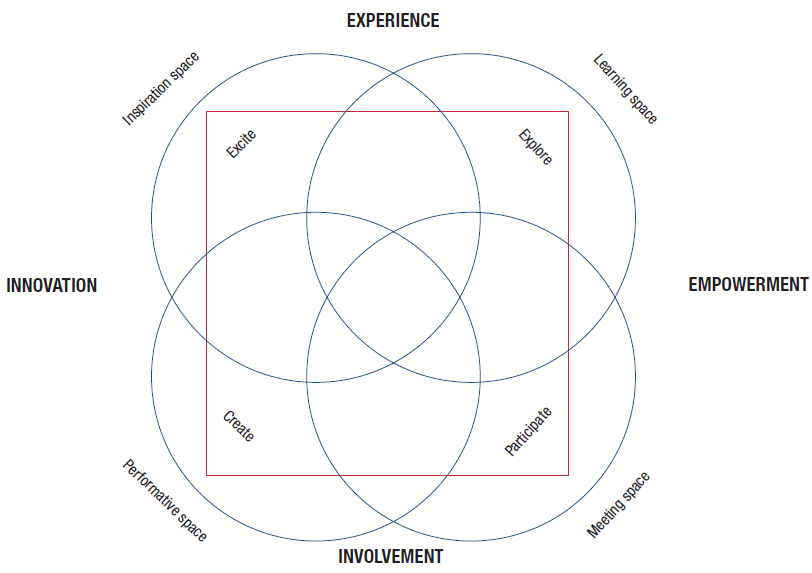
The model consists of four different overlapping ‘spaces’: the inspiration space, the learning space, the meeting space and the performative space. These four spaces’ overall objective is to support the following four goals for the public library in the future:

  • Experience
  • Involvement
  • Empowerment
  • Innovation

The four spaces are not to be seen as concrete ‘rooms’ in a physical sense, but rather as possibilities that can be fulfilled both in the physical library and in cyberspace.
fourspacemodel

Fig. 1: The four spaces by Dorte Skot-Hansen, Henrik Jochumsen and Casper Hvenegaard Hansen  

Inspiration Space
This space for meaningful experiences transforms our perception. This can happen through story-telling and other artistic expressions within all media, culture patterns and genres. The inspiration space should make you want to move beyond your familiar choices, and therefore the space must open up for the irrational, emotional and chaotic by mediating a multitude of aesthetic experiences.

Learning space
The learning space particularly underpins experience and empowerment. This is the space were children, youngsters and adults can discover and explore the world and thereby increase their competences and possibilities through free and unrestricted access to information and knowledge. Learning in the library is always an offer. It happens through play, artistic activities, courses and many other activities.

Meeting space
The meeting space is an open, public space and a place between work and home where the citizens can meet other people, who are both like them and differ from them. In a segmented society, you need platforms where you come across people with different interests and values from your own and encounter opinions that challenge you through discussion and debate. The meeting space provides the frames for non-committal, accidental meetings in both small intimate spaces as well as in lounge areas with newspapers and café facilities and as in more organized meetings, where topics and problems can be analyzed and discussed. Meetings can happen live as well as on the net through chat groups, blogs or other social technologies.

Performative space
The performative space particularly supports involvement and innovation. In the performative space the users, in an interaction with others, can be inspired to create new artistic expressions in the meeting with art and culture. Here they have access to tools that support their creative activities through interactive games, writing-, sound- and video, and they can get support for their creative activities through workshops with professional artists, designers, multimedia developers etc. Finally, the performative space can act as a platform for mediation by publishing and distributing the users’ work and products and providing stages for their activities.                     

 If you want to redesign your library, I recommend you take a look at the model and consider how you want to integrate the four spaces in your library and which ones you wish to empathize.



Building new libraries and redesigning existing libraries


image


One of my main interests – and I believe also a main interest for many people working in the library sector – is library design. Whenever I visit a new city I always try to visit at least one library – to try and get a feel for how the libraries there work, and to see if there are any good ideas that I can “borrow”.

All over the world we are seeing new libraries rising or existing libraries being redesigned. As the role of the library is changing to meet tomorrows needs, we are slowly but surely seeing libraries around the world undergo a significant design transition.

It seems to me that there is an important shift going on from solely space planning for collections, equipment and associated physical infrastructure to a stronger focus on design for people, community outcomes, experience and innovation. We are seeing a shift from designing buildings with fixed spaces for books – to designing much more flexible spaces that may be used for many different purposes by many different kinds of people at different times or even at the same time.

The role of the library is changing and that calls for buildings old or new that meet the new needs.

But where do you start if you are planning a new library, rebuilding an existing library or are interested in redesigning your library or part of a library?

One of the sites that I have found useful as a source of inspiration is the Modelprogramme for Public Libraries. Here you can find inspiration if you are interested in how to optimize the interior design of your library or if you are involved in the planning of a new library. The Modelprogramme is about homing in on and describing a number of decisive design principles in relation to elements that concern the new public library. The website is quite big and has inspiration, specific cases and design guidelines.

If you are interested in reading more about the spaces and design issues that should be considered when building a new library and seeing pictures from best practice examples from 17 libraries around the world, you should read the report Building Libraries for Tomorrow. Here Patti Manolis and I have done an international survey. The report also has an extensive literature review where you can find a lot of the relevant ressources and literature about designing and building public libraries.

New competencies for children’s librarians released.


image

The Association for Library Service to Children (ALSC), a division of the American Library Association (ALA), has released a revised edition of its Competencies for Librarians Serving Children in Public Libraries.

ALSC recommends these core competencies to all children’s librarians and other library staff whose primary duties include delivering library service to and advocating library service for children ages birth to 14.

Competencies for Librarians Serving Children in Public Libraries was created (1989) and revised (1999, 2009 and 2015) by the ALSC Education Committee, and approved by the ALSC Board of Directors at the on 2015 American Library Association Annual Conference.

For more information about ALSC, please visit www.ala.org/alsc

BibCharts: Libraries and Information Centres in the Social Web

IFLA_Sarah-Dudek

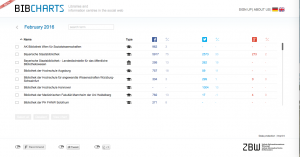
How are libraries performing in the social web? Which library is on Facebook, which one on Google+, too, and how many libraries twitter? Has my library more fans on Facebook than the library xyz?

Since 2011 the Leibniz Information Centre for Economicslocated in Kiel and Hamburg—collects daily data and draws up monthly overviews on the social media activities of libraries.

Bildschirmfoto 2016-02-25 um 18.09.55

When the ZBW started with the BibCharts there was some criticism: a blogger stated that mere quantitative comparism was superficial. Success in the social web was not expressed by fan numbers, but by interaction (see also comments on the ZBW blog, in German).

The ZBW responds to such criticism that their table is not a ranking, but an overview.

It is stated in „About Bibcharts“ that the values are fetched directly via the interfaces of Facebook, Twitter, and Google+, and are automatically entered into the table at the beginning of each month.

Currently there are mainly libraries from Germany, Austria, and Switzerland on the list, but the ZBW wants to extend the overview step by step. If your library wants to join the BibCharts please sign up on their website: http://en.bibcharts.eu/signup.jsp

Building Connected Communities

btn-logo

The Urban Libraries Council has just released a ULC Leadership Brief Building Connected Communities which focuses on how libraries are bridging the digital divide through free and open access to current and emerging technology and related resources.

Libraries bridge the digital divide, build digital literacy skills, and improve the quality of life in communities. Building Connected Communities demonstrates how public library technology is used for education, innovation, workforce development/entrepreneurship purposes and health/wellness.

Included in the Brief are examples from leading US libraries. These snapshots show ways that libraries are playing a central role as technology leaders in our communities. This critical role is highlighted by quotes from government leaders’ recognizing the many contributions our libraries make.

Winners of IFLA Marketing Awards Announced

Sunshine Coast Libraries, Australia

Sunshine Coast Libraries, Queensland, Australia

IFLA’s Management and Marketing  Section has announced the winners of the 13th IFLA BibLibre International Library Marketing Awards. This includes public libraries in Canada, Columbia and Australia.

Altogether M&M received 71 applications from 26 countries, in 6 languages from all over the world. How fabulous.

[2016 Winner!] Vancouver Public Library Inspiration Lab Launch Campaign – Canada
[2nd place] Tuan Time – Each library experience is a memorable treasure – Xiamen University Libraries – China
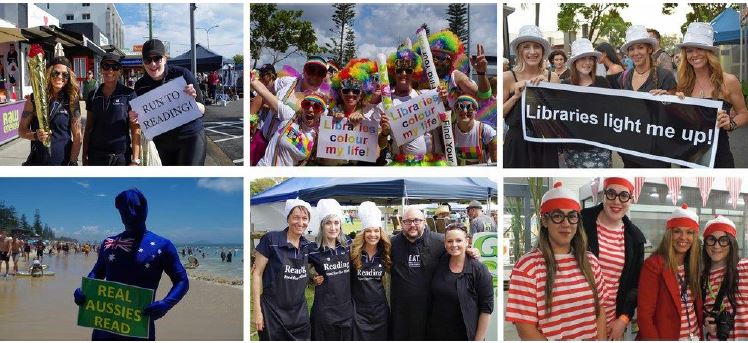
[3rd place] Sunshine Coast Libraries Pop Ups! – Sunshine Coast Libraries – Australia

Find more information about the Award, the winners and the Top 10 projects here.

Some cat content for my fellow librarians at Valentine’s Day <3

It might be a cliché: the (female) cat-loving librarian. But I admit: I am one of them. So I want to give to my fellow librarians who also confirm this cliché some cat content as a valentine.

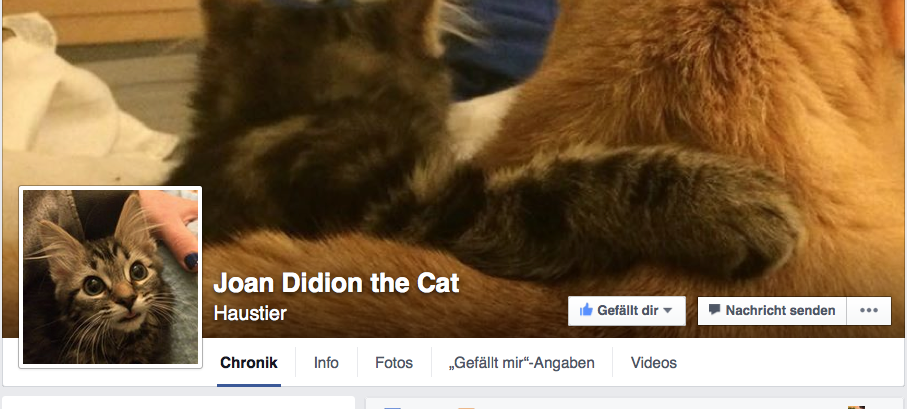
A while ago I joined the Facebook group ALA Think Tank expecting to get into the most profound discussions and the best of the best practice for libraries. Although all of this might be true I came along a heartbreaking story which changed my daily life on Facebook providing me with the cutest cat content ever. Apparently on 11/14/14 a cat was found in the bookdrop of Cincinnati’s Main Library. It got the name Joan Didion the Cat. “She now resides happily with Steve, Cassie and Rio (the cat) Kemple.”, as her Facebook info says. Oh, and yes: she has a Facebook page indicating she likes Joan Didion and experimental music.

Bildschirmfoto 2016-02-14 um 07.05.53

As far as I understand Joan Didion the Cat lives with a librarian now, but there are plenty of cats living in libraries as well, there is even a map which shows who lives where.

If you want to see some more cat content you might want to have a look on a German blog of a cat loving librarian who has posted quite some cat stories and films on library cats. Have a nice Valentine’s Day!