Category Archives: General

Meet the candidates: Adriana Cybelle Ferrari

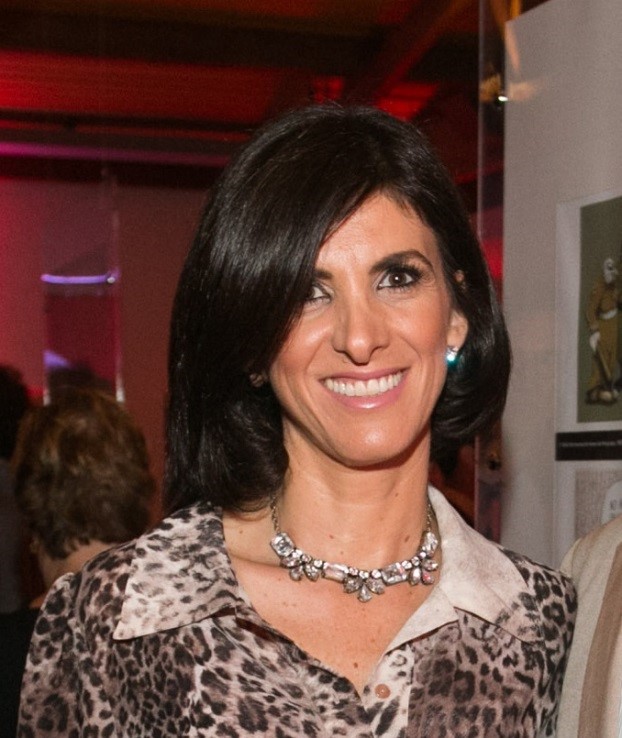
Adriana Cybelle Ferrari
President
Brazilian Federation of Librarians’ Associations
BRAZIL

I am a candidate for re-election (having served on the Standing Committee 2015-2019) and I would like to say that interaction at this moment with the Committee has been extremely enriching. I really wish to continue collaborating and learning, especially, to work with the revision of the Guidelines for Public Libraries, a project that is ongoing.

I was the coordinator of the projects – Biblioteca de São Paulo (launched in 2009 ) and Biblioteca Villa Lobos Park, (launched in 2015) which are considered references in promoting reading and citizenship. These libraries received national awards and were finalists of international awards.

I am the President of the Brazilian Federation of Librarians’ Associations (FEBAB) and for this reason, I strongly believe that at this political moment especially in Latin America, we must talk more about advocacy, spread the libraries´s work as a partners of  the 2030 Agenda. Is extremely important to make our voice reach out to decision makers! Libraries are being threatened and we can be an important advocated in defending this cause. The new Guidelines for Public Libraries will be an important tool for us!

For more information about voting for members of the Public Libraries Standing Committee take the time to read our post.

Meet the candidates: Jane Cowell

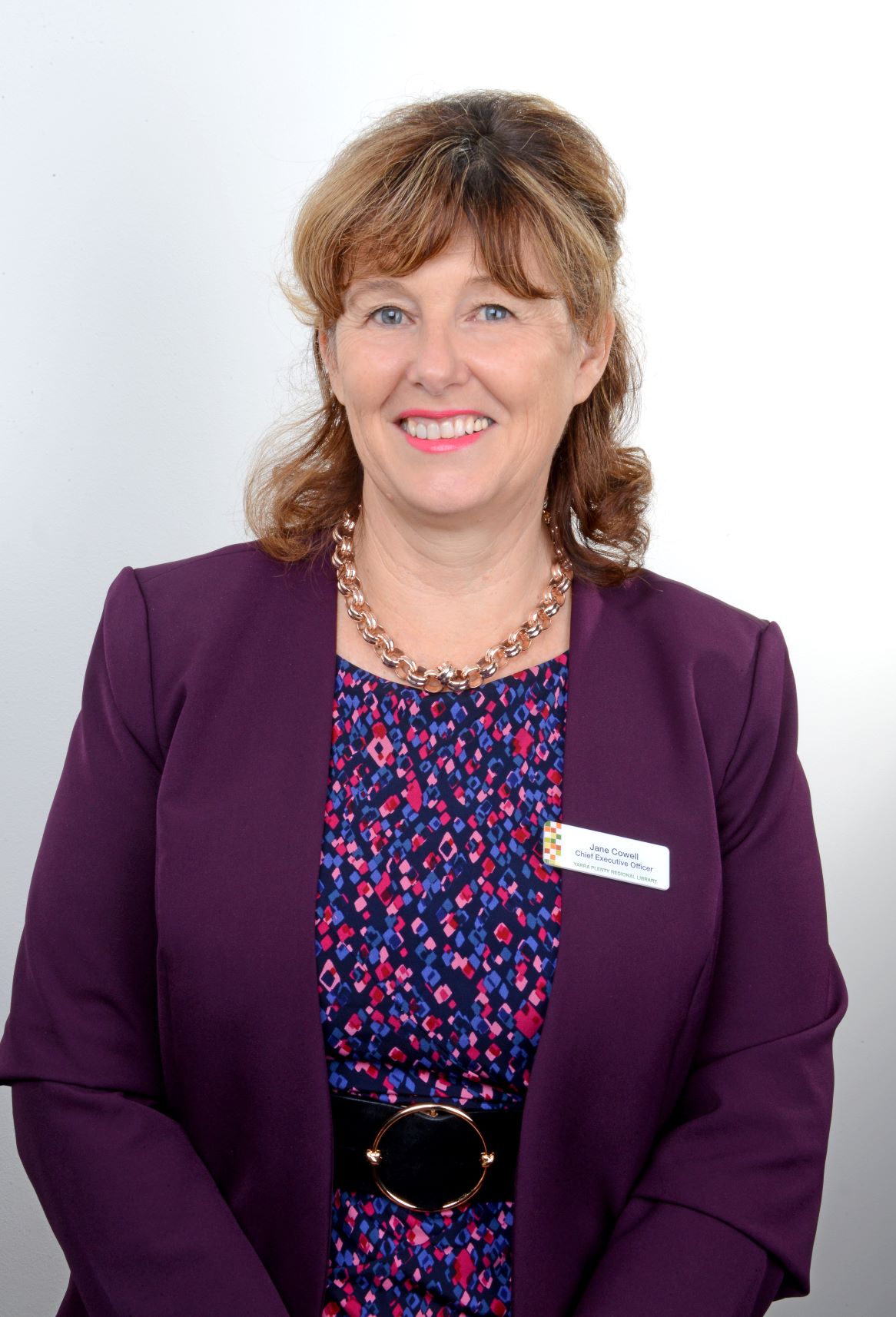
Jane Cowell
Chief Executive Officer
Yarra Plenty Regional Library
AUSTRALIA

I can bring a broad career experience to the Standing Committee that encompasses 20 years working in Public Libraries, including over 10 years as a Public Library Manager, significant strategic planning skills honed through four years as a national Library Consultant working with Public Libraries, State Libraries and Archives in developing future directions, and 8 years working as an Executive Director State Library of Queensland which included responsibility for Public Libraries, Rural Libraries Queensland (a service for very small regional local government Councils) and the Indigenous Knowledge Centres in the remote corners of the State.

I have also played an integral part in the research and Public Library policy development delivered at the State Library of Queensland in collaboration with the public libraries in the State.  This included, The Library Dividend: A study of the socio-economic value of Queensland public libraries, The Impact of Libraries as Creative spaces, and The First Five Forever early literacy program and I bring an excellent understanding of current issues, future opportunities and advocacy skills for Public Libraries today.

I have also participated in the wider Australian library industry sector and have served as President of the Queensland Public Library Association, a Director on the Australian Library and Information Australia board, participated on a national conference committee and State based library industry programs and projects, such as mentoring new Librarians.

My passion and enthusiasm for the impact that public libraries can deliver for all their communities abounds and I will bring energy, commitment and future based thinking to the role.

For more information about voting for members of the Public Libraries Standing Committee take the time to read our post.

Voting is now open!

Voting for members of the IFLA Public Libraries Standing Committee for the 2019-2023 term is now open. All financial members of the Public Libraries Section are eligible to vote and the ballot papers have been posted out by IFLA Headquarters. Voting closes on 29 March 2019.

We are excited to announce that  18 people have nominated to be members of our Standing Committee. Sadly we only have 9 vacancies.

To help you make an informed decision we asked each of the nominees to tell us a little about themselves and why they are standing for election. Over the next few days we will be gradually posting these on our Blog and on Facebook. Please take the time to read them.

Our Standing Committee is very active and geographically distributed to give us links into the wider public library community. Our continuing members will be:

Lo Claesson (Sweden); Montserrat Espunga (Spain); Leikny Indergaard (Norway); Corinne Hill (USA); Pirkko Lindberg (Finland) Sue Considine (USA); Margaret Allen (Australia) Ismea Meic (Croatia); Lenka Pruckova (Czech Republic); Spaska Tarandova (Bulgaria); Qiang Xu (China).

We also have 5 Corresponding Members who are eligible to stand for a second, two year term:

Rursudan Asatiani (Georgia); Sarah Dudek (Germany); Mark Freeman (UK); Fatemeh Pazooki (Iran); Shaddy Shadrach (India).

So take the time to read about our candidates and make an informed decision. Make your vote count!

Jan Richards
Chair IFLA Public Libraries Standing Committee


Swedish IFLA-active from LSN-section rewarded national prize

Myself and Anette Mjöberg, both in Public Libraries Section, are members of the jury of the Swedish national prize for librarian of the year, called Bengt Hjelmqvist Prize. The prize winner is rewarded for outstanding efforts in the public libraries area.

This year Heidi Carlsson Asplund was awarded the prize. She has for many years been very interested in, and worked with, accessibility issues nationally and internationally. She receives the prize for her dedicated efforts to develop and make available the library’s services, from refurbishing a youth library together with teens and regional work focusing on accessibility issues, to an international involvement in IFLA, where she is in the Standing Committee for the Library Services to People section with Special Needs. Heidi has also been noted for her efforts to engage the local community in the library work, for example: by involving local people in the program activities at Sjövik library branch. Heidi has used her great horse interest as a resource for developing new activities, such as the “ride-in library” idea.

Photo:Ingrid Kallstrom

PLS through the eyes of a newcomer

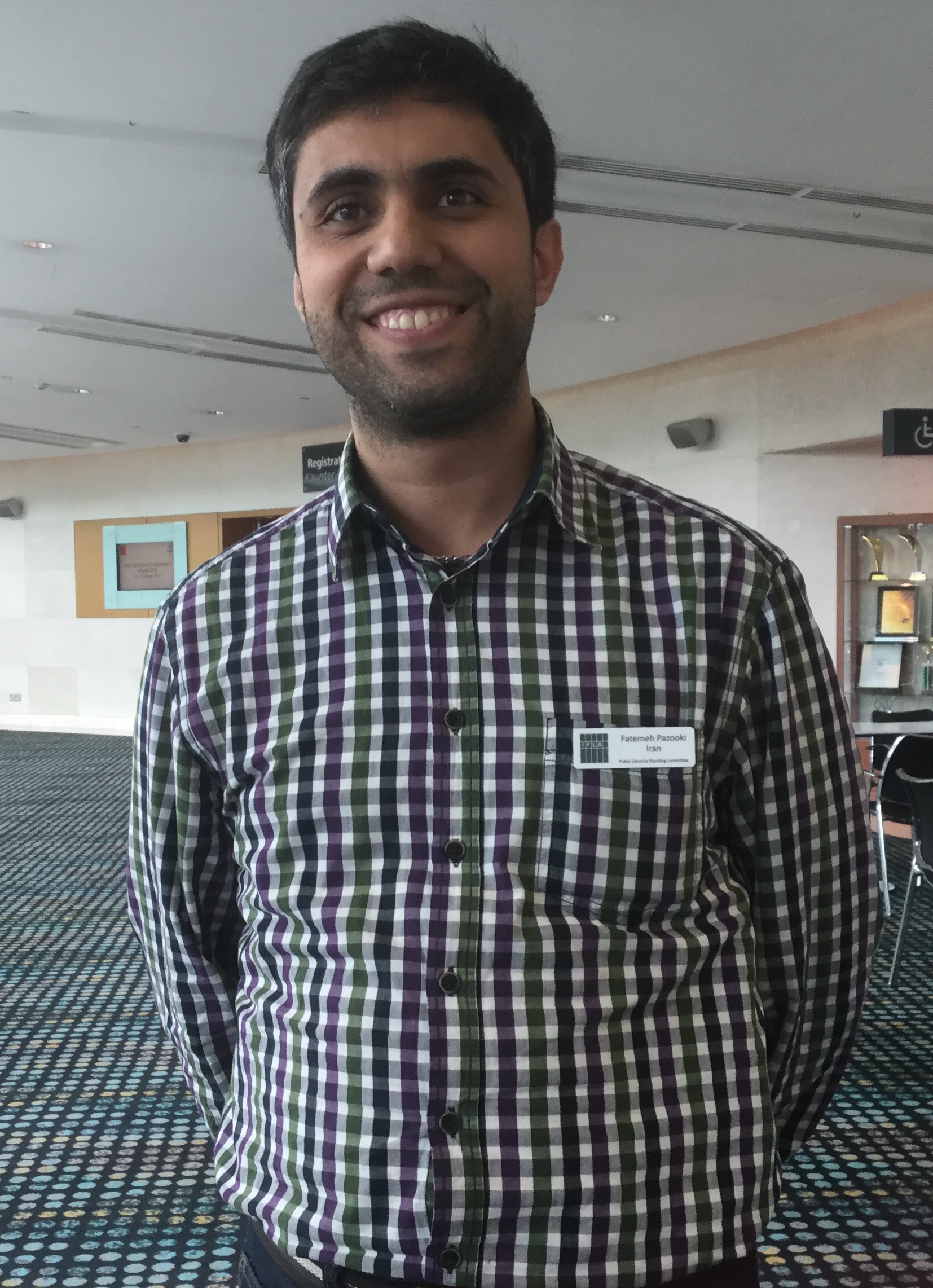
Saleh modelling Fatemeh’s PLSC name badge! We could tell the difference.

At the Public Libraries Standing Committee sessions in Kuala Lumpur we were delighted to welcome Saleh Zamani from Iran. Saleh is a colleague of our corresponding member Fatemeh Pazooki and as she was unable to come Saleh attended so he could report back to Fatemeh when he returned home..

We have just received this report from Saleh (via Fatemeh) and we would like to share it with you. We think it demonstrates what IFLA is all about.

This was the first time that I came to IFLA as newcomers. Although I was not familiar with IFLA’s structures, I first got acquainted with Public Libraries Section. So, my first visit to IFLA was through the Public Libraries group in the Chinese restaurant. I got surprised due to the friendly, warm and inclusive behaviors of all the members specially Jan. I’m not a librarian, but from the time of meeting Jan and her friends, I was interested in Librarianship. From the two Public Library’s sessions, I could attend the first session and enjoy the reports of the program. I remember one of the reports was on the investment in Libraries that could reduce social costs of communities. This report was important to me because of bearing social background. Another attractive point for me was that among the sections which I participated in, the Public Library Committee was much more active than the others. Empathy and coordination among the members made them an effective family. Jan’s flexible management has made it so easy for any non-librarian to be interested in librarianship. Unfortunately, at the second session of the committee, I was not able to attend because I took part in another section (CDNL).

However, I will never forget the memories of friendship with committee members. I really thank Fatemeh Pazooki because she introduced me to this committee for the first time, and I had the chance to take part in that section. I remember, I was so happy with the selection of Public Library Section on the last day at the Planetary Theater. I realized Jan and her colleagues are doing a lot of ongoing efforts to update their activities while loving their profession. I really love to see them all again and wish them good luck.

Sanctuaries in the city: the public library as a safe space

IFLA WLIC 2018

Kuala Lumpur

Synopsis prepared by Corinne Hill, Public Libraries Section member.

Sponsored by Metropolitan Libraries and the Public Libraries Section, this program had the unenviable scheduling position next to IFLA’s Global Vision session. Nevertheless, Sanctuaries still drew a respectable crowd.

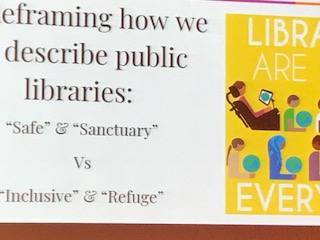
The session opened quite strongly with Derr Leonee Ariel’s “Public Libraries are safe and neutral spaces…when people aren’t in them!From Malvern Library in Melbourne, Australia, Ms. Ariel delivered a compelling presentation framed around the use of language, and why language matters. She is a lover of language, and evidence of this can be seen throughout her entire presentation. She spoke of how “the past informs practice and expectations today.” My favorite slide was when she compared “Safe and Sanctuary,” vs “Inclusive and Refuge.”
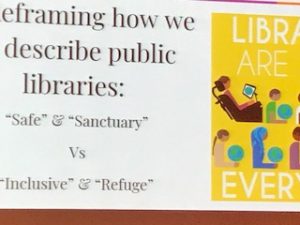
What I took away from this was that we build trust with our communities over time. While we have standards of behavior when working in public space there is the reality of what it is truly like to work in a public space—and it’s not a safe space. We strive to create inclusive experiences in an unpredictable world often with vulnerable populations not captured in census.

Ms. Ariel see’s our future as social justice in action—while we are not a political institution, our current political environment has made us one.

She is someone to watch as she has her pulse on our current predicaments. I encourage you to read her presentation in its entirety:

http://library.ifla.org/2272/1/114-derr-en.pdf

Walsh Benjamin followed with his “Public library and private space: Homeless queer youth navigating information access and identity in Toronto.” Mr. Benjamin examines the public library as an important space for homeless lesbian, gay, bisexual, transgendered, transsexual, two-spirit, and/or queer youth. As an academic librarian, he’s report stands at the intersection of public library services and library research—something not well represented in the literature and something for which he should receive accolades.

The first challenge to delivering services to this population is finding them –essentially, delivering services for those you cannot see. Homeless queer youth often hide their identity and such deception often leads to chronic and/or critical information poverty. Essentially, queer youth are seeking privacy in an Urban Hybrid Space as they cannot embrace their queerness in a public space.

The entire presentation is available here:

http://library.ifla.org/2144/1/114-walsh-en.pdf

The discussion shifted to building design with Traci Engel Lesniski, Minneapolis, USA, “Welcome to All: Design’s Role in Creating an Inclusive, Safe, and Beloved Community Destination.” Ms. Engel spoke of the community’s resistance to the Central Library’s redesign identifying it as a “fancy homeless shelter and an irrelevant space for the rest of the population.” Ms. Lesniski’s architectural firm, MSR,  took this “homeless issue” as a design challenge recognizing the actual and perceived safetyissues. They incorporated onsite offices for social service providers, study rooms for consultations, computer table design that allowed for privacy and space for belongings of the homeless, and they created a 2nd controlled entry to the children’s suite. Essentially, MSR turned the library from a fear-based program to a home-based program, and opened in 2013 to community acclaim. The entire presentation is available here:

http://library.ifla.org/2218/1/114-lesneski-en.pdf

Libraries Without Borders, Paris, France presented “Libraries as vectors of integration for immigrants and refugees: access to information and education in the Ideas Box in France. With 68.5 million displaced individuals worldwide, libraries play an important role in integrating immigrants and refugees into host communities. The “Ideas Box” is a flexible, modular, mobile library that makes for an excellent outreach tool. Outreach to displaced individuals helps them to regain a sense of normalcy after trauma, and demonstrates that the library is a place to build hope again. Presentation not available.

Continuing the discussion of the public library as a safe space, “Public library as a safe place: principles and experiences of Brazilian Park Libraries in Rio de Janeiro,” looks at a public library as a space and place rather than as a service. Park Libraries in Rio de Janeiro are located in very poor and violent regions of the city. The purpose is to explore the social capital theory as it applies to public libraries. The entire presentation is available here:

http://library.ifla.org/2143/1/114-silva-en.pdf

The final presentation, “Library for the homeless: A case study of a Shelter House and a School for Homeless in Indonesia and Malaysia,” examined the impact of library materials and services at homeless shelters. The study found that sustainability is an issue both for materials and staff training. The entire presentation is available here:

http://library.ifla.org/2140/1/114-lastiwi-en.pdf
What is Universal Design for Libraries

By Guest Blogger

Lo Claesson

Here is a short summary of the session “What is universal design for libraries? – A joint session by Library Services to People with Special Needs, Public Libraries and Library Services to Persons with Print Disabilities”:

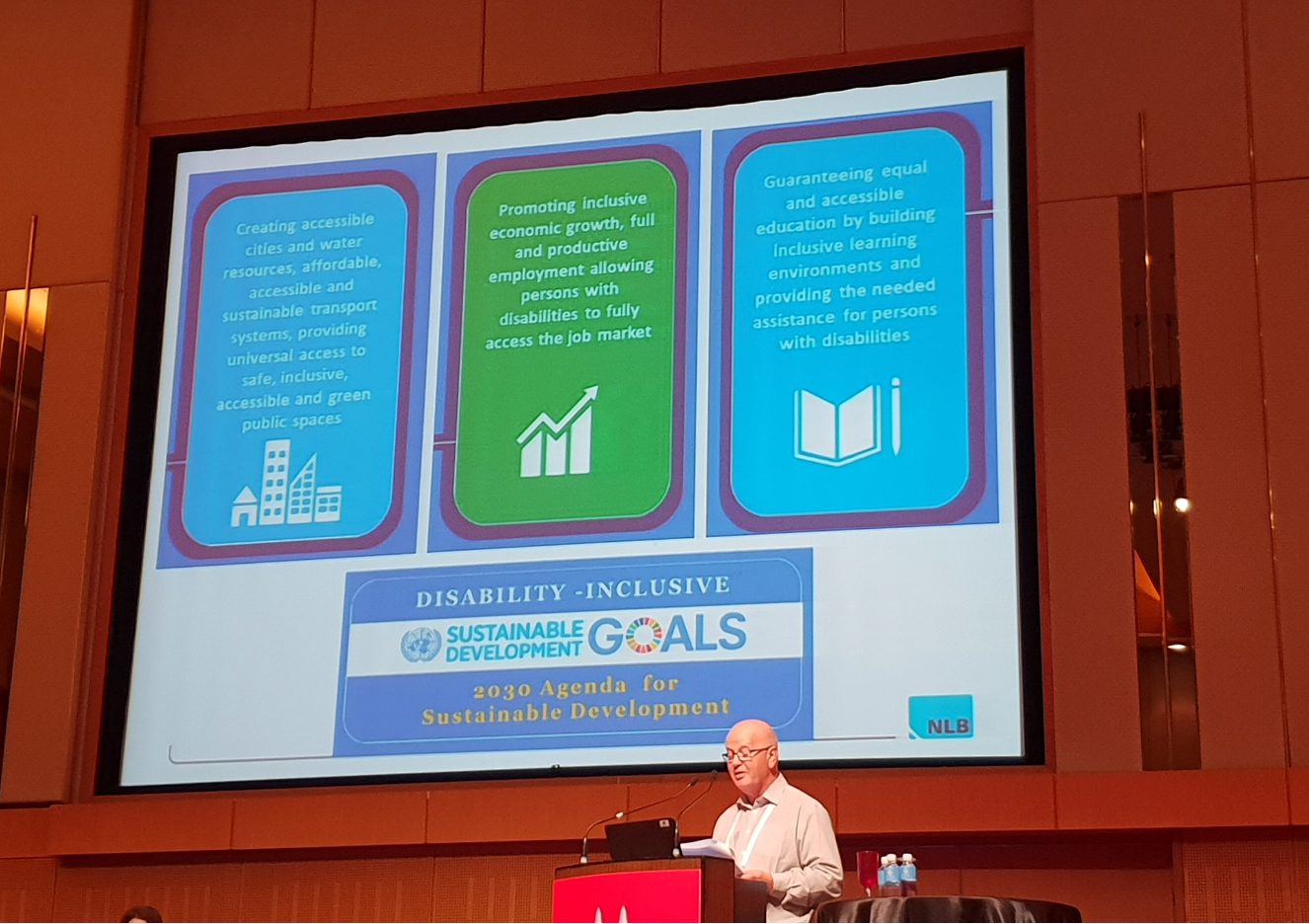
The first speaker was Knut M. Nygaard, Director of Norwegian Library of Talking Books and Braille. He talked about different terminology, used for about the same concept as “universal design”. The aim of universal design is to simplify life for everybody. Target groups are everybody, regardless of age, size or ability. You can talk about universal design at threee levels: a strategic level (macro), technical solutions and standards (meso) and individual perspective (micro).

The next speaker was Anne Sieberns, German Institute for Human Rights. Her presentation was on Universal Design and Human Rights. There is a Convention on the Rights of Persons with Disabilities (CPRD), which now (June 2018) is ratificated by 177 State Parties.
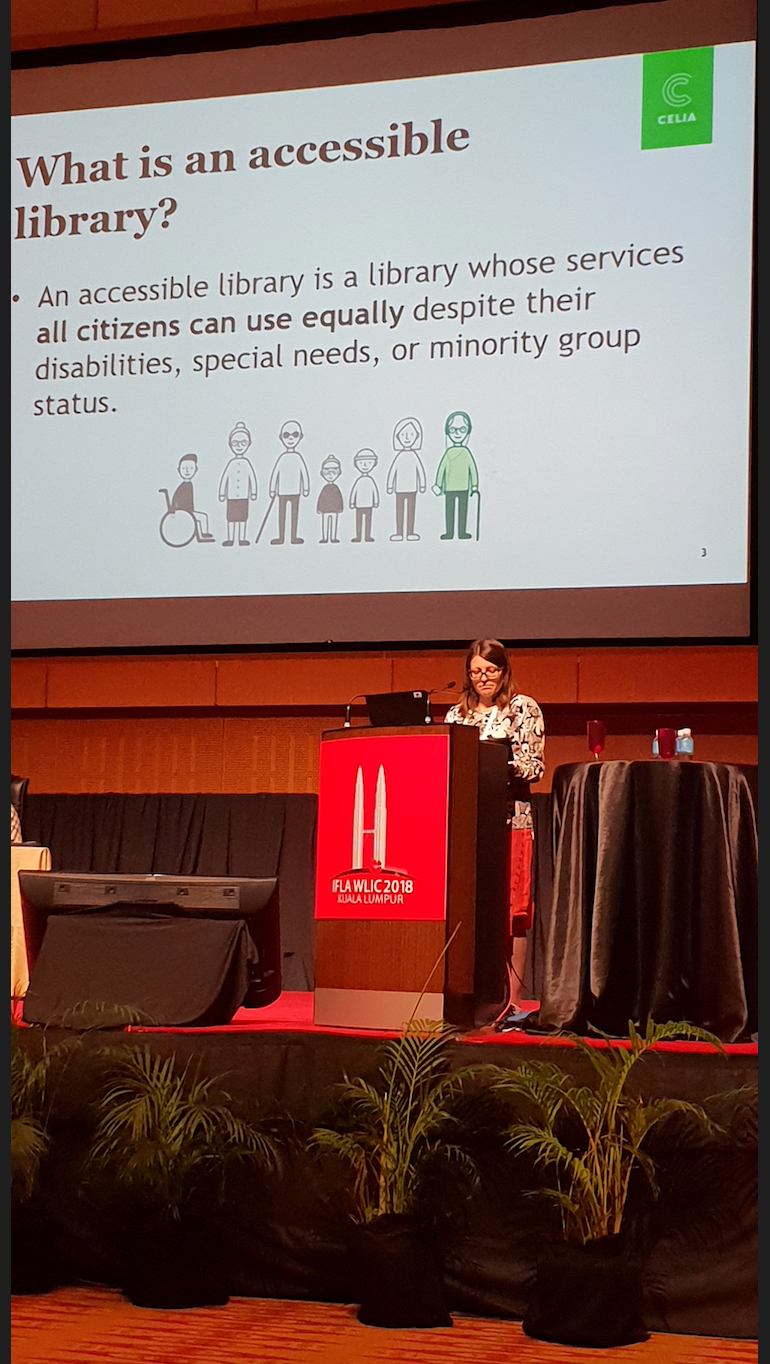
Then we heard about guidelines for universal design in Finnish libraries by Kirsi Ylänne, Celia Library Finland. The English translation of the guidelines is available (pdf) at https://www.celia.fi/eng/accessible-library/ . It is published on a Creative Commons  license and can be translated and adopted into other languages.


Then Mr Hiroshi Kawamura held an oral presentation on Universal Design an Print Disabilities – DAISY Technology and Accessible Multimedia. He stressad that universal design does not exclude assistent technology for those who need it. There is also an issue of accesibility for for example indigenous people. It´s a very complex matter.

We also got some best practices from the UK from Mark Freeman as Yarm Library, Chelmsford Library, Great Sankey and Ammanford Library. These libraries also include persons with autism or dementia in their design thinking.

Nancy Bolt from the section Library Services to People with Special Needs finished the session by summarazing what has been done in the section in recent years: Guidelines concerning people with Dyslexia, people experiencing homelessness and people who are deaf, hard of hearing and deaf/blind. They are planning to do guidelines concerning refugees and prisons as well. They are also suggesting how the IFLA conferences can be more accessible in the future. The on-going conference is not very accesible for people using wheel chairs.