
This post was generously contributed by Jannatul Islam Muna, a Library Circulation Officer, and Shaharima Parvin, a Senior Assistant Librarian, both of whom are with the East West University, Dhaka, Bangladesh.
In this rapidly transforming era, where the world is shifting from the digital age to Artificial Intelligence (AI), we can now see the impact of AI in every sphere of life. AI is assisting us in numerous ways, and libraries are also integrating AI tools into their services. In the workplace, we strive to acquire essential skills to transform our workplaces, including integrating machine learning, Natural Language Processing (NLP), innovative chatbot services, big data analysis, and more. Still, we sometimes overlook the importance of developing essential soft skills, including emotional intelligence, teamwork, leadership, communication, conflict resolution, and stress management. In libraries, we need both soft skills and hard skills.
Regarding emotional intelligence, Maya Angelou once said, “I’ve learned that people will forget what you said, people will forget what you did, but people will never forget how you made them feel.” The term Emotional Intelligence (EI) was first coined by Peter Salovey and John D. Mayer in 1990, describing it as “a form of social intelligence that involves the ability to monitor one’s own and others’ feelings and emotions, to discriminate among them, and to use this information to guide one’s thinking and action. Emotional intelligence refers to the cognitive abilities that help humans understand the feelings of others with self-awareness. People who are emotionally intelligent consistently strive to regulate their emotions, are motivated and self-driven, empathetic towards others, and self-aware of their strengths and weaknesses. They also possess good social skills. In libraries, especially academic libraries, librarians serve the diverse needs of university communities. Librarians also need to serve many users at a time patiently which requires stress management, patience under working pressure, self-regulation mostly emotional regulation, ability to manage anxiety, courage to develop other skills such as confidence, positivism, service orientation, teamwork, problem solving, critical thinking, conflict resolution, communication, learning mindset, tech management and decision making.
Though AI has become increasingly prevalent, human qualities have become more valuable than ever. AI automates repetitive tasks, allowing librarians to focus on innovative services, user engagement, and community outreach. Additionally, if we observe that AI can answer basic factual questions through chatbot services, the empathy that is needed can only be provided by librarians. Students or users visit the library for guidance, reassurance, suggestions for various purposes, where human interaction is more required than AI. A librarian with emotional intelligence can handle a student patiently and wisely who is anxious, stressed, and overwhelmed.
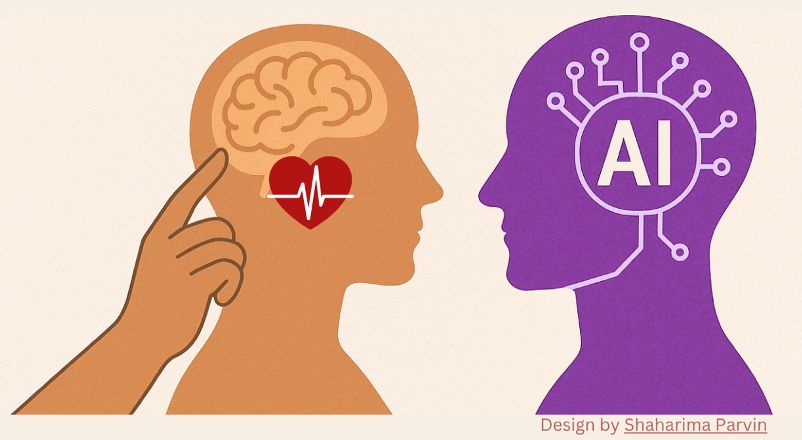
In the age of technology and AI, especially among the young generation, they can become overwhelmed. In such cases, an emotionally intelligent librarian can play a vital role by patiently empowering students with library resources and services. AI can perform routine tasks, but when it comes to community engagement, it requires more emotionally intelligent librarians who can provide emotional support and reassurance that help build genuine connections and trust. In developing countries, although the world is changing with the evolution of technologies, many students still experience anxiety about technology use, particularly those in the librarians’ work environment. Academic libraries provide research support, where they must assist faculty and students simultaneously with their research projects. Therefore, they require being more proficient, efficient, creative, and self-controlled learners. Although many libraries are utilizing AI research tools such as SciSpace, Semantic Scholar, Research Rabbit, and EndNote with AI plugins, creativity, unique ideas, and their presentation still require a human touch, which librarians can provide efficiently.
EI and AI must be balanced to ensure the library’s efficiency and a human-centered environment. If we rely solely on AI, users will be disappointed by not experiencing human connections, as many crave genuine human interaction, and there are also concerns about trust. On the other hand, if we neglect technological advancement, we can face prompt service errors. For that reason, we need to balance EI and AI more effectively. Moreover, librarians’ or employees’ feelings can be deteriorated in several ways, such as organizational needs and skill mismatch, proper evaluation of performance, work satisfaction, and effective communication. Research has shown that emotionally intelligent librarians are consistently motivated to adopt innovative ideas and create a better workplace. To achieve this balance, libraries need to train their staff in emotional intelligence skills, which include empathy, active listening, and conflict resolution. Academic libraries play a significant role in their communities, and in this regard, they have an opportunity to demonstrate that technology and humanity can work together effectively. By embracing AI to improve efficiency and enhancing EI to strengthen personal connections, libraries can become smarter, smoother in service, and more inclusive in their purpose.
References
Landry, L. (2019, April 3). Why emotional intelligence is important in leadership. Harvard Business School Online.https://online.hbs.edu/blog/post/emotional-intelligence-in-leadership
Sadiku, M. N. O., Olaleye, O. D., & Musa, S. M. (2020). Emotional intelligence in the workplace. International Journal of Trend in Research and Development (IJTRD), 7(1), 272-275. http://www.ijtrd.com/papers/IJTRD21980.pdf
Salovey, P., Woolery, A., & Mayer, J. D. (2003). Emotional intelligence: Conceptualization and measurement. In G. J. O. Fletcher & M. S. Clark (Eds.), Blackwell Handbook of Social Psychology: Interpersonal Processes (pp.279-307). Wiley-Blackwell. https://doi.org/10.1002/9780470998557.ch11