Author Archives: library-policy

The 10-Minute International Librarian #74: Think of a way in which you can promote intellectual freedom

Libraries have a clear commitment to promoting access to information as a key pre-condition for the fulfilment of the rights to education, research, culture, democratic participation and development in general.

We work to combat barriers to this access, linked not just to resources, but also to policies which may risk censoring content.

Yet access is only one part of the broader concept of intellectual freedom. This also includes the possibility to share information – freedom of expression.

Indeed, the ability to apply existing information and create new knowledge is arguably just a logical continuation of the possibility to access. It is also of course what guarantees that there will be new works in future.

Libraries therefore have a strong interest in promoting broader intellectual freedom, with many already seeing promoting creativity and expression as central to their mandates.

So for our 74th 10-Minute International Librarian Exercise, think of a way in which you can promote intellectual freedom.

What can you do, not just to help readers access materials which they wouldn’t otherwise be able to read, but then to draw on this information, to express themselves?

Is it a question of skills, or of confidence? Are there restrictions that are holding people back, and which need to be removed?

What platforms can you provide for people to think freely, and realise their potential?

Share your ideas in the comments box below.

Good luck!


This idea relates to the IFLA Strategy! Key Initiative 1.4: Shape public opinion and debate around open access and library values, including intellectual freedom and human rights

As we publish more ideas, you will be able to view these using the #10MinuteInternationalLibrarian tag on this blog, and of course on IFLA’s Ideas Store! Do also share your ideas in the comments box.

The 10-Minute International Librarian #73: Think of a communications tool that works well on you

Communication is an important part of impact.

It allows us to engage more effectively, both with users and with the decision-makers who determine the future of our institutions and profession.

Improving our ability to talk about what we do and why it matters is therefore essential.

Fortunately, it’s also an area where there is plenty of experience and inspiration out there.

From advertising to political campaigning, and from education to public information, we come across good – and potentially bad – communications all of the time.

Crucially, we can be reflective. Given that we are the target of so much communication ourselves, each of us can bring to the table our own experience of what is most effective, and draw on this in our work.

So for our 73rd 10-Minute International Librarian exercise, think of a communications tool that works well on you.

What have other people done that made you pay attention, better understand an issue, or even change your mind?

Was there a specific tool, approach, or format that made thus communication more effective?

Is this something that you can do in your own work to communicate the value of your work?

Let us know about what you have learnt from others about communication in the comments box below.

Good luck!


This idea relates to the IFLA Strategy! Key Initiative 4.4: Increase our visibility through excellent and innovative communications

As we publish more ideas, you will be able to view these using the #10MinuteInternationalLibrarian tag on this blog, and of course on IFLA’s Ideas Store! Do also share your ideas in the comments box.

Leaving No Child Behind: The Importance of Investing in Library Services

World Children’s Day is the anniversary of signing both the Declaration of the Rights of the Child in 1959, and the Convention on the Rights of the Child in 1989.

It is an opportunity to focus on ensuring that the rights and interests of children are understood, and incorporated into decision-making at all levels.

This year’s theme is a Better Future for Every Child, concentrating on the impacts of inequalities on children, and the need to combat child poverty. It draws, in particular, from the economic and social divides exposed by the COVID-19 pandemic, which demonstrated how different factors can interplay to lead to worse outcomes.

This focus also recalls the fact that the experience of poverty in childhood is too often associated with negative outcomes later in life, such as higher unemployment or lower incomes, poorer health, and beyond.

This link begins early, with poverty all too often correlating with lower literacy and other skills leading to less good education performance. This can risk reinforcing poverty over time, with poor children turning into low-income parents, whose own children then face the same challenges.

In the long run, putting an end to child poverty means increasing income levels. A key way of achieving this is by breaking the link between economic poverty and other negatives, such as low literacy and wider educational outcomes.

The strength of this link can come from a variety of factors: there may be fewer resources available at home, parents may be less able to help with homework and language development, families may participate less frequently in cultural events that can develop a taste for reading, and children may not have a space or quiet for learning.


Library interventions combatting educational inequality

Clearly, schools have a key role to play in tackling this situation, with skilled teachers with adequate resources helping ensure that children from poorer backgrounds genuinely do have the same chances as their better-off peers.

Complementing these, however, are great library services for children, through both school and public or community libraries, drawing on their unique potential to support learner success.  This role that libraries play is well documented (here and here, to give just two examples).

A first contribution comes through the wider work of libraries in giving access to materials that help develop ideas and expand horizons, something that may be particularly important for young people growing up without access to a wider range of experience.

They can run programmes focused on poorer communities, such as KidsREAD in Singapore, targeted at improving the English language skills of young people who risked falling behind otherwise, and run by the National Library Board. Similarly, Kids on the Tab in Kibera, Kenya, worked through libraries to complement the schooling of children from poor areas, contributing to much improved exam results, which in turn open up new possibilities. Libraries can also be useful venues for promoting programmes aimed at encouraging better educational outcomes, such as the MathsWhizz programme in Kenya.

A particularly important activity can be summer reading clubs, addressing the fact that over the long break, children without opportunities to learn and develop literacy skills at home risk falling behind their peers, leading to lower performance and frustration when they return. Holiday breakfast clubs can serve a similar purpose, while also tackling food insecurity. Homework clubs also help children who may lack a quiet space at home to work.

Libraries also play an important role in supporting school-readiness, ensuring that children are able to engage properly when they start formal education. A number of countries have adopted initiatives based on or similar to Bookstart, for example Boekstart in the Netherlands, Kindertreff in Switzerland, Start Life with a Book in Czechia, and Better Beginnings in Australia. They typically involve the provision of age-appropriate materials from a young age, and then ongoing support, including in cooperation with doctors, in order to keep an eye on language development.

While these are often universal programmes, a key goal is to support those families which may not have other opportunities, or children with difficulties that may hold them back at school (such as disability, anxiety, or attention deficit).

Connected to this, libraries (both school and public) can support family learning, helping to engage parents in the effort to develop children’s literacy skills, and potentially brining direct benefits to them as well. Furthermore, they serve as community convening spaces, and bring in an important experience of supporting personalised learning, as underlined by the Urban Libraries Council.

Even outside of specific service offers, research demonstrates that children from poorer background report relying far more on libraries than their richer peers.

IFLA’s Library Stat of the Week series drew on data from the Organisation for Economic Cooperation and Development’s Programme for International Student Assessment (PISA) to show how children who don’t have a room of their own, have parents with lower qualifications, or who come from foreign language or immigrant backgrounds tended to have greater levels of dependence.

Further research using the same data just for the US has echoed this point, noting that even if levels of usage are the same, this usage will be more important for children who don’t enjoy access to space, resources and connectivity at home. Work in the UK underlines the same, focusing on the reliance of poorer children on public libraries.

They also help by providing internet access and equipment that families may not be able to afford, or simply extending opening hours (both providing a space for young people, and allowing parents to take on full-time work).

Indeed, in situations where children face insecurity and deprivation at home and outside, libraries can act as places of retreat and safety, both in richer countries, and in others facing serious endemic violence problems, such as Brazil and Colombia. Village and mobile libraries can extend possibilities to access information and technology to rural areas, which often also face higher levels of child poverty, as in India and Burkina Faso, or those which are remote, such as the Galapagos.


From potential to practice

However, the continued existence of education inequality, to the detriment of young people from poorer backgrounds, makes it clear that there is a lot still to do.

To some extent, there is work to do within our field, drawing on existing good practices. For example, as the Literacy Trust in the UK notes, it is important to reach out, given that there may be a reluctance to use libraries in some circumstances. Libraries’ reputation as a quiet place, only for the more highly educated, can represent a barrier to overcome. There is a risk that the people who need library services most simply don’t take the opportunity.

Libraries need to be able to reach out to poorer children where they are, rather than relying on traditional tools such as brochures, with cooperation with schools offering a powerful possibility in the case of public libraries at least, as underlined by the Urban Libraries Council.

There may even be an opportunity, as libraries open up following the pandemic, to do things differently and to engage people who previously never participated in library activities. For example, creating small public libraries in people’s homes in Foshan, China, helped increase outreach to families in deprived areas who would not otherwise come to existing institutions.

The way in which services are provided also matters. It is important not to create stigma around using services targeted towards children on low incomes, as underlined by the Child Poverty Action Group.

Skills also matter, a point also underlined by the Urban Libraries Council, and which lies at the heart of the Library at School programme in the Netherlands. So too does the ability to evaluate the impact of the work of libraries on educational outcomes among children facing poverty.

However, for our institutions to be able to fulfil their potential, they also depend on adequate resourcing and support. Yet all too often, it is poorer schools that aren’t offering school library services, a point made by the UK Children’s Laureate recently, but which has been known for over a decade.

As she set out: Millions of children, particularly those from the poorest communities worst hit by the pandemic, are missing out on opportunities to discover the life-changing magic of reading – one that OECD research suggests is a key indicator in a child’s future success. How can a child become a reader for pleasure if their parents or carers cannot afford books, and their primary school has no library, or that library is woefully insufficient?

Some have worried that cuts to library services happen quicker in less well-off areas, with impacts both on collections, and on spaces and staffing. In both cases, under-investment risks leading to unrealised potential to support investment in combatting inequality in education and literacy.


In conclusion, this year’s World Children’s Day provides an important reminder of the need to act on education and literacy as part of wider efforts to combat inequality and poverty among children. Libraries – both school and public – have a strong and proven role in doing this, drawing on their unique strengths.


Yet with significant challenges remaining, often exacerbated by the pandemic, these good practices need to be taken as a call to action, both within our field, but also – and perhaps more importantly – to the governments and others that determine what resources libraries have, and how they can work.

What advocacy activities are libraries undertaking? Analysing the Results of the IFLA Regional Advocacy Priorities Study (Part 2)

IFLA’s Regional Advocacy Priorities Study collected responses from library associations, institutions, and individuals in June and July of 2021 in order to build up an understanding of the status of library advocacy in the world today.

Its goal is to get library and information professionals around the world (and in particular in IFLA’s new Regional Council and Division Committees) thinking critically about library advocacy.

As set out in the first part of this blog last week, reflection is important. Our time and energy is far from infinite, and so we need to keep on asking ourselves how to use it most effectively. Priorities change, so too do circumstances.

The same reflection is necessary around the way in which we advocate.

As such, the Study included a question about the degree to which libraries in different countries carry out different types of activity as part of their advocacy efforts. You can read the full answers on p56 onwards of the Report.

The question draws on IFLA’s Advocacy Capacities Grid, which aims to break down the different elements of advocacy. It is a tool, allowing libraries to think about where they are already strong, and where they may be able to do more.

It recognises, in particular, that advocacy involves a range of steps, reaching from what can be seen as lobbying (working with politicians, around specific legal changes) to broader public relations.

A first set of activities relate to engagement with laws and lawmakers – practices which are more at the ‘lobbying’ end of the spectrum of advocacy:

  1. Understanding laws and policies: this refers to the ability of libraries to understand the content of laws and policies, and follow the process by which they are developed and approved. This matters, if libraries are to be able to spot issues and seize opportunities on a timely basis to obtain better laws and policies (or avoid bad ones)
  2. Contacts with government officials: this refers to whether libraries have a strong network of contacts with ministers and civil servants who prepare and take decisions which can shape the situation facing libraries.
  3. Meet regularly with government officials: this refers to the particular importance of being able to talk regularly with policy-makers and shapers. Such meetings are both an opportunity to share views and build common understanding, as well as being important in order to respond to emerging issues.
  4. Contacts with legislators: in addition to work with the executive, it can also be powerful to work with members of parliament. They are important not only when voting on law, but can also help hold governments to account when they are not doing enough for libraries, or even propose laws that could help libraries in their work.

A second set focuses on who carries out advocacy work:

  1. Staff focused on advocacy: this refers to whether there is a named individual or individual who is responsible for carrying out advocacy on behalf of libraries. Allocating responsibility can help with coordination of work, as well as allow for the development of relationships and knolwedge.
  2. Members as advocates: this refers to whether individuals across the library field are mobilised to advocate for libraries. This can help ensure that libraries can engage effectively at the local level, as well as making the voice of libraries stronger.

A third set looks at communications:

  1. Attractive communication tools: this refers to the ability of libraries to create communication tools which are professional and appealing. This is important if libraries are to be able to seize people’s attention.
  2. Impact communication: this refers to the ability to present evidence of the impact of libraries, for example through collecting powerful stories of how libraries contribute to development, or to share data. This can help convince people of the need to support libraries.

A fourth set looks at working with and through others to deliver on advocacy goals:

  1. Contacts with journalists: this refers to whether libraries have relationships with the press and other commentators or influencers. This can allow library messages to be heard by a wider audience, potentially in a way that is more effective than if libraries communicate themselves!
  2. Partnerships: this refers to relationships with other organisations and stakeholders who can support library advocacy, such as non-governmental organisations. They can open up possibilities to build new contacts, and convince new audiences.

Finally, there is evaluation:

  1. Advocacy impact evaluation: this refers to the capacity to assess the impact of advocacy efforts in order to inform future work. It is an important step in order to ensure continuous improvement in the effectiveness and reach of your work.


As set out in the previous blog, the study is limited by the number of respondents. It should therefore not be taken as a definitive snapshot of advocacy around the world, but rather a conversation starter.

To help with this, the study breaks down responses by region, by type of respondent (association, institution, individual), and by size (of association and institution), allowing us to highlight interesting trends in library advocacy practices around the world.

Looking at the answers to the question around advocacy activities, we can therefore identify the following potential findings, as a basis for further discussion.

Libraries focus more understanding laws, than engaging with lawmakers: a consistent finding across regions was a tendency to more active in work to keep track of laws, and understand what they mean, than to engage with decision-makers (and in particular, members of parliament).
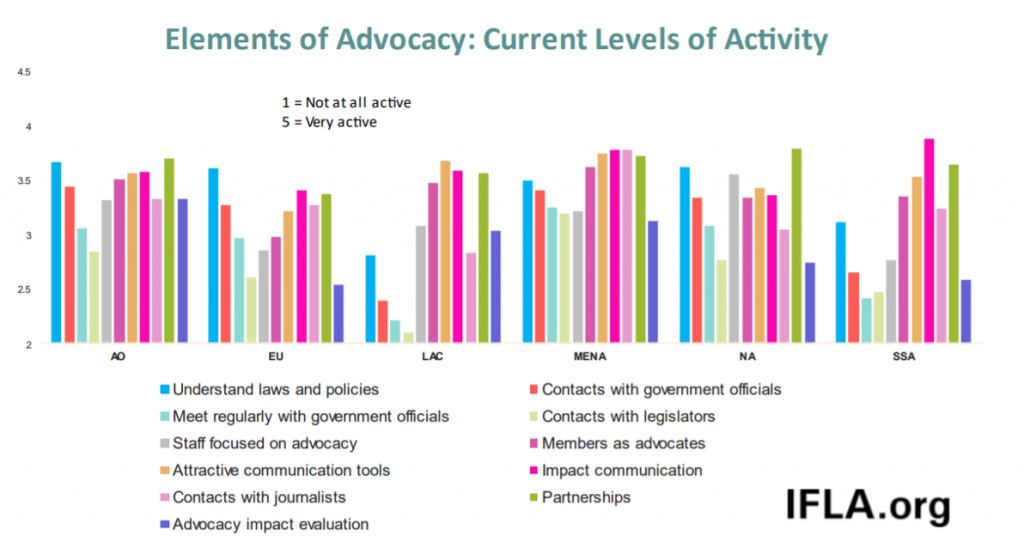
Chart 1: Level of activity on different elements of advocacy - results for all respondents (by region)

Chart 1: Level of activity on different elements of advocacy – results for all respondents (by region)

Clearly, understanding laws is important, in order both to be able to follow them, and to understand and set out how they can be improved. Yet relations with decision-makers matter, given that in the end, they are the ones determining whether libraries will get the policies and provisions they need.

It is particularly interesting that legislators receive least attention. It is true that a single member of parliament is likely to have less power than a minister, but they can be powerful advocates, and may be freer in making proposals than those in government already.
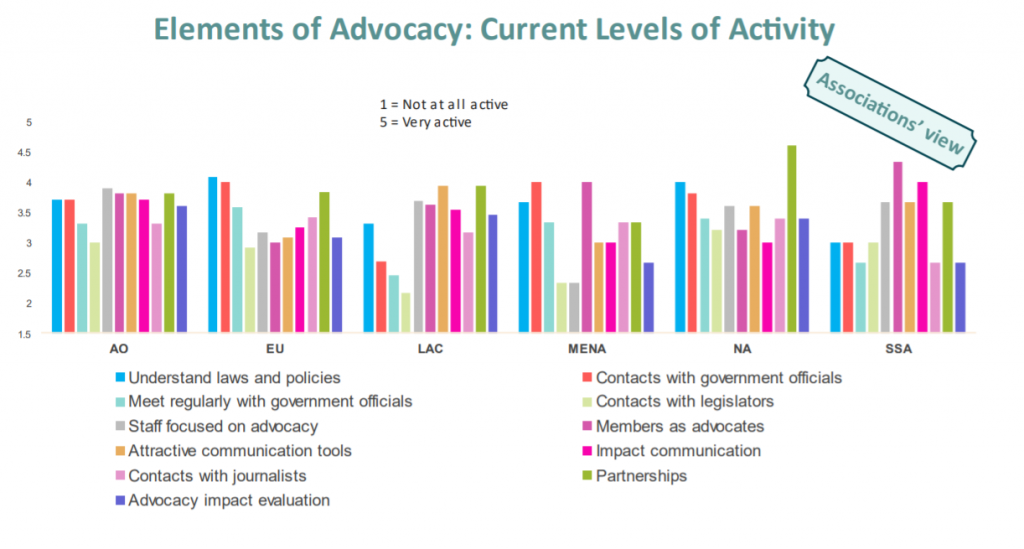
Chart 2: Level of activity on different elements of advocacy - association respondents only (by region)

Chart 2: Level of activity on different elements of advocacy – association respondents only (by region)

Looking in particular at associations, it is also notable that the place of this engagement varies by region.

In Europe, North America and the Middle East and North Africa, understanding laws and maintaining contacts with decision-makers stand out as areas of focus. Meanwhile, for associations in Asia-Oceania, these activities stand out less, while in Latin America and the Caribbean, and Sub-Saharan Africa, they play a relatively smaller role than other types of activity.
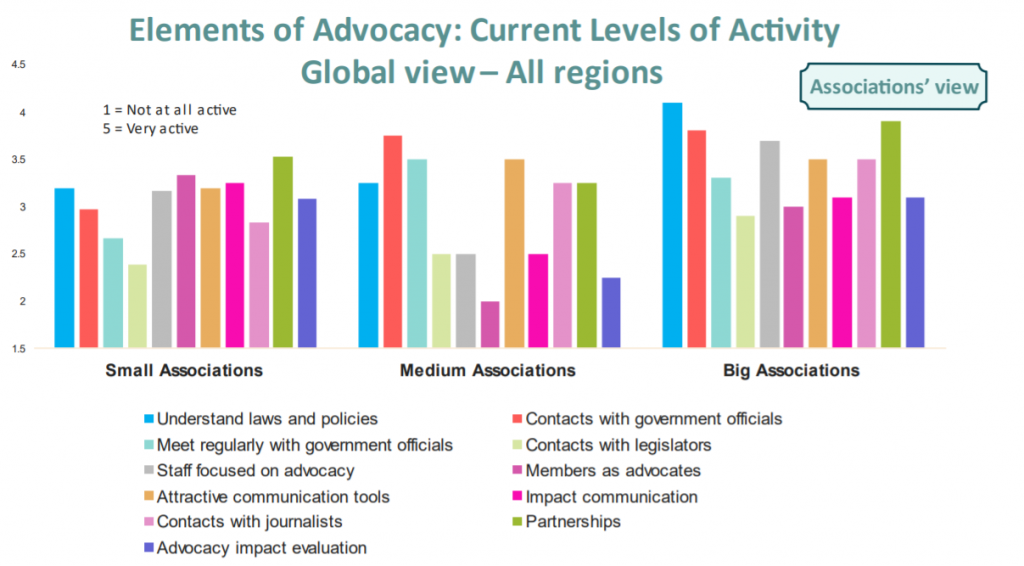
Chart 3: Level of activity on different elements of advocacy – association respondents only (by size of association)

There is also a distinction between larger and smaller associations, with larger players more likely to be involved in engaging with law and lawmakers. This may be explained by the fact that this sort of engagement does require time and resources which may be less readily available for smaller players.

This raises an interesting challenge – what can be done to strengthen the ability of smaller associations to carry out these aspects of advocacy?


A varying focus between dedicated advocacy capacity and mobilising the field: as highlighted above, it is important both to have named individuals who can lead and coordinate advocacy work, and to enable librarians everywhere to speak up in favour of our profession and institutions.

In almost all regions of the world, there is a stronger emphasis on helping individual librarians to act, than on building a central capacity for advocacy, with only North America focusing more on the latter (see chart 1 above).

Nonetheless, the gap is not a wide one in Asia-Oceania, Europe, and North America. It is wider, however, in Latin America and the Caribbean, the Middle East and North Africa, and Sub-Saharan Africa, indicating a potential area of focus for capacity-building.

Looking specifically as associations, the picture is different. In Asia-Oceania, Europe, Latin America and the Caribbean, and North America, there is a slightly stronger focus on dedicated advocacy capacity, while in the Middle East and North Africa and Sub-Saharan Africa, a lot more effort goes into mobilising members.

Turning in particular to associations of different sizes (see chart 3), the data indicates that larger players may be more focused on dedicated advocacy capacity, while smaller ones emphasise mobilising their memberships more.

In the end, the goal must be to ensure a similar focus on these two elements, and so learning how to develop both types of capacity, in order to support advocacy that is as strong as it is coordinated.


Partnerships complement libraries’ own efforts: as highlighted above, forming partnerships can be a powerful way of supporting library advocacy by recruiting a wider range of voices, able to reach out to a wider audience.

In general, the importance of building such partnerships appears already to be well recognised . Looking across all respondents, by region (see chart 3), in Asia-Oceania and North America, it appears to be the element of advocacy where there is most activity. In every other region, it is in the top three or four elements of advocacy.

The same does not go for contacts with journalists – it is only in the Middle East and North Africa, and in Europe, where there is the same level of activity in working with them as in partnerships in general. In Latin America and the Caribbean, and in North America, there is a significant gap.

Looking only at associations, the picture is similar – there is more activity around forming partnerships than working with journalists, with the exception of the Middle East and North Africa where the scores are equal (see chart 2).

Turning to associations of different sizes, it is notable that while the focus on partnerships is relatively similar, it tends to be bigger associations who work more work with journalists (see chart 3).

Overall, there is a welcome strong focus on partnerships across the board, but evidence that there may be some benefit in helping smaller associations develop their ability to engage with the media.


Communications plays a key role in respondents’ advocacy, but with varying responses for content and design: around the world, the importance of being able to communicate evidence of the value of the work of libraires, in an effective way, seems to be well recognised when looking at all respondents. Indeed, in Latin America and the Caribbean, the Middle East and North Africa and Sub-Saharan Africa, both of these are in the top three in terms of level of activity (see chart 1).

Looking only at associations, these two elements stand out less strongly, although the Middle Eastern and North African and Sub-Saharan African associations still focus strongly on these compared to associations from other regions (see chart 2).

As for associations of different sizes, smaller associations tend to focus more strongly on content, while larger ones indicate that they focus more on the presentation of materials – something that may be associated with the fact that they have more resources available for design work (see chart 3).

Looking across these results, it may be possible to conclude that when faced with more limited resources, many may decide to focus on communications which can be sent to a variety of stakeholders, rather than concentrating on individual decision-makers. Certainly, this work can play a useful role in trying to shape broader public opinion, and indeed there may be useful lessons to share about how to do communications on a small budget.


Evaluation underrelated?: a final point to note is the relatively low level of investment of energy in the evaluation of advocacy efforts. Indeed, looking at all respondents, this comes last in Europe, the Middle East and North Africa, and North Africa, and near-last in Sub-Saharan Africa (see chart 1).

Looking at the data only for associations, impact scores slightly higher among smaller associations than larger ones (potentially because of greater pressure on advocacy resources) (see chart 2). Moreover, associations in Asia-Oceania and Latin America and the Caribbean are also readier to engage, it seems, than those elsewhere.

Overall, it appears that advocacy evaluation may well be an area where there are lessons to share and to learn from.

The 10-Minute International Librarian #72: Be able to explain the costs of not having libraries

It’s normal to try and be positive in advocacy!

Decision-makers will often hear people complaining about not getting what they want, or asking them to come up with solutions.

It is understandable, then, that they are keen to find stakeholders who, instead of offering problems, bring answers.

However, it is always useful to be able to make clear that institutions and communities stand to lose if libraries are cut, or disappear altogether.

This can be a great way of focusing minds, and avoiding worst-case scenarios.

So for our 72nd 10-Minute International Librarian exercise, be able to explain the costs of not having libraries.

Think about what it could mean for education, research or culture. What opportunities would not be open for different members of your community?

What long term consequences could there be for development?

As ever, make sure you can make your arguments clearly and simply, so that they are easy to understand!

Do share your strongest arguments in the comments box below.

Good luck!


This idea relates to the IFLA Strategy! Key Initiative 1.1: Show the power of libraries in achieving the Sustainable Development Goals

As we publish more ideas, you will be able to view these using the #10MinuteInternationalLibrarian tag on this blog, and of course on IFLA’s Ideas Store! Do also share your ideas in the comments box.


A Right to Be Remembered: A Task for Copyright Laws

Ever since the decision of the Court of Justice of the European Union to allow people to request the removal of articles that violate their right to a private life from search results about them, the notion of a ‘Right to be Forgotten’ as entered the language.

It is not uncontroversial. Supporters highlight the possibility it offers for people to leave past minor misdemeanours behind them (especially once they have served their time), or to protect themselves against damage to their reputation, for example from allegations or charges which were never proven to the true.

Opponents worry that such provisions can be used to make it more difficult to find out about the past activities of people in power, and even the deletion of records (not just their removal from search results). The fact that decisions as to who has this right are effectively left to private companies also worries some.

In parallel, however, some commentators have pointed out the relevance of thinking about a ‘right to be remembered’.

This blog starts by exploring some of the different ways in which this has been talked about already as an idea, before underlining its relevance in a digital age, and finally setting out how this could manifest itself in copyright laws. In doing so, it covers much of the same ground as the UNECO 2015 Recommendation on Documentary Heritage.


From Forgetting to Remembering

Soon after the idea of the ‘Right to Be Forgotten’ appeared, that of a ‘Right to Be Remembered’ also popped up.

For some, the concept was an excuse to justify the collection of data about customers in order to offer them an ‘improved’ customer experience on websites.

However, already in 2015, Irina Raicu from the Markkula Centre for Applied Ethics at Santa Clara University in 2015 talked about being remembered as a  ‘privilege’, raising the idea of the importance of ensuring that individual stories are not lost. In particular, she highlights the importance of ensuring that the names of Holocaust victims where known, in order to promote awareness of what happened.

An article published by people involved in the High Atlas Foundation went further, suggesting that creating a right for communities to protect and preserve their heritage, and have autonomy over its safeguarding should be added to the Universal Declaration of Human Rights.

In this, it made the connection with the practices of many Western institutions in the past in appropriating elements of heritage from other cultures (often seen as inferior), and supported efforts at restitution.

This work does also highlight the issue, increasingly recognised in the library field, of the need to reconsider practices that risked treating knowledge and experience from much of the world and its populations, consciously or unconsciously, as inferior. In doing so, this has led to a situation where some groups’ lives have been more easily forgotten, allowing our image of the past to be distorted.

In parallel, we also have more conscious efforts to eradicate the experience of individuals or groups from history altogether, either through the altering of existing records, or the deliberate destruction of materials that testify to people’s existence.

In short, we can argue that individuals and groups should have the possibility to be remembered, and their experiences and contributions valued by those who come after.

Indeed, this could be seen as an element of the cultural rights offered by international law; future generations risking seeing these rights jeopardised if the memory of those who have come before – their ancestors – is simply wiped away.


New Possibilities

The emergence of the internet, and its spread to a greater and greater share of the global population have meant that there are now more opportunities than ever before to share stories, ideas and experiences.

It is no longer the case that only those with access to a printing press and a distribution network can share their ideas, experiences, and knowledge widely, through websites, blogs, social media, and beyond.

However, the possibility to be heard today is not the same thing as the possibility to be heard in future. The internet is a poor preserver of material. Materials published there, or otherwise in digital form, can easily be lost, and so the knowledge and experience of their creators forgotten.

Ironically, in parallel, in a world so focused on digital access, the same fate also risks befalling physical works, which are less easily found and accessed. And in the meanwhile, the intensification of the consequences of climate change risk seeing whole collections of memory destroyed.

This is where libraries, archives and museums can step in, with a mandate to ensure as broad a preservation of the experience of today for the benefit of tomorrow. This is a key social function, an investment today in ensuring the possibility for future generations to learn, to carry out research, and to enjoy their cultural rights.

In other words, the right to be remembered depends on having libraries, archives, museums and other heritage actors and institutions, tasked with preserving the memory of all cultures, libraries, archives and museums, and giving access to it.

It is clearly not something that can be left to the market. We cannot put a price on the value of memory or of the cultural rights it supports, just as we cannot charge our future selves for the cost of this work today. We need empowered libraries, archives and museums to fil the gap.

Clearly, this is work that needs to be taken forwards in line with ethical principles, in particular as regards Indigenous peoples, with collections built and managed in a way that respects the interests of the groups affected. There is growing awareness of how this can be done, in parallel with wider efforts to ensure that collections practices reflect the communities our institutions serve.


Acting for a Right to Be Remembered

A number of the elements that need to be in place for a Right to Be Remembered are already covered above – heritage institutions with the resources necessary to safeguard the knowledge and experience of the present and past, as well as collections policies and practices that promote inclusion while also respecting the interests of Indigenous groups in particular.

Yet beyond this, there is also the question of how to ensure that copyright laws do not end up representing a barrier to the right to be remembered.

This is a distinct possibility. Copyright already applies to works regardless of whether there is any intention to exploit them commercially. Even for works which are produced with a market in mind, for all but a tiny minority the term of protection extends far beyond their commercial lifespan.

In fulfilling their mission to defend the right to be remembered, libraries, archives and museums do risk running into blockages, being forbidden to take preservation copies of in-copyright works, in the most appropriate format, unless they seek permission (which may be impossible) or pay remuneration (which diverts resources away from the work of preservation itself).

This is the case in the 70% of countries which do not offer libraries, archives and museums a guarantee of being able to preserve works using whatever technology is most appropriate. Only among the 27 countries of the European Union is there (supposed to be) a clear possibility to form cross-border partnerships for preservation, helping ensure most effective use of resources and expertise.

As highlighted above, simply leaving the Right to Be Remembered to the market is unlikely to be an effective strategy. We tend to discount the value of access to knowledge for future generations, and of course even just the potential of earning revenues on a work in the short-term may prove too strong a temptation for rightholders.

Importantly, the Right to Be Remembered cannot be effective if works containing memory are locked away. While, of course, the Right to Be Remembered should not in itself mean the loss of the right to exploit a work commercially, it is meaningless if it is not accompanied by the possibility for people to access this memory. Cultural rights do not only apply to works that are old enough to have fallen into the public domain.

As the UNESCO 2015 Recommendation notes as early as its title, preservation and access must go hand in hand.

In short, if we are to take the Right to Be Remembered seriously, we need to ensure that institutions charged with making this right a reality themselves are guaranteed the possibility under copyright law to do whatever is necessary to preserve knowledge and experience, and to provide access to this knowledge in ways that do not jeopardise commercial exploitation.

Which policies matter? Analysing the results of the IFLA regional advocacy priorities study (Part 1)

IFLA’s Regional Advocacy Priorities Study was designed in order to start conversations about where we focus in our advocacy, and how we do it.

It is intended, in particular, to stimulate reflection about the focus of coordinated, national-level efforts, such as those carried out by associations, and of course about how IFLA and its different structures can support them.

This reflection is worthwhile. While IFLA underlines strongly that advocacy is something that individuals can do without needing extensive training or to dedicate a huge amount of time to, it is clear that full campaigns or other efforts to change policies and laws do require investment of effort.

We need to make sure we’re picking impactful areas on which to focus, and then mobilising the energy of library and information workers and supporters!

Determining what these areas are can depend on a number of factors.

A first is simply how big an issue is in general. It’s obviously difficult to mobilise efforts anyway around an issue that really isn’t particularly important, but also, if a change in law or policy isn’t going to have a major impact, it may not deserve much energy.

A second is what impact libraries can expect to have. This is perhaps more important even than the first factor. It can be easy to want to act on every issue that hits the headlines, but we need to be realistic about whether there is a ‘library angle’, and so whether libraries getting involved could make a difference.

A third is whether you have the ability to take the steps needed to make a difference. There may be many important issues where, with unlimited resources, libraries could effect change across the field. However, this is not the case for any of us, and so choices need to be made.

In the Library Advocacy Priorities Study, we therefore asked respondents to indicate which broad policy issues they felt mattered most as areas of focus for library advocacy.

We picked the below – these are of course just one way of ‘cutting the cake’, and if you want to reproduce this exercise in your own association or institution, you may want to do it differently. You may want more detail on some issues, or group other issues together. You could also use the division of policies among ministries in your government, or other structures!

Library laws: this refers to legislation setting out the status, rights, and responsibilities of libraries at a high level. Such laws can in particular establish obligations on governments at different levels to set up libraries, and the services they should offer.

Library staff: this refers to laws and policies concerning library staff, including qualifications. This is a recurrent question in many countries, where there can be pressures to remove qualification requirements for certain posts, or a shortage of qualified librarians.

Copyright and OA: this refers to laws and policies around copyright and open access. Such laws can either enable, restrict or create uncertainty around what libraries are able to do with their collections. They can also include rules obliging open access publication of research results and data, or funding for it.

Literacy and Reading: this refers to laws, policies, and strategies concerning literacy and reading promotion. Some countries also have strategies for promoting books, which can include libraries too of course.

Education and lifelong learning: this refers to laws policies, and strategies for learning, in particular adult learning. Libraries are often active skills providers, as well as being gateways towards more formal offerings.

Digital inclusion and connectivity: this refers to laws, policies, and strategies focused on ensuring that everyone can get online and make the most of the internet. It includes work on connectivity, but also skills and arguably content, plus the rules by which the internet itself operates.

Heritage and culture: this refers to laws, policies, and strategies around preservation of and access to heritage and support for contemporary culture and creativity. It can cover funding for this work too, and of course efforts to ensure that libraries are seen as an essential cultural infrastructure.

Legal deposit: this refers to the policies and laws that give deposit libraries (often national libraries) the right to receive copies of a range of works, in different formats, including for example to creation national bibliographies, or simply to maintain the historical record.

Social inclusion: this refers to policies and strategies for tackling inequalities and exclusion, for example to support potentially marginalised groups to participate and fulfil their potential. It can also, potentially, extend to wider efforts to promote social cohesion.

Division of responsibility: this refers to efforts to ensure that the division of responsibility for libraries between levels of government works in a way that best enables our institutions

So what did we find in terms of where priorities lay, bearing in mind that the number of responses (around 400) is far from enough to allow for any definitive conclusions?

Here are three initial ideas:

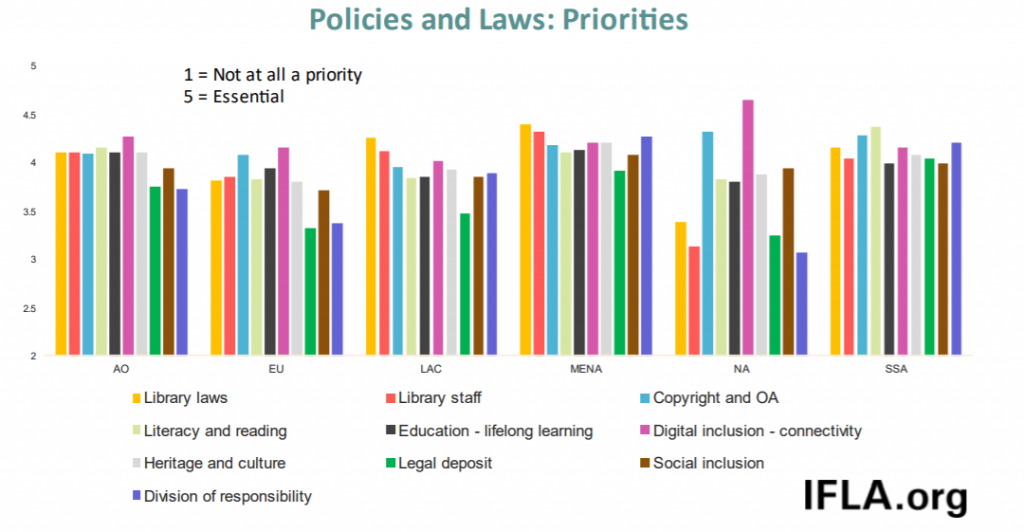
Does overall level of development correlate with the policy focus of library advocacy?: an initial thing that stands out from the results for all respondents (see p37 of the report), are the difference between richer regions, and those with a higher share of developing states.

Regional Advocacy Priorities Survey - level of priority of different policy areas by region (all respondents)

The three regions with generally higher incomes (North America, Europe, and Asia-Oceania, or at least East Asia and the Pacific) placed digital inclusion first on their list of priorities. This makes sense, in the light of an increasing focus on digital inclusion as a key for delivering wider policy goals, such as combatting inequalities.

Indeed, as these countries move to do more and more using digital tools (education, health, eGovernment), the need to find solutions to engage people who are unconnected grows (as the pandemic has illustrated). In addition, with many of these countries also risking losing some lower skilled jobs to foreign competition, the need to get more people into higher-skilled, digital work grows.

Engagement in such programmes can of course be associated with greater funding and support for libraries.

The two ‘middling’ regions – Latin America and the Caribbean and the Middle East and North Africa focus rather on library laws, policies and staff. This may reflect a need to ensure that libraries are able to fulfil more fundamental roles, and concern about funding in general. Indeed, governments in these region may face budgetary pressures that can lead them to under-fund libraries.

In this situation, it makes sense to focus first of all on how to ensure that libraries have a strong starting point, and then only later look to branch out to other policy areas where there may be possibilities to secure funding that complements core budgets.

Finally, Sub-Saharan Africa places literacy and reading first. With almost 40% of the population counted as illiterate, it is logical that libraries would see this as a key area of focus, not least given that a more literate population potentially also of course increases demand for and interest in libraries. At the same time, literacy and reading policies can serve to increase the profile of libraries, and provide them with the funding needed to operate.

The size of associations may be linked to different areas of focus: the study made sure to ask respondents whether they were answering on behalf of associations, institutions or just themselves, and what size of association or institution they represented.

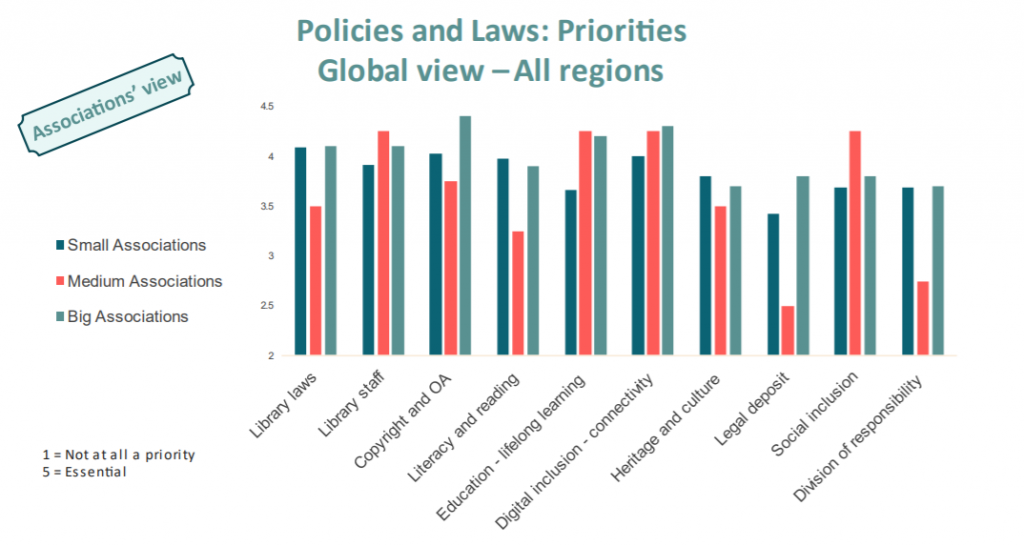
Regional Advocacy Priorities Survey - level of priority of different policy areas bysize of associationThe logic here was in line with the third reflection above – do you have the capacity to make a difference. Smaller, general associations could be less focused on more ‘technical’ issues, and find it easier to engage more general efforts to ensure that libraries are properly supported.
The results do seem to vindicate this assumption to some extent. For smaller associations, the highest scoring policy area was library laws, which can be seen as a more general topic (or at least one where there may not be so much need to develop technical expertise), although this is followed by copyright and digital inclusion. Copyright tends to be a more technical area, while advocacy around digital inclusion can stretch from general calls for support to more technical elements, such as setting up programmes, engaging around internet regulation and beyond).

Meanwhile, larger associations themselves place copyright first, perhaps reflecting the fact that they are better placed to develop specific expertise. Digital inclusion comes next, and then education and lifelong learning. As above advocacy around digital inclusion can be both general and technical – the same arguably goes for education as well.

In particular in Europe (p49), the picture is clearer still – small associations focus on library laws and staffing most, while larger ones see copyright, digital inclusion, and education and lifelong learning as most essential.

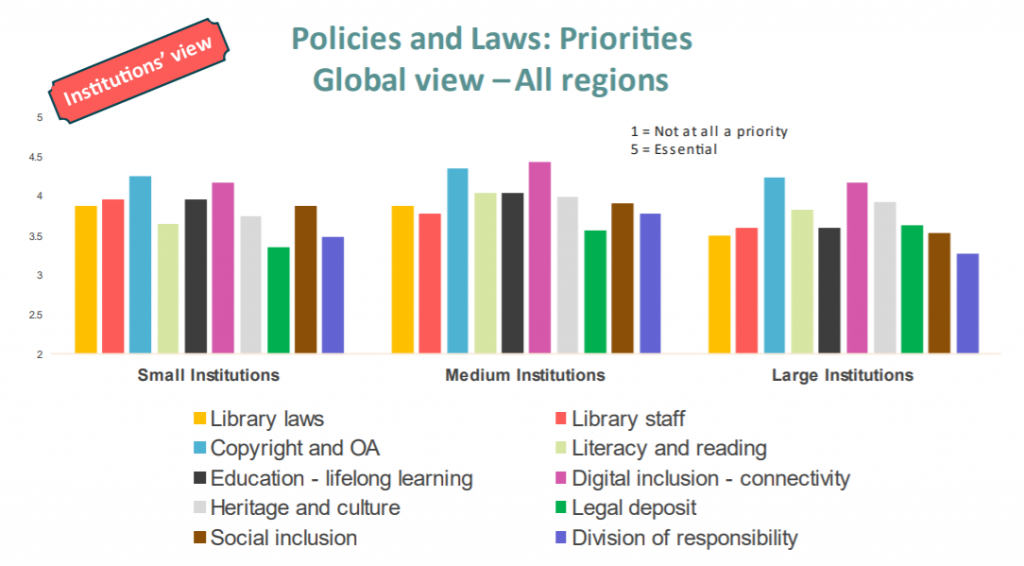
Institutions globally tend to focus on copyright and digital inclusion: looking at the global level across the issues that matter most for institutions (p52), regardless of size, copyright and open access, and digital inclusion come out on top. This makes sense, given the impact that policies in these areas can have on the daily operation of institutions, determining the programmes they can run, and what they can do with their collections.

Regional Advocacy Priorities Survey - level of priority of different policy areas by size of institutionLarger institutions place heritage and culture in third place, while medium-sized ones look at education and literacy, and smaller ones give a bigger role to library laws and staffing.
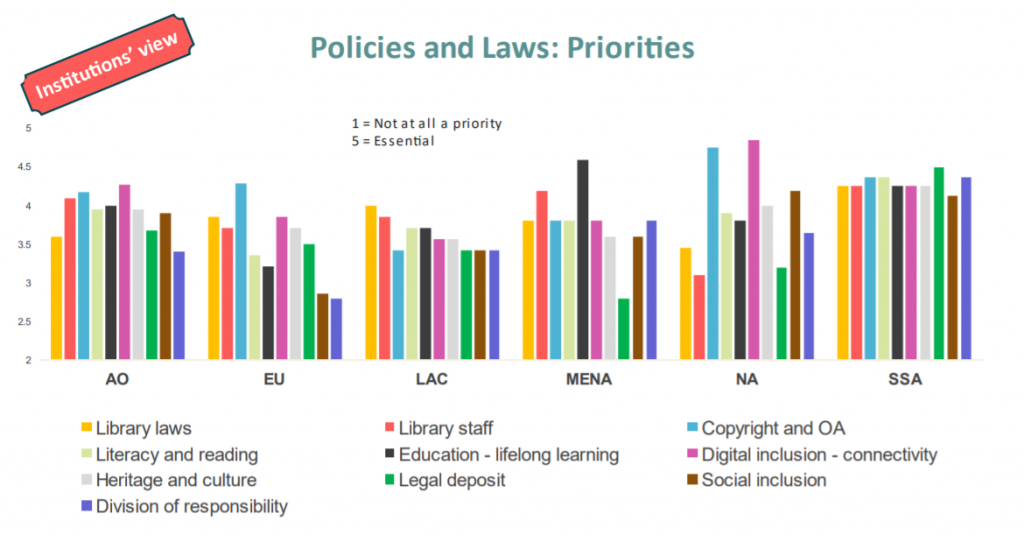
Regional Advocacy Priorities Survey - levels of priority of different policy areas for institutions, by regionBreaking this down regionally, a different picture emerges though. In Asia-Oceania, Europe and North America, it is again copyright and digital inclusion that come first. However in Sub-Saharan Africa, legal deposit is the priority (it is possible that a large share of respondents were national libraries for example), while in the Middle East and North Africa, education and lifelong learning comes top, followed by library staffing. This may reflect a priority on enabling school and academic libraries to thrive.

Finally, Latin America and the Caribbean institutions again see library laws and staffing as being most important, mirroring the results for all respondents in the region (set out above).

In terms of the issues that come third, interesting features include the high result for social inclusion among North American institutions, and for divisions of responsibility for libraries between levels of government in Sub-Saharan Africa. Literacy also features in the top four or five response in all regions except Europe.


Watch out next week for an analysis of the results about advocacy activities!