
Author Archives: library-policy

10 Things in Our Common Agenda

 Our Common Agenda is the United Nations’ Secretary-General’s response to the Declaration made by Member States on the UN’s 75th Anniversary in 2020. It marks an important step from defining priorities to defining concrete actions that can strengthen both the UN, and broader efforts to achieve its objectives.

It complements key existing texts, not least the 2030 Agenda and its 17 Sustainable Development Goals, both by highlighting areas where there is a particular need for action, and proposing ways of ensuring that countries, together, can promote development more effectively.

The Agenda both has implications for libraries, and creates opportunities to underline how our institutions and profession contribute to global policy goals. As decisions are taken, and more detailed plans are put in place, there should be chances to contribute experience and perspectives, and seek recognition for our work.

IFLA has produced a briefing on Our Common Agenda that sets out in more detail the ideas and issues it covers. In this blog, we highlight ten key points that are relevant to libraries. You can draw on these points in your own engagement with local UN offices, or even in your advocacy, given how much support the Agenda offers for many library priorities:

 1) Renewing the social contract: Our Common Agenda emphasises the idea of a new social contract – a set of shared rules and values that provide a basis for government, and for relations between members of society. This, the report argues, needs to be founded on respect for rights (and access to justice), and on solidarity between the more and less fortunate. Crucially, such a social contract should offer a basis for quality public services.

Arguably, libraries (public and national libraries in particular) are part of such a social contract, provided by governments in order to provide opportunities for all to realise their rights, and their potential.

2) Combatting the infodemic: The report makes addressing the infodemic – the spread of misinformation – into a major priority, not just as concerns health, but across the board. It calls for steps both to ensure stronger scientific inputs into policy making, but also a code of conduct on the integrity of public information. There is blunt language about politicians and others who spread false information, with the Secretary General calling for it to be clear that it is wrong to lie.

For libraries, a greater focus on quality information and use of evidence vindicates the role of our profession, and will hopefully create new opportunities to ensure that this is recognised by decision-makers.

3) Universal connectivity: the Secretary General has also made universal internet connectivity a key part of Our Common Agenda, recognising how vital this is both for access to public services, and to wider economic, social and cultural opportunities. Connecting schools represents a particular priority, with more effective digital taxation seen as a way of paying for it.

Libraries have a long-standing, recognised role in supporting public access to the internet, as a stepping stone towards private access, or as a complement to it. It will be important to work to ensure that libraries are included in initiatives taking place under this heading.

4) Protecting rights, online and off: the report reiterates how central respect for human rights should be to all that governments do, echoing the 2030 Agenda. In particular, it calls for a Global Digital Compact, in order to find solutions to the challenges created by the behaviour of private and public actors alike. In particular, it warns about the impact of internet shutdowns, as well as more targeted blocking or filtering of content.

The need for the internet to work in support of human rights is a long-standing priority for libraries, and we bring important insights and perspectives. Libraries can also be key players in more community-based initiatives around information and connectivity, such as community networks or local archives.  

5) Thinking to the future: a large segment of the report is dedicated to making the future more present in policy discussions taking place today. One way of doing this is through intensifying work to draw on evidence and expert viewpoints in order to identify what the years to come could look like. In addition to doing this more at the UN itself, Our Common Agenda also advocates for boosting listening exercises, as well as those focused on envisioning the future.

Libraries are not only crucial players in ensuring that decision-makers have the information needed to think about the future, but can be important venues for involving communities in collective reflection. In many cases, public libraries already fulfil this function, giving an opportunity to share good practices and spread them further.

 6) Literacy matters: a further step in order better to integrate the future into present planning is by focusing on children, and giving everyone a better start in life. A key element of this is universal basic literacy, with it clear that many schools still don’t have the resources needed to provide this, even if children are able to attend. The answer will need to be a new drive to deliver skills, including through better focusing of aid budgets.

Globally, libraries have a key role in promoting literacy, both within schools and wider communities, that is often recognised in national literacy and reading strategies. It will be important now both to ensure that this is reflected at the global level, and to see how we can increase the impact of libraries’ work in this area.

7) A universal entitlement to lifelong learning: Our Common Agenda’s emphasis on education is not limited to children, but also recognises the situation and needs of adults faced with a world and employment market for which their previous education and experience may not have prepared them. Yet lifelong learning is too often under-supported compared with other policy areas – this needs to be corrected if everyone is to be able to play their part in sustainable development.

Libraries are both providers of, and portals to lifelong learning opportunities. We have a strong interest then both in promoting the idea of a universal entitlement as a goal, and contributing to efforts to define how it is delivered.  

 8) A more networked multilateralism: Our Common Agenda underlines that for success in delivering the goals of the United Nations, not least the Sustainable Development Goals, a full range of actors needs to be involved, including business, academics and civil society. Crucially, development cannot just be a top-down thing, but needs to mobilise different strengths and capabilities.

Beyond the work of library associations in engaging with discussions around implementation of the SDGs, this priority may support efforts to promote models of SDG delivery that mobilise libraries more effectively, drawing on their strengths in terms of collections, spaces and staff.

 9) Dedicated focal points for civil society: As part of the drive to ensure stronger participation of different stakeholders in delivering on policy goals, Our Common Agenda includes proposed steps to make it easier for civil society organisations to engage with UN agencies. A key one is the suggestion to name dedicated focal points who can organise opportunities to input, and make it easier to find out how to get involved.

For library associations, as civil society organisations, this development would be a helpful one, especially in more specialised or regional UN agencies. Once these are identified, it will be possible to focus advocacy more effectively, through understanding better what is possible.

10) The role of parliaments and local and regional governments: as part of its emphasis on the need to work with a wider range of stakeholders, the report highlights in particular the need to work more with Parliaments and regional governments, both of which have key roles, respectively, in designing and scrutinising policy, and in taking many of the actions needed to achieve development.

Libraries and research services have a particularly essential role in helping parliaments to do their jobs, while local and regional governments often have libraries under their direct responsibility, making them more aware of what our institutions can achieve. The focus on parliaments and local and regional governments offers new possibilities to demonstrate, and advocate for, the importance of libraries.
No, loss of access to information should not just be collateral damage: 10 years on from the SOPA-PIPA Internet blackout

Today marks 10 years since many major websites replaced their landing pages with black blocks or messages, in protest against efforts to pass laws in the United States that would have created dramatic new possibilities to block or otherwise damage websites accused of hosting copyright-infringing works.

The Stop Online Piracy Act and Protect Intellectual Property Acts were developed in response to fears that there were few ways to address piracy on websites outside of the United States. While domestic legislation (the Digital Millennium Copyright Act) did offer a means of calling for the removal of pirated content, the worry was that this was not doing the job.

To overcome this, the proposals focused on those aspects that could be more effectively controlled in the United States – the Domain Name System (DNS – which makes the links between the URLs we put in browser bars, and the series of numbers that takes you to content), search engines, advertisers and payment providers.

These tools were necessarily blunt – they could not focus on individual items of infringing content, but rather sites as a whole, regardless of how much legal content was there. Such sites would risk disappearing from search engine results, or simply not appearing when a user typed in the URL. Added to this was concern that meddling with the DNS could also create significant security questions.

In addition to this, the bills opened up the possibility not just for the US Attorney General to create a list of sites which would be subject to restrictions, with only vague definitions of which sites could be included. These rules would have applied to all sites, not even only the foreign-based sites which were the theoretical original target.

More worrying still, there would have been the possibility to seek court orders that would have prevented advertisers or payment providers from working with sites accused of infringement, without solid proof having been offered.

In short, while the bills may have led to the blocking of pirate sites or pirated content, it would likely have caused huge collateral damage, including to sites which in fact contain no pirated content at all. To turn this around, it would have had a huge impact on the possibilities open for people to create and share online, including, for example, repositories and digital libraries.

A post from the Electronic Frontier Foundation sets out what could have happened if the Bills had been passed, with sites hosting user-generated content slowly eliminated, and indeed only the best-funded sites ready to operate under the new rules.

Various events and activities are taking place around the world, for example organised by Creative Commons – take a look to find out more. But below are just a few lessons emerging from the events around PIPA and SOPA, as well as developments over the last ten years, which are relevant to libraries.

Access to information needs to be valued: a key problem with the PIPA and SOPA legislation was the failure to consider the negative impacts on access to information as a sufficiently serious problem to stop any earlier.

There are many claims shared about the value of the copyright industries, and assessments of the costs of piracy, but many fewer about the value of access to information itself. This is partly because it is far harder to calculate (without over-stating the accuracy of the value claims mentioned earlier), but also because it tends to be far more widely dispersed.

While there are calculations of the value of economic activities depending on fair use or other exceptions to copyright, these of course do not necessarily account for the broader benefits of access to learners, researchers, and indeed readers in general. More needs to be done to ensure that this access is given its due weight in decision-making.

Enforcement cannot ignore equilibrium or equitable process: PIPA and SOPA arguably represented a landmark in efforts to promote copyright enforcement, without regard to the costs of depriving people of access to information (as mentioned in the previous point), or indeed of whether there is any justification.

However, efforts to find new ways to enforce copyright law have continued, and alongside valid and proportionate approaches, there continue to be less discriminate ones. The creation of ‘watch lists’, based only on (untested) accusations made by individuals and companies, pressuring platforms into implementing imperfect upload filters, promoting the use of technological protection measures without consideration of whether they prevent legitimate uses – all represent efforts at enforcement without bothering to value access.

Such a disproportionate emphasis on enforcement, without respect for user rights, needs to be resisted, both in domestic policy, as well as in trade deals and international cooperation programmes.

Zero tolerance approaches have a chilling effect: by creating the possibility for sites to be ‘disappeared’ or otherwise penalised for hosting even only individual pieces of pirated content, SOPA and PIPA effectively promoted a zero-tolerance approach to copyright infringement.

While action in such situations may be justified in order to remove individual content, the risk of having entire websites taken down makes the cost of hosting infringing content, even inadvertently, so high as to dissuade many from even starting. Setting high fines or criminal penalties may have a similar impact.

This could be the case both for platforms used by libraries, as well as repositories run by libraries, where it is near to impossible to ensure that there is no infringing content at all there. Faced with this, the emergence of community-owned and run infrastructures risks being reversed and ended.

Decisions need to be global: there are two key reflections from the events around PIPA and SOPA. One is that it highlighted the general need for global internet governance, given that the tools available to individual countries are ill-suited to solving challenges associated with a global internet. The risk, in acting at the national level, is to splinter the internet between different jurisdictions (with standards often dictated by the biggest and richest players – arguably initially the United States, but now, Europe).

This, indeed, is why organisations like IFLA engage at the Internet Governance Forum and World Intellectual Property Organisation, as well as supporting regional engagement.

A connected concern is that the control of the US at the time over the Domain Name System meant that it had a unique possibility to interfere with a key part of the internet architecture. This, in turn, provides an argument for ensuring that this infrastructure is in global hands, not just that of any one player.


Of course, over the last ten years, more issues have emerged since then, including in particular the role of platforms, with business models which raise new questions, some of which may touch on copyright, but many of which belong more to the competition or anti-trust fields.

The size of platforms has meant that imposing rules on them risks becoming a proxy for addressing underlying problems, such as copyright infringement or hate-speech. Dislike and distrust of such platforms, in the light of their profits and practices, doubtless also helps in these efforts.  However, while certainly there can be no justification for business models based on promoting illegal content, this should not be a substitute for efforts to bring criminals to justice. There is also plenty else going on, around privacy, disinformation, and much more.

Nonetheless, the points set out all represent issues that were raised in the debates about SOPA and PIPA, ten years ago, which are arguably still with us.

The 10-Minute International Librarian #81: Discover your local Wikimedia chapter

A couple of days ago, the first #1Lib1Ref campaign of 2022 launched, encouraging librarians from around the world to add references to Wikipedia.

In this way, librarians help build and extend Wikipedia as a free and open source of reliable information for all able to access it.

Yet as already set out in our blog, people who are interested in going further than adding a reference have lots of options also!

You can create new articles – for example to provide information about underrepresented people or themes, contribute to projects such as WikiData – or even plan events.

But of course, the work of Wikimedia in promoting access to information takes place around the year, and you can get involved!

So for our 81st 10-Minute International Librarian exercise, discover your local Wikimedia chapter.

There are 38 chapters for different countries around the world, operating as independent organisations but aligned around the goals of the movement as a whole.

There are also many more user groups, many of which bring together Wikimedians in countries which do not yet have a chapter.

These groups get involved in projects and networks, such as the network for Galleries, Libraries, Archives and Museums (GLAMs), or WikiData as mentioned above.

In some cases, they are also in advocating for policy changes that favour access to knowledge, taking positions which are often strongly aligned with the interests and focus of libraries. As such, they can be powerful advocacy partners too!

Use the links above to find out what is going on in your country, and even get in touch!

Good luck!


This idea relates to the IFLA Strategy! Key Initiative 1.2: Build a strong presence in international organizations and meetings as a valued partner

As we publish more ideas, you will be able to view these using the #10MinuteInternationalLibrarian tag on this blog, and of course on IFLA’s Ideas Store! Do also share your ideas in the com

The 10-Minute International Librarian #80: Make a contact count

Librarianship is all about helping people to achieve their goals through meaningful access to information and knowledge.

It of course includes a wide range of roles, from the front desk or out among the stacks, to the conservation lab or the cataloguing room.

Nonetheless, in each case, it is through meeting people – in person on online, through direct conversation or through a user’s interaction with a service provided – that access is provided and supported.

Clearly, different members of the field will therefore be in contact with a greater or smaller number of users, in person or online, and they will interact in different ways.

The common thread, though, is the importance of ensuring that interactions are effective, and provide the support the user needs.

So for our 80th 10-Minute International Librarian exercise, make a contact count.

Think about how you approach a contact with someone (or design a service with which someone will interact). Is it having the effect you want on the user?

Is there anything that might be holding you – or them – back?

Are there alternative approaches that you could use, both in terms of what you are saying (or doing) and how?

Don’t forget that a satisfied user is also potentially an advocate for your services!

Let us know about how you have managed to make a contact count in the comments below.

Good luck!


This idea relates to the IFLA Strategy! Key Initiative 2.3: Develop standards, guidelines, and other materials that foster best professional practice

As we publish more ideas, you will be able to view these using the #10MinuteInternationalLibrarian tag on this blog, and of course on IFLA’s Ideas Store! Do also share your ideas in the com

#1Lib1Ref 2022: Your chance to broaden access to verifiable information!

The coming of the internet has, at least for those who are adequately connected, allowed billions of people to enjoy an extraordinary increase in the volume of information available to them.

This represents major progress towards libraries’ goal of guaranteeing meaningful access to information to all, but it is far from being the same thing as achieving this goal fully.

For one, there are still billions of people who have no access to the internet at all. Furthermore, those counted in the statistics as being online often only have slow or limited connections, and only have access to a restricted range of content in their own language, or covering the issues that matter for them.

Crucially, quantity and quality of information are also not the same thing. There is a big difference between a random claim, and an assertion backed up by references to other works which can be checked, controlled, and shown to be accurate and reliable.

While library users – especially those affiliated with national or academic libraries – may have possibilities to access high quality research collections, this may not always be easy as it should be.

Copyright laws may mean that it is only possible to consult works in person (something that may of course also be impossible, for reasons of COVID or disability for example), or simply local libraries may not have the resources for a major collection. Paywalled information sources are, by definition, only available to those people and institutions with the resources to pay.

The easiest option is therefore just to turn to the internet.

This is why, in order to achieve libraries’ mission of meaningful access to information, it is so important that people can benefit from a free and reliable – verifiable – source of information online. This is what Wikipedia seeks to provide.

Crucially, Wikipedia does not replace the work of libraries, but rather complements it. And in turn, librarians, libraries and their collections can have a key role in turn in delivering on Wikipedia’s potential as a comprehensive, accessible, and verifiable source of information.

This is what #1Lib1Ref is all about, with its call on librarians around the world to add just one reference to a Wikipedia article, in order to improve its verifiability!

#1Lib1Ref is taking place for the 7th year on 15 January – 5 February, and then again on 15 May – 5 June, with the first period coinciding with Wikipedia’s 21st birthday.

The Wikimedia Library, which organises the event, sets out some great ways to get involved, with translations in 46 different languages! Take a look at the blog they have prepared for more.

Key opportunities involve:

  • Add a reference: look at the instructions on how to find an article that requires citations or improved sources, including using the CitationHunt tool which is now available in 7 more languages!
  • Create a new article: for example, in order to help diversify the information available on Wikipedia, to celebrate unique people or things covered in your collections, or to share your expertise – find out more here
  • Organise an event so that others can add references with you!: take a look at the guidance on how to set something up (it doesn’t just need to be during the period of #1Lib1Ref!)
  • Create WikiData items for works on WikiSource: help strengthen Wikipedia by creating WikiData items for works already mentioned in your local WikiSource
  • Share!: as part of the guidance for adding a reference, there are instructions on how highlight that it is a #1Lib1Ref edit. If you are organising an event, you can register it on the Wikimedia platform (you’ll need to create an account first). And of course, just use the hashtag #1Lib1Ref to talk about your participation on social media!

Good luck!

The 10-Minute International Librarian #79: Think about how to green your library

In November of last year, governments made new commitments to reducing emissions in order to limit climate change.

While many have suggested that not enough was promised, it will be worse still if even this is not delivered.

Crucially, mitigating and adapting to climate change requires work at all levels.

It is about changing practices and behaviours, not just policies.

Amongst our New Year’s Resolutions, it is therefore important to think about how we can be more sustainable, and use the place of libraries within communities to do the same!

So for our 79th 10-Minute International Librarian exercise, think about how to green your library.

You could think about any or all of your buildings, your operations, your collections and your programming.

Are there renovations that could make a difference? Could you use less energy? Could you share more works explaining the issues around climate change and greener living? Could you work with other organisations to promote sustainability literacy?

All have the potential to have either a direct impact on reducing emissions, to inspire others in your community to do the same, or both!

You could take a look at the Green Library Checklist, prepared by what is now the Environment, Sustainability and Libraries Section.

Or you could seek ideas from the work of other libraries, as set out for example in our blog, or in our article summarising papers submitted to our World Library and Information Congress.

Let us know what ideas you have in the comments box below.

Good luck!


This idea relates to the IFLA Strategy! Key Initiative 2.3: Develop standards, guidelines, and other materials that foster best professional practice

As we publish more ideas, you will be able to view these using the #10MinuteInternationalLibrarian tag on this blog, and of course on IFLA’s Ideas Store! Do also share your ideas in the com


Happy Public Domain Day: three ways of looking at why it matters

1 January of each year is Public Domain Day, the day that a new set of historical works enter the public domain, opening up wide new possibilities for access and use.

The reason for this all happening on 1 January is because many copyright laws provide protection for a set number of years (at minimum 50, often more) after the end of the year in which the creator died.

This protection gives an exclusive right to control things like reproduction, distribution, translation, performance, or communicating to the public online. These tend to be known as ‘economic’ rights; meanwhile ‘moral’ rights (such as to be named alongside a work) do not have a limit in time.

As such, in countries with protection lasting for life plus 50 years, it means that the works of creators who died in 1971 are now far more freely available. In countries with protection lasting for life plus 70 years, it is the works of creators who died in 1951. Some other countries have more complex rules – you can find out more on the relevant Wikipedia page.

While of course it may seem odd to be celebrating the fact that a certain time has passed since a death, in reality, entry into the public domain brings many benefits, including of course to creators insofar as their original motivation for creating will have been to share their ideas with the world.

Nonetheless, there is an unfortunate trend towards trying to extend copyright terms, often as part of trade deals, limiting when new books, songs and images enter into the public domain. There are also efforts in some countries to charge fees for use of public domain works, or at least direct reproductions of them.

This blog sets out three connected angles to the argument for celebrating Public Domain Day.


Library collections liberated

Public Domain Day is an important moment for libraries holding works whose economic copyright protection comes to an end.

To survive until this point, relevant books, documents, recordings, images, and other materials will likely have benefitted from significant investment in preservation and conservation.

And while they may well have been open for limited access and use already, entry into the public domain is what creates many new opportunities to ensure an impact in terms of access to and use of works.

For example, new possibilities emerge to make digital copies of works which can be made freely available online, to use copies in class or even research, in person or remotely without payment, and library users have much wider options to play with or remix works.

In effect, it allows for a much deeper, richer engagement between library users and the heritage and ideas of the past, going beyond the simple ‘consumption’ of works.

Clearly, in providing access, it remains important to remember that copyright is not the only factor at play in deciding whether to provide access to works or not. Factors such as the interests and preferences of indigenous groups, privacy and beyond will also come into play!


Building the knowledge commons

Connected to the previous point is about what entry into the public domain means for the ability of libraries to make an impact, a second argument focuses on how this contributes to the building of the Knowledge Commons.

This is a term that has existed for a while already, building on previous ideas of ‘commons’ – things and resources that are owned by, and available, to all, contributing to individual and collective wellbeing.

It receives particular attention in the recent UNESCO Futures of Education report, which refers to it as ‘the collective knowledge resources of humanity that have been accumulated over generations and are continuously transforming’.

The UNESCO report underlines how important it is for young people, as they learn, to be able not only to access this commons, but also to contribute to it. It cites this as a step away from rote-learning, with young people simply forced to accept the status quo.

Clearly, possibilities for access, analysis, and re-use are at their strongest when works are in the public domain! In effect, each year on 1 January, we can mark the moment that the knowledge commons grows stronger, offering new possibilities for learning, sharing and creativity.


Maximising welfare

Of course, a key argument for copyright in the first place is that it is by keeping works out of the public domain, and so crating artificial scarcity, that it is possible to generate the income necessary to cover the costs of creation.

While of course it is unsurprising that actors depending on a business model built on the exploitation of copyright will tend to paint this as the only possible means of supporting creativity, it is also true that no other dominant single dominant model has yet emerged to replace it, at least in the creative industries. Clearly we do have an interest in ensuring that those who have a talent for developing and expressing new ideas should have a means of earning a living by doing it.

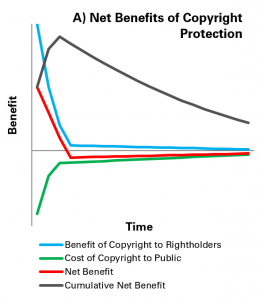
The question then is where to find the balance. One way of thinking about this is by looking at costs and benefits over time.

Graph suggesting that the cumulative net benefits of copyright peak at a certiain time, and then fall awayGraph A offers a way of reflecting on this, for a complete set of works published in a given year. The horizontal axis represents time after publication, and the vertical, benefits/costs. Figures are not included, as the graph provides a model, rather than a set calculation, and because it can be hard to put a clear figure on monetary costs or benefits to some things.
The blue line represents the benefit to rightholders from copyright – in effect what is earned from sales and other licensing revenue. This starts high, but rapidly falls, with a ‘long tail’. This reflects the fact that most copyrighted works have a very limited commercial life, and just a few will continue to make money for a long time while others are effectively forgotten or worse, lost.

The green line represents the costs to the public – the impact of people who would benefit from having access to the full set of works not having it, for example to support education, research or wellbeing. Clearly some people can buy works, but it’s assumed that they have paid what they felt the work was worth, and so there is no net cost or benefit to them.

The red line therefore represents the net benefit of copyright to society as a whole – i.e. the benefit to the rightholder minus the cost to the public.

At first, this is positive. However, after a time, the cost to the public of not being able to access works becomes greater than sales or licensing fees for rightholders. At this point, the red line drops below the axis, representing a net loss to society as a whole.

Finally, the dark grey line represents the cumulative net benefit over time. At first, this is growing. However, once the costs of copyright grow higher than the benefits, this line starts falling, representing a falling total benefit to society over time.

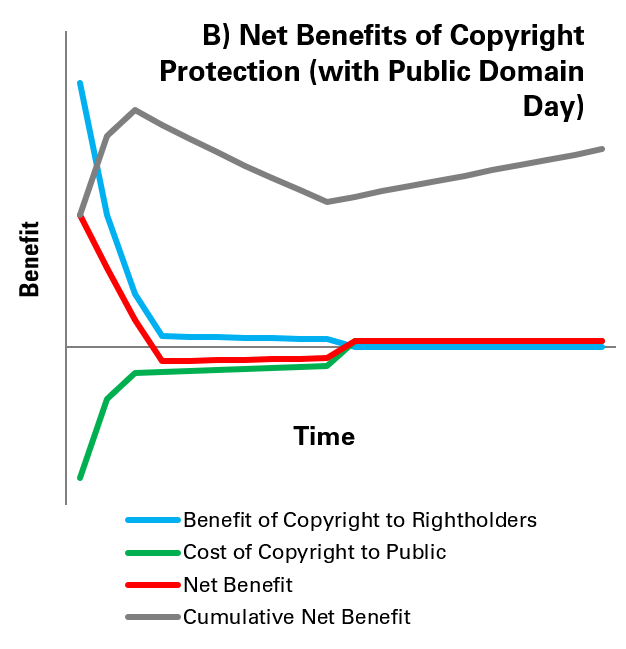
Graph indicating that the net cumulative benefits of copyright peak and start falling at some point. However, by having a date of entry into the public domain, it is possible to halt this fall in net benefitsEntry into the public domain provides a response to this situation of a falling cumulative net benefit over time. Graph B illustrates this. At halfway along the horizontal axis, works from a given year enter the public domain, and so benefits to rightholders from sales and licensing fees (blue line), which were already low and falling, are reduced to zero. However, the costs to the public (green line) also disappear, and in fact turn into benefits as people are able to use and enjoy works freely.

The impact of this is that there is now a net benefit to society again (red line), meaning that cumulative net benefits (grey line) also start to rise again, reversing the downward trend previously seen.

Of course, the specific shape of some of these lines can be discussed (and of course, date of entry into the public domain most often depends on when the author dies), but in effect, this provides a more economic model for understanding why the public domain matters for the societies that libraries serve.

In particular, assuming that the term of copyright protection is already longer than the point at which the costs of copyright start to outweigh the benefits, then any extension of terms would certainly lead to further net losses to society.


In summary, public domain day is something to be celebrated, both for libraries themselves, and for the societies we serve. It creates new possibilities for libraries to get the best out of their collections, it significantly expands the knowledge commons, and it corrects a situation of falling net benefits to society.

Happy Public Domain Day!


Interested in finding out more? Key organisations associated with the public domain are holding a celebration on 20 January, with a particular emphasis on the sound recordings now becoming available – find out more here!