Tag Archives: advocacy

Reflexiones tras el webinar con FEBAB: la IFLA ante la OMPI y perspectivas ante la Unión Europea

[Versión en inglés disponible aquí]

Hace unos días participé en un webinar organizado por comisión brasilera de derechos de autor y acceso abierto FEBAB, la Federação Brasileira de Associações de Bibliotecários. Es el primero de cuatro webinars, una serie que busca acercar al sector bibliotecario al ámbito del derecho de autor en Brasil y a nivel internacional. Fue moderado por Sueli Mara Ferreira, de la Universidad de Sao Paulo, y contó con la colaboración de Anderson de Santana, también de la Universidad de Sao Paulo, y de Walter Couto, doctorando en ciencias de la información en la misma institución.

Centré la presentación alrededor de la actividad de la IFLA ante la Organización Mundial de la Propiedad Intelectual (OMPI) y de los cambios en materia de derechos de autor que están teniendo lugar en la Unión Europea. La OMPI es una agencia especializada de las naciones unidas a cargo de patentes, marcas, derechos de aturo y otros temas relacionados. La IFLA está representada desde hace años en su comité de derechos de autor, el SCCR (siglas dadas por su nombre en inglés, el Standing Committee on Copyright and Related Rights), como organización no gubernamental. En este foro, la IFLA defiende la necesidad de avanzar hacia un instrumento internacional que garantice excepciones y limitaciones al derecho de autor adecuadas par el funcionamiento de bibliotecas, archivos y museos.

No estoy segura de si el webinar fue interesante para los participantes (¡aunque espero que sí!) pero ciertamente lo fue para mí. Hubo diversas preguntas muy interesantes que invitan a la reflexión. Las preguntas muestran la clara preocupación del sector bibliotecario por la falta de adaptación del derecho de autor al trabajo de las bibliotecas. No se trata de pequeñeces, y ya ni siquiera de adaptar la ley al mundo digital. Se trata de aspectos fundamentales como la preservación o el préstamo público. Mientras que determinados países cuentan con excepciones y limitaciones al derecho de autor que autorizan expresamente este tipo de usos de interés público, la ley de derecho de autor en Brasil no cuenta con ninguna excepción ni limitación al derecho de autor.

Esto deja a los bibliotecarios en un estado de indefensión y preocupación constante sobre los usos que se hace de las obras en bibliotecas. Aún y los muchos esfuerzos que hacen los bibliotecarios para explicar al usuario final cómo utilizar las obras, es incontrolable. Sin ninguna garantía, las bibliotecas temen ser responsables de malos usos por falta de información, especialmente dado que se puede llegar a discutir que todo uso lo puede ser, incluso siendo de interés público, sin una ley de propiedad intelectual adaptada que lo ampare.

Los avances ante la organización mundial de la propiedad intelectual dan cierta esperanza al sector bibliotecario en los países en los que los cambios no están teniendo lugar por falta de iniciativa a nivel nacional. El tratado de Marrakech y su rapidez en ser ratificado o adherido por los estados miembros de las naciones unidas es un muy buen ejemplo del efecto que tienen este tipo de instrumentos. Estos estados han debido hacer cambios a su legislación nacional que de no ser por el tratado probablemente no habrían tenido lugar. El mismo Director General de la OMPI Francis Gurry señaló en la última asamblea general de la OMPI que el tratado de Marrakech se estaba moviendo a una rapidez que excedía la de cualquier otro tratado de la organización.

A continuación intento responder a dos preguntas, en mi opinión muy relevantes, que planteó Walter Eller do Couto durante el webinar:

1. El Convenio de Berna establece el principio del “trato nacional”, según el cual los países deben aplicar su legislación a los extranjeros. Esto puede dificultar el trabajo del bibliotecario, que necesita conocer el derecho de autor de varios países. ¿Es posible vislumbrar algo parecido al Tratado de Marrakech en relación a las otras limitaciones excepciones para facilitar este tipo de actividades transfronterizas?

La IFLA ha venido insistiendo en la necesidad de un tal tratado precisamente para hacer frente a la difícil aplicación del derecho de autor de forma transfronteriza si no existen unos estándares mínimos a través de fronteras (perdiéndose muchas posibilidades de colaboración e intercambio cultural), y a la vez para forzar el cambio legislativo en países que de forma individual no están tomando la iniciativa, aunque sea posible bajo el Convenio de Berna.

Sin embargo, en el seno de la OMPI, determinados países se oponen (principalmente la Unión Europea, lo cual es sorprendente dado que ya cuentan con excepciones y limitaciones al derecho de autor para instituciones del patrimonio cultural e incluso las están adaptando al mundo digital). Alegan que los países ya tienen libertad para legislar, y no están a favor de un instrumento internacional con efecto vinculante.

El comité de derechos de autor de la OMPI ha definido un plan de acción, que tras varias reuniones regionales y un ejercicio de intercambio de ideas, finaliza con una conferencia internacional. Ésta tiene como objetivo “tomar en consideración los frenos y contrapesos de las distintas soluciones internacionales destinadas a hacer frente a los desafíos reconocidos, por ejemplo, arreglos contractuales, recomendaciones conjuntas, tratados u otras formas, según corresponda”.

2. Hablando de asumir riesgos, la historia del derecho de autor tiene casos de bibliotecas que desafían la legislación, asumiendo riesgos para poder hacer su trabajo. Un ejemplo es el nacimiento de la Sección 108 en la legislación estadounidense, que surgió tras una disputa judicial entre una editorial y una biblioteca. ¿Cómo es el posicionamiento de la IFLA en relación a conductas de bibliotecas que desean asumir riesgos incluso sin salvaguardias legales?

La IFLA no tiene posición oficial al respecto, y es claramente una situación muy delicada. Sin embargo, recientemente la IFLA adoptó una posición sobre alfabetización y educación en materia de derecho de autor. Esta declaración insiste en la necesidad para el sector bibliotecario de tener un mínimo de conocimientos sobre el derecho de autor y hace una serie de recomendaciones. No resuelve el tema que plantea la pregunta, pero reconoce que la falta de conocimientos en este ámbito, y sobre todo la falta de legislación adaptada, puede ser muy problemático. Por otro lado, anima a más conocimiento como un primer paso para que el sector entienda de forma global la necesidad de cambio legislativo, y lo impulse.

Los bibliotecarios hacen esfuerzos para asegurar el cumplimiento de la ley, pero en algunas ocasiones, ésta está tan lejos de la misión principal de las bibliotecas de preservar y facilitar acceso al conocimiento, que se plantean situaciones imposibles de resolver a no ser que los bibliotecarios actúen sin tener la completa seguridad de estar dentro de la legalidad. Hay claramente una necesidad urgente de cambios a nivel legislativo.

Para más información, el webinar completo está disponible en la página YouTube de FEBAB.
Thoughts after the FEBAB webinar: IFLA’s work at WIPO and current perspectives in the European copyright reform

[Spanish version available here]

A few days ago, I took part in a webinar organised by the copyright and open access committee of FEBAB, the Brazilian Federation of Library Associations. It was the first of four webinars that seek to inform the library field about copyright in Brazil and at the international level. It was moderated by Sueli Mara Ferreira, from the University of Sao Paulo, and was co-hosted by Anderson de Santana and Walter Couto, from the same institution.

My presentation focused on IFLA’s advocacy work at the World Intellectual Property Organisation (WIPO) and on the European copyright reform. WIPO is a United Nations specialised agency in charge of patents, trademarks, copyright and other related matters. Since several years, IFLA has been represented in this institution’s copyright committee, the Standing Committee on Copyright and Related Rights (SCCR), a forum in which IFLA defends the need to advance towards an international instrument that guarantees exceptions and limitations to copyright suited to the functioning of libraries, archives and museums.

I am not entirely sure of whether the webinar was helpful to participants (although hopefully it was!) but it certainly was to me. There were many interesting questions that referred to key challenges for the library profession around copyright. These questions show the struggle that librarians face when dealing with outdated copyright laws in their work. And by outdated I do not only mean that they are not adapted to the digital world: in some cases, they simply do not allow for fundamental activities such as preservation or lending. While some countries have exceptions and limitations to copyright that expressly allow some public interest activities, copyright in Brazil, for instance, has no exception at all.

This puts librarians in a very difficult position, having to constantly worry about copyright law infringement. Also, even if librarians are careful in guiding the user in how to use works, they cannot control all their actions. With no guarantee, librarians are worried that they might be considered guilty of infringements by users, especially under a legislative framework where any use, even when it is part of public interest activities, can be considered an infringement.

Progress at WIPO gives hope to the sector in countries in which the necessary change has not taken place. The Marrakesh Treaty and its numerous ratifications and accessions by United Nations member states is a very good example of the impact of an international instrument. Changes are happening at the national level that wouldn’t otherwise have taken place.

Two particular questions raised at the webinar are worth exploring in this blog:

  1. The Bern convention establishes the principle of “national treatment”, according to which countries need to apply its own legislation to third party nationals. This may make librarians’ work difficult, as they need to figure out what copyright laws say elsewhere when working across borders. Would it be possible to adopt something similar to the Marrakesh Treaty regarding other exceptions and limitations that can facilitate cross-border work?

IFLA has been advocating for the need of an international instrument, precisely to face the difficulty in applying copyright law across borders where no minimum standards exist. This would also encourage legislative change at the national level.

However, several WIPO member states oppose such an instrument (mainly the European Union, which is surprising given the fact that it already has exceptions and limitations to copyright for cultural heritage institutions and that it is now adopting them to the digital world).

Given the lack of consensus, the SCCR has defined an action plan to advance discussions on the topic, which among other things, establishes several regional meetings, a brainstorming exercise, and finalizes with an international conference whose goal is “to consider the opportunities and challenges provided by various international solutions including soft law, contractual/licensing and normative approaches, as appropriate”.

  1. In the history of copyright, there have been cases in which libraries challenge legislation and assume risks in order to do their work. An example is at the origin of the creation of Section 108 in US legislation, which was created after a legal dispute among a publishing house and a library. What is IFLA’s position regarding libraries wishing to take risks to do their jobs even with no adequate legal guarantees?

IFLA has no official position on that matter, which is clearly a delicate situation. However, IFLA recently adopted a Statement on Copyright Education and Copyright Literacy. The document insists on the need for librarians to have a minimum knowledge of copyright and also makes a series of recommendations. While it does not solve the question, it recognises that the lack of an adequate legal framework in this area can be very problematic. It also encourages more knowledge as a first step for the library field in order to understand the need for change in copyright law, and to advocate for it.

Librarians make efforts to ensure that copyright law is respected, but in some occasions the legal framework is so far away from their public interest mission that they are put in difficult situations. There is clearly an urgent need for change in copyright legislation.

For more information, check the full webinar (in Spanish and Portuguese) on FEBAB’s webpage.


Words of the SDGs: Sustainability

As highlighted in our previous blogs about #WordsOfTheSDGs, the vocabulary that marks discussion on the UN’s 2030 Agenda if often obscure or jargonistic.

A shared understanding of what these words mean does of course help governments and others communicate with each other in the corridors and meeting rooms of the United Nations. A key task for libraries, in getting into advocacy around the Sustainable Development Goals, is to ‘join the club’, to become familiar with these terms, and use them.

To end this series of blogs, we will tackle ‘Sustainability’. This is perhaps one of the most central ideas behind the 2030 Agenda, not least as it appears, more or less, in the name of the SDGs. It is also familiar from daily life within own institutions – ts a particular activity sustainable? A strategy?

Sustainability

The word is particularly charged in the UN context. Already in 1992 at the time of the original Rio Earth Summit, the Brundtland Report opened a new era of thinking about development at the global level.

This thinking took lessons not only from the environmental movement, but also new ways of thinking about economic and social policies. In bringing these elements together, it called for a way of living today that would not risk or limit the ability of future generations to do the same.

Within this, the idea of three ‘pillars’ of sustainable development remain. These are environmental (are we leaving enough resources – from natural resources to things like air or a favourable climate – for those to come), economic (are we putting tomorrow’s economic wellbeing at risk?) and social (are conditions within society sufficient to ensure cohesion).

It is worth noting some debate about the difference between sustainable development and sustainability. Some argue that true sustainability may need to come at the cost of development (i.e. growth). Others (including this blog) take ‘development’ in this context to mean the broad set of policies and actions taken by governments and others which can impact sustainability.

So how does this apply in the library context? This blog highlights how libraries contribute to sustainability in its three dimensions.

Libraries and Economic Development

There are many concerns today about whether we can expect continued growth in income per person, especially with a rising population, or even if this is desirable.

Yet for countries where many people are still in poverty, the idea of giving up on growth – and what this makes possible in terms of accessing healthcare or education – is absurd.

Fortunately, the key underlying factor behind growth is productivity. How can we get more out of the resources (both human labour, and physical resources) that we already have? This increases thanks to finding new and more efficient ways of doing things. In short, innovation.

This is an area where libraries have something to add. Ready access to research and other materials, as provided by libraries, can stimulate and support research. New efforts to connect collections, as well as new techniques for making use of them, promises a lot for science.

The result is just the new products, processes and ways of doing things that allow people to produce and earn more. Without libraries, research is weaker. As such, sustainable economic development relies extensively on libraries.

Libraries and Social Development

Social development is a question of maintaining cohesion – this is key to promoting cooperation and wellbeing.

Societies which are highly unequal risk losing this, with those at the wrong end of the scale resenting those at the other. Similarly, societies which are intolerant risk creating tensions, and missing out on opportunities to renew and refresh.

Equality (in provision of service) and equity (in the results achieved) both help provide for social development. They ensure that everyone has the possibility to move within society, and to feel confident in building networks and contacts. They do not have to feel trapped.

Libraries help with this too, and in one of the most powerful ways – through providing access to information. This opens up possibilities to learn and earn, as well as take better decisions about issues such as health or agriculture. When there is an information gap, there is a risk of a development gap.

Not only are libraries, in most places, a free service, available for all in an area, but they also have specific mandates to reach out to those hardest to help. In this way, no-one need feel excluded, or without the possibility to learn and move ahead, regardless of the initial challenges they may have faced.

Libraries and Environmental Development

Unlike many other sectors, libraries are fortunately not classed among major producers of CO2 or other gases. However, they have a dual role in promoting environmental sustainability.

The first has already been mentioned – the role of libraries in supporting research. As we look to help farmers, manufacturers, transporters and others find new ways of doing things, this will help significantly.

But libraries can also, crucially, act as exemplars. IFLA’s Green Library Award, coordinated by the IFLA Special Interest Group on Environment, Sustainability and Libraries, highlights great examples. Even recently, the nomination of an environmentalist in residence at Toronto Public Libraries highlighted how much attention this is getting internally. We need only to share this role externally.

The same Group is planning further work on education on sustainability at the 2018 World Library and Information Congress too – come along to hear more if you are interested.

Sustainability is therefore a useful term to bring up when advocating for libraries, both in terms of how libraries deliver it, but also how they can become exemplars and teachers for others on the subject.

Happy advocating!


Words of the SDGs: Leave No One Behind

Continuing our series of blogs looking at the words (and phrases) which mark the United Nations’ 2030 Agenda, today’s edition looks at ‘leaving no one behind’.

Perhaps unlike some of our previous ‘words’ (intersectionality, resilience, participation), this feels like a refreshing step away from jargon. This has also made it particularly powerful as a term, although, as this blog will explore, it is not the subject of complete consensus.

As with our other ‘words’, it also has an impact on how libraries work with the Sustainable Development Goals, and can become a useful part of library advocacy in this area.

Leave No One Behind

A Vital Shift: From Focusing on the Poorest to Leaving No One Behind

At the heart of the Millennium Development Goals – the predecessor to the 2030 Agenda and its Sustainable Development Goals – was the notion that economic and social progress around the world had failed to make a difference to the poorest. Too many lacked education, sanitation, healthcare, or adequate income. The eight Millennium Development Goals (MDGs) therefore focused on the worst-off.

The measures of progress chosen focused on this group, but used global averages. As a result, thanks to rapid growth in countries like China, leading to falls in absolute poverty and improvements in services, it was possible to declare success on a number of the Goals.

This did not mean, however, that all countries or groups saw progress. Many of the most vulnerable – the targets of the MDGs – saw little improvement, or even went backwards.

The 2030 Agenda acknowledged this point head on by asserting that not only were the SDGs an indivisible whole (all had to be achieved, together), but that they could only be achieved if they were achieved for everyone. This is the basis of the concept of leaving no one behind.

More Complex than it Sounds

While the idea of achieving the Goals for all appears simple, it also raises questions. What does this mean about where governments – and the global community – should focus efforts? Does ‘no one’ refer to countries (i.e. developing countries), groups within countries or individuals? How does this relate to sustainability? All came up in a civil society debate on Sunday, as well as in previous research on the topic.

Fortunately, there is a relatively simple answer to the first question – the primary focus should be on those who need it most. This follows a concept known as ‘progressive universalism’ (for which the model was a Mexican healthcare reform that specifically served the most vulnerable before anyone else).

Yet debate remains as to ‘who’ is left behind. With the 2030 Agenda explicitly focused on the whole world, the implication is that it is citizens and groups within countries who run this risk. Nonetheless, there is also a strong argument that countries with low national income are also vulnerable, and so need support.

A further evolution in the 2030 Agenda is the recognition that being left behind is also a question of where you stand relative to the population as a whole. Even in a rich society, inequalities can have significant impacts on life chances and general wellbeing. The SDGs even include a focus on inequality (SDG10), underlining that even when (if) we can put an end to absolute poverty, there is still much work to do.

In turn, these inequalities are often the result of discrimination. This can come both in social and cultural forms (racism, sexism, etc), but also discrimination through lack of access to the same services as others. People living in rural areas do, arguably, run a higher risk of being unable to access health and education than those in towns and cities. The focus on fighting discrimination – a key notion from human rights – is also a novelty in the SDGs.

Finally, an ongoing debate surrounds whether bringing everyone up to the standard of living of the best off is a good idea as far as the planet is concerned. It seems clear enough that if all pollute as much as the highest polluting, climate change will only get worse. To avoid this, those lucky enough to live in richer societies either need to find much more energy and resource-efficient ways of living, or accept having to share.

What Impact for Libraries

As a universal public service, libraries can already make a strong case, within their communities, to be realising the concept of leaving no one behind. Given the importance of information, as highlighted across the SDGs (19 targets), this is a role worth championing.

In many countries, libraries have a specific mandate to reach out to those populations who are more at risk of being left behind, such as those with special needs. Evidence from the Pew Research Centre suggests that groups seen as minorities rate libraries as more important than others.

In effect, through providing a universal service, paired with additional support to those who need it, libraries both provide targeted assistance to those most at risk, and act as a force for equality in general.

Clearly there is still progress to make in some parts of the world. The idea of leaving no one behind provides a strong argument for investment by governments in libraries.

This is the case not only in terms of promoting physical accessibility (both for people with disabilities, and a wider network of libraries in rural areas), but also as concerns financial accessibility (where there are fees for access), and socio-cultural and legal accessibility (ensuring that citizenship status is not a barrier, as highlighted by the Mayor of Montreal in a session on Monday, and overcoming the belief in some communities that the library is not for them).

Libraries can be key players in fighting both information poverty and information inequality. The concept of leaving no one behind provides a valuable tool for advocacy to make this a reality.

Find out more about IFLA’s presence at the 2018 High Level Political Forum, as well as our broader work on libraries and the UN 2030 Agenda.

Further reading:

Words of the SDGs: Intersectionality

UN Headquarters, New York

Foreword

The High Level Political Forum is an overwhelming experience, with enough events taking place at the same time to make planning your day full of hard choices. But in addition to the number of events, getting to grips with the words, the vocabulary used in discussions can be a further barrier.

While it is easy enough to criticise such words simply as jargon, a key lesson of IFLA’s International Advocacy Programme has been if we want to convince experts and decision-makers of our message, we need to use this language.

Therefore, a number of our blogs during HLPF 2018 will focus on key words used in the SDGs, in order to explain how they are used, and what they mean for libraries. The goal – to help libraries feel ownership of these words, and use them in their own work.

Introduction

The idea of intersectionality is not unique the SDGs, but is particularly relevant in this context. It is the idea that while academic – and often policy – debate focuses on specific themes, at the level of individuals and communities, these themes come together.

Indeed, the crossing of different issues can have a variety of different outcomes, sometimes to make things worse, sometimes better. Sometimes a lack of progress in one area simply cancels out progress in another.

Intersectionality

Intersectionality in the UN Context

The concept of intersectionality is indeed at the heart of the 2030 Agenda. The Sustainable Development Goals are not just indivisible, but interconnected. Indeed, next year’s Global Report on Sustainable Development will focus on these linkages. By recognising these relationships, it becomes easier for governments and others to plan actions that will have a positive impact for individuals.

The importance of intersectionality – getting the right combination of measures to make a difference – has come up in a number of side events at the High Level Political Forum.

Intersectionality and Smart Cities

A first – a side event organised by the UNESCO Institute for Lifelong Learning and the Committee on NGOs – focused on inspiring examples of smart city initiatives from Korea, Mexico and the Philippines. Each of these had focused not just on ‘hard’ technology, but including people. The city of Suwon in particular had developed adapted opportunities for people of all ages to learn and be informed, provide necessary spaces, and change mindsets.

The key common trend across the examples – making use of libraries. Because as institutions focused on finding the best solutions in individuals, they can help not only with providing materials, but also comfort and motivation for learning. In the Philippines and Korea in particular, there had been strong investment in libraries, with the results already paying off.

Intersectionality, ICTs and Development

The second side event, organised by the International Telecommunications Union (ITU), brought together people focusing on how ICTs can support development. Here too, it was clear that there are a number of factors and trends at play in determining whether the Internet realises its potential, from physical connections to local content, from the financial to the psychological.

A major drive on public internet access could be undone by a failure to protect privacy, while changes to regulation to favour market solutions will have less effect if there is no work to develop skills and confidence online.

Here too, libraries stand at the point of intersection, offering not only Internet access, but also the support and training to make this meaningful.


For all of its apparently technical nature, the idea of intersectionality is at the heart of what libraries and librarians are doing when they look to support users in accessing information. As institutions which, by their nature, cross disciplines and information sources in order to focus on what works, libraries can take ownership of this word – and concept – in their own work.

Meaningful Access to Information: Essential, but not Easy

In its engagement with the United Nations, IFLA’s messaging centres on the importance of access to information. The type of information may vary – government, health, educational, communications – as may the specific objective, but the need for access is constant.

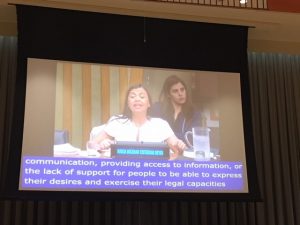
Address by María Soledad Cisternas Reyes at the Opening of the HLPF 2018

Address by María Soledad Cisternas Reyes at the Opening of the HLPF 2018

The opening session of this year’s High Level Political Forum saw a great explanation of why this is important. Ms. María Soledad Cisternas Reyes, UN Secretary-General’s Special Envoy on Disability and Accessibility highlighted how we are not addressing civil or political rights of millions of people who have no access to information.

Those without access had no way of knowing how to achieve social development and participate in society. The lack of efforts to provide meaningful, inclusive access to information left people unable to express their desires, realise their potential, and exercise their rights, not least the right to vote. Addressing the lack of access to information, for all, was vital in sustainable development.

HARD TO DELIVER (BUT THERE’S AN ANSWER)

Yet given how multi-faceted it is, delivering access to information is not necessarily easy. At a session organised by UNESCO in cooperation with the Permanent Mission of the Argentine Republic to the United Nations: “The role of Information and Communication Technologies (ICTs) in the implementation of the targets in SDG 11” the focused on how to deliver truly smart cities.

Side event by UNESCO: "The role of Information and Communication Technologies (ICTs) in the implementation of the targets in SDG 11"

Side event by UNESCO: “The role of Information and Communication Technologies (ICTs) in the implementation of the targets in SDG 11”

Participants highlighted different elements of access – the need for transparency about government information, the need for connectivity and digital skills, the need for places where people could feel safe to go online, and the need to protect privacy yet at the same time understand community needs.

In short, access is about more than creating an app or creating a website, it also requires adapted, welcoming, and outcome-orientated support mechanisms.

Fortunately, libraries help on all of these fronts. As pre-existing, trusted public institutions, with trained, dedicated staff, ensuring citizen empowerment and participation, they provide access to information, internet connection, and digital skills, while protecting privacy.

IFLA’s intervention was very well received by the audience. To support the point, the example of Medellín (Colombia) was mentioned, where building libraries was the solution found by government in a city formerly marked by violence and exclusion. Libraries, and library parks, became community centres, chosen and owned by citizens as safe public gathering and learning spaces.

HARD TO MEASURE (BUT WE’RE WORKING ON IT)

Side event: “Monitoring peace, evaluating institutions, building capacity: A data-driven conversation on SDG 16 and its upcoming 2019 review SDGs Learning, Training and Practice”

Side event: “Monitoring peace, evaluating institutions, building capacity: A data-driven conversation on SDG 16 and its upcoming 2019 review SDGs Learning, Training and Practice”

At the side event: “Monitoring peace, evaluating institutions, building capacity: A data-driven conversation on SDG 16 and its upcoming 2019 review SDGs Learning, Training and Practice”, organized by UNITAR & IDEA, the issue of lack of proper indicators to monitor SDG 16 were again addressed as a big issue that needs to be solved.

Given next year’s HLPF focus in this SDG, participants proposed to organise a meeting for SDG 16 civil society stakeholders in preparation for this review. This idea was supported by the speakers as an idea worth exploring.

Side event: "SDGS on a local level"

Side event: “SDGS on a local level”

There were similar reflections on the need to find ways to measure progress towards sustainable development, especially at the local level (for example “SDGS on a local level”, organized by UNITAR, and “Practical Tools to Localize and Implement the SDG11 and the New Urban Agenda in Cities in the Developing World”, organized by UN-HABITAT.

Especially in the case of target 11.4 (safeguarding cultural heritage), this was particularly important, given that data needed to be collected locally to be meaningful. Yet for them to be comparable – to be able to get a global idea of progress – there had to be enough similarity in the methods used.

Side event: “Practical Tools to Localize and Implement the SDG11 and the New Urban Agenda in Cities in the Developing World”

Side event: “Practical Tools to Localize and Implement the SDG11 and the New Urban Agenda in Cities in the Developing World”

IFLA is addressing both of these challenges. In order to resolve the complexity of how to measure access to information, the Development and Access to Information (DA2I) report, produced in partnership with TASCHA, suggests a basket of indicators. These can be followed over time, and the interactions between the different components explored in order to understand what an effective set of policies for access to information could look like.

Similarly, through IFLA’s Library Map of the World, we are looking at developing capacity to collect library data locally, in a form that then can be explored globally. As this develops, it will become an essential tool in the analysis of the global library field and its contribution to development.

IFLA at the Second meeting of the Forum of the Countries of Latin America and the Caribbean on Sustainable Development – Days 3, 4 and 5 (Advocacy at the Forum, Side event and Civil Society Declaration)

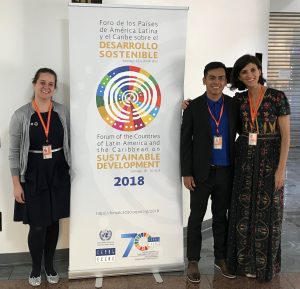
IFLA Delegation at the ForumAfter taking active part in two days of Civil Society meetings on 16-17 April at the Second meeting of the Forum of the Countries of Latin America and the Caribbean on Sustainable Development, IFLA’s delegation in Santiago, Chile, continued its advocacy efforts to get libraries and access to information into the Agenda.

18 April started bright and early, securing a seat in the Civil Society area to attend the official opening of the Forum by Alicia Bárcena, Executive Secretary of the Economic Commission for Latin America and the Caribbean (ECLAC) (read the speech and watch the video).

During her welcome address, she stressed:

“It is essential that the civil society is actively involved in the processes that contribute to decision-making, planning and implementation of policies and programmes that promote sustainable development in its three dimensions and at all levels, and that appropriates it to ensure it permeates widely in all social sectors, and everywhere.

This is even more relevant in the current political context, and the changes in the governments that the region is going through. Civil society must be guarantor of continuity in the process of implementing the 2030 Agenda and that this roadmap is a substantial part of the development agendas of the new governments of the region.”

“Let’s continue creating together the conditions for civil society to continue articulating its modalities of participation, dialogue and collaboration with national and regional mechanisms such as the Forum for monitoring and progress review of the implementation of the 2030 Agenda for Sustainable Development, and that, in this way, we generate renewed and solid partnerships for the implementation of the Sustainable Development Goals and their respective targets.”

She then continued by adding:

“Actually, the 2030 Agenda will only be achieved if all the actors are sitting around the table and that’s why we wanted the present Forum to have a multi-actor characteristic.”

The address was followed by a message pronounced by Norma Munguía, Director General for Global Affairs, on behalf of Ambassador Miguel Ruiz Cabañas, Undersecretary for Multilateral Affairs and Human Rights of the Secretariat of Foreign Affairs of Mexico and Chair of the Forum (read the speech).

In her message, Norma Munguía stated:

We must encourage the use of technology and innovation in improving the living conditions of our societies, while facilitating access to information and promoting the mobilization of public and private resources.

Later, Alicia Bárcena gave an overview of the key points (download presentation) of the Second annual report on regional progress and challenges in relation to the 2030 Agenda for Sustainable Development in Latin America and the Caribbean launched during the  Forum.

While part of IFLA delegation was still working on drafting the Civil Society Declaration, the rest of IFLA delegates attended the peer learning sessions in the afternoon. This helped to find the right moment to approach Alicia Bárcena to bring the message of libraries.

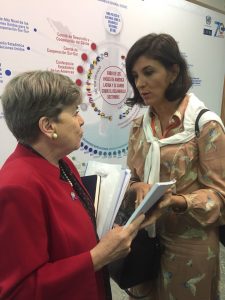
Alicia Bárcena, Executive Secretary of the Economic Commission for Latin America and the Caribbean (ECLAC)Adriana Cybele Ferrari (FEBAB President, Brazil and IFLA IAP participant) approached ECLAC’s Executive Secretary and delivered a copy of the Development and Access to Information (DA2I) report, informing her that the library community is present at the Forum advocating for libraries and access to information. She also took the opportunity to mention the side event at the ECLAC Library on 19 April, and the launch of the “Santiago Declaration: Access to information to achieve sustainable development in Latin America and the Caribbean” during this event, which was enthusiastically encouraged by Mrs. Bárcena.
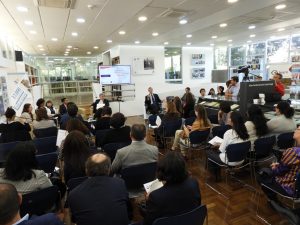
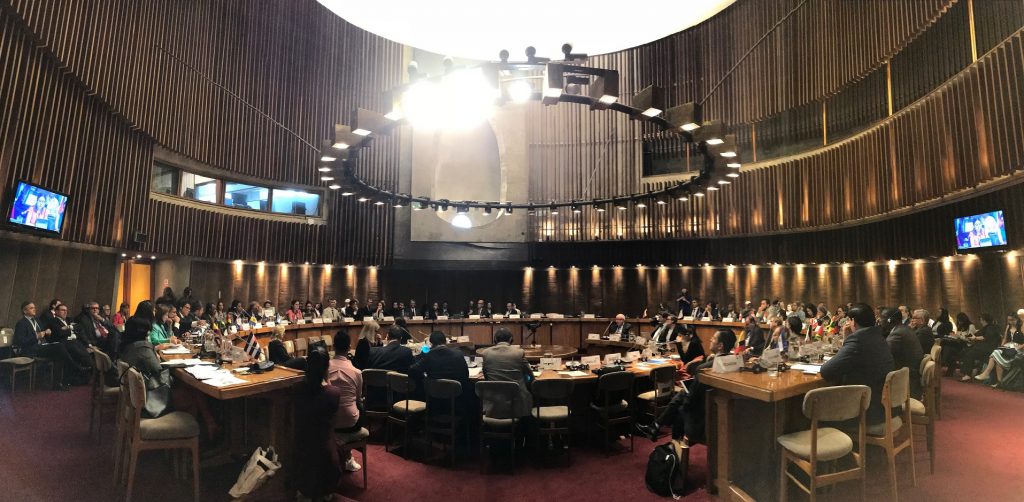
IFLA ECLAC Side Event19 April was an extremely successful day for our IFLA delegation, with two main highlights: the side event hosted by ECLAC’s Hernán Santa Cruz Library in partnership with IFLA: “The importance of access to information to achieve sustainable development in Latin America and the Caribbean, and the reading of the Civil Society Declaration during the session “Dialogues on multi-stakeholder contributions to the implementation of the 2030 Agenda for Sustainable Development”, including access to information and culture. Learn more details of these two key milestones by reading our news piece and watching the recording of the side event.Reading of the Civil Society Declaration
At the end of this day, Jonathan Hernández Pérez (CNB President, Mexico and Associate of IFLA’s ILP) had the opportunity to meet Miguel Ruiz Cabañas, Undersecretary for Multilateral Affairs and Human Rights of the Secretariat of Foreign Affairs of Mexico. Jonathan took this chance to introduce himself, IFLA and the CNB, present the work of libraries supporting development in Mexico, and offered the support of the library community for the preparations of Mexico’s next Voluntary National Review (VNR), providing clear examples of libraries’ contributions to development.

On 20 April, the last day of the Forum, IFLA delegates attended several sessions, including “Special statement on the importance of the regional dimension in the 2018 and 2019 meetings of the high-level political forum on sustainable development” and the side events: “Engaging scientists in the Latin American and Caribbean region to support the implementation of the SDGs” and “Recognizing the whole-of-society approach to the SDGs through integration of volunteerism data in VNRs”.

A quieter day at the Forum, allowed for pop-up advocacy action by both of our delegates Adriana Cybele Ferrari and Jonathan Hernández Pérez.

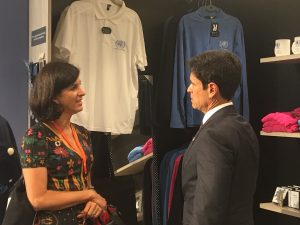
Jonathan approached Adolfo Ayuso-Audry, General Director of the 2030 Agenda for Sustainable Development, Office of the President of Mexico, at the end of a side event to introduce the work of libraries in development, and ask for involvement in the Mexican VNR Commission. Minister Ayuso-Audry asked for his contact information and requested a brief to learn more about how libraries support the SDGs.

Adriana found her chance when she bumped into Enrique Villa da Costa Ferreira, National Secretary for Social Coordination of the Government Secretariat of the Office of the President of Brazil, and took the opportunity to introduce herself, present the work of libraries in Brazil, and ask to be included in the sectoral committees that work in the monitoring and implementation of the Agenda at the national level. Secretary Villa da Costa Ferreira provided guidance on how to get involved and Adriana promised to follow up.

Would you like to learn more about the Forum of the Countries of Latin America and the Caribbean on Sustainable Development – 2018?

Watch the recording of our side event with ECLAC’s Library in YouTube, find out more about IFLA’s work on libraries and development and the Development and Access to Information (DA2I) report.

*Photos by Sueli Mara Soares Pinto Ferreira, Lucia Abello and IFLA.