Tag Archives: Libraries

Living in Interesting Times – Three Key Debates in Information Politics

Libraries and the politics of information in 2019

Information has long been political – who has it, who should have it, and how can it be used to shape decision-making. However, it is only relatively recently that this has been recognised.

On the philosophical side of things, much comes from the work of thinkers such as Michel Foucault, who explained the power that comes from organising information in specific ways (‘knowledge is power’). On the more practical side, the emergence of the internet has given a practical focus to broader reflections on how information is created and shared.

It therefore makes sense to think about the politics of information – the discussions and disagreements that take place around key issues. These questions are particularly key for libraries, as central stakeholders in how information is accessed, shared and governed.

2018 has seen a number of key debates come into focus, with further developments expected in 2019. These relate to whether information should be privatised or made publicly available, where privacy should triumph over access, and where free speech should give way to public order concerns.

This blog will offer a short introduction to each question, and relevant examples of legal and policy discussions which will shape information politics in the coming year.


Privatisation vs Public Availability of Knowledge

Knowledge – at least in the form of books or other documents – was long subject to constraints both on producers and users. These helped avoid widespread copying, but at the same time allowed users some flexibility in what they did with the written knowledge they held.

The expense of owning a printing press meant that the number of people who could publish was limited (although of course not enough to prevent calls for copyright to be invented in 1709). At the same time, once a book or newspaper had been sold, it was easy enough to share it with others or use it for research or other purposes.

Therefore, while the concept of copyright was intended to give the writings contained in books and other documents the same status as physical objects (in terms of the possibility of owning them), it was only ever an imperfect solution.

Digital technologies have weakened these constraints. It is far easier to publish (or copy) and share works than ever before, but also to place limits (through a mix of legal and technological means) on their uses. In other words, it has never been easier to provide universal access to knowledge, but at the same time, it is also simpler to make the knowledge contained in a book or other document private, with all access and use subject to licences.

These new possibilities have created a gap in legal provisions in many countries, given that there had, previously, been no cause to make rules. With this has come a sense that laws also need to be updated, rather than leaving things up to the market or the courts. This is the underlying reason for the ongoing European Union copyright reform, but also elsewhere.

Specific questions raised in this reform, as elsewhere, include whether people involved in teaching should be able to use materials to which they have access, whether researchers and others should be allowed to carry out text and data mining, and whether libraries should be allowed to take preservation copies.

There are also questions about whether the platforms which allow users to share materials should place the protection of intellectual property above the right of their users to free expression.

2019 is likely to see some sort of conclusion to discussions on these subjects in the European Union, South Africa and Nigeria, as well as key steps forwards in Canada, Singapore, and Australia.


Protecting Privacy vs Giving Access

The idea of ‘ownership’ of information is not only associated with intellectual property rights. Increasingly, it also comes up when we talk about personal information – anything that says anything about a person.

Once again, the idea that people have an interest in information about them is not new – there have long been laws on libel which allow individuals to act against writings that are unfair or defamatory. Rulers have also been prolific users of laws against sedition or lèse-majesté. However, such provisions have tended to be limited to the wealthy and powerful.

Here too, digital technologies have changed things by allowing for a much greater potential to collect and use information about people, be it for advertising, security or other purposes. They have also – for example through search engines – made it much easier for ordinary people to access information that might otherwise have been forgotten or too difficult to find.

With this, the idea of a right over information about you has emerged in a number of privacy and data protection laws around the world. The primary focus tends to be on data gathered by companies, with justifications running from a desire to understand advertising choices to enabling customers to shop around between service providers.

In parallel, security concerns have tended to see greater powers given to governments in the types of data they can collect and use, as well as limitations on the transparency obligations they face.

2018 saw the entry into force of the European Union’s General Data Protection Regulation, and similar rules emerge in a number of US States and Latin American countries. There have also been new security rules applied giving governments new powers to gather data on suspected terrorists (as well as many others).

2019 may well see more similar efforts, as well as new efforts to take advantage of new powers over personal information.


Protecting Free Speech vs Tackling ‘Dangerous’ Content

A key way in which the political value of information has long been recognised is through the efforts made to control free expression. Ideas and writings deemed to be dangerous to political, economic or social goals, for example through calling for insurrection, infringement of copyright, or simply because it is criminal, have long been the subject of attention by governments.

It is true that the right to free speech is a crucial one, but it is not absolute. The Universal Declaration of Human Rights notes that all rights can potentially be limited when this is necessary to fulfil the rights of others. As regards the right to equality, there is explicit mention of the importance of combatting incitement to discrimination.

More recently, the way the internet has developed has both made it easier for people to share and spread ideas (dangerous or otherwise). It has also involved relatively well defined actors and channels – search engines, social media platforms, internet service providers – with key powers over what is shared. Through their own actions – or actions they are obliged to take – there is a possibility to exert much greater control over what can be said and shared than when someone opens their mouth.

We come across this debate in discussions around concepts like ‘fake news’, terrorist content, hate speech, criminal content, and to some extent copyright infringement. In each situation, there is content that is clearly illegal and clearly legal. But there are also often grey areas, where judgement and nuance may be needed.

The problem is that the solution often proposed for identifying and blocking such content – automatic filtering, brings its own challenges. There are issues that go from the practical (are they good enough?), to the political (without incentives to protect free speech, do they risk ‘accidentally’ blocking legal content?), and human rights-related (should rights be given and taken away by a machine?).

At the same time, human moderation is expensive (in particular if done properly, by people with knowledge of relevant cultures), and can cause serious psychological damage to the people doing it. The costs are likely too high for smaller actors.

Clearly, this is a particularly difficult problem in information politics, not helped by cross-over with other areas of politics. This can make it hard to promote proportionate or nuanced approaches.

There is legislation in a number of jurisdictions which seeks to crack down on terrorist content and copyright infringement through (explicitly or otherwise) automatic filtering. Some have sought to ban ‘fake news’ (a highly dubious step), and others have put pressure on internet platforms to do the same, creating incentives to take an ever tougher line on content. With public pressure growing, major internet companies seem set to implement ever more conservative approaches in order to avoid blame.


What Implications for Libraries?

As highlighted at the beginning, libraries are key actors in information politics. They are central – both practically and symbolically – to the idea that everyone should have meaningful access to information.

A first priority is to defend this core idea. Too many are still offline, too many lack formal education or the possibility to learn throughout life, too many cannot find the information they need to live healthily, find work or start businesses, or to engage in public life.

Libraries are also unique, as public, welcoming institutions, with a clear social interest goal, rather than a focus on profit. Nonetheless, this status does not spare them from the effects of decisions taken in relation to the three major debates set out above.

They clearly depend on limitations on the privatisation of knowledge in order to do their jobs, but need a system that allows writers, researchers and others to keep on producing. They need to protect privacy (key to giving users the sense that they can seek and share information freely), but must also resist sweeping restrictions on what materials they can collect, hold and give access to.

And while they understand the need to act against dangerous speech, they know from long experience that managing information is complicated and requires skilled judgements based on expertise and values – something that a machine cannot replicate.

While it may not always be popular – or easy to explain – libraries will need to set out and defend the importance of a balanced approach, one that allows for meaningful access to information for all, not just in 2019 but long into the future.


This blog is based on a presentation initially given at the Eurolib conference in Brussels on 12 November 2018.

Making Progress: Welcome Vote in South African Parliament on Copyright for Libraries

After years of discussion, the South African copyright amendment Bill was adopted by the South African National Assembly on 5 November. The process is not completely over, as the Bill will now be sent to the National Council of Provinces for concurrence, which is likely to happen early 2019.

As it currently stands, there are very positive provisions for libraries and other cultural heritage institutions, some of which are particularly positive. There are significant improvements such as the adoption of fair use, strong exceptions and limitations for libraries, archives, museums, galleries and educational institutions, provisions on Marrakesh and orphan works and a national open access policy.

These very positive results would not have been possible without the constant advocacy work by many librarians in the country, among which Denise Nicholson, expert advisor of the Copyright and Other Legal Matters Committee at IFLA. They engage with decision makers to insist on the need for adequate provisions for libraries to fulfill their missions, and to bring down unfair allegations against these provisions.

Here’s an overview of the most relevant provisions for libraries, archives, museums and research and education institutions:

  • Fair use: non-exhaustive list of uses (research, criticism, reporting current events, teaching, comment, parody, preservation, etc.) and four relevant factors (nature of the work, amount and substantiality of the part of the work affected by the act, purpose and character of the use and substitution effect of the act upon the potential market for the work)
  • General exceptions for libraries, archives, museums and galleries, for non-commercial purposes:
    • to lend a work in a tangible media
    • to provide temporary access to a work in an intangible format accessed lawfully, to a user or to another institution
    • to undertake preservation and web archiving (copies for back-up and preservation of works in the collection, and preservation of works in publicly accessible websites)
    • to combine the preservation exception with making the work available when it has been withdrawn from public access after having been communicated to the public
    • to get copies from other institutions for incomplete works
    • to format-shift
    • to make copies when permission from the copyright owner cannot be obtained
    • to make copies to lend them to other institutions for exhibition
    • to supply documents
    • a limitation of liability for any library, archive museum or gallery employee working within the scope of his or her duties

*none of these provisions limit the fair use provision

  • Marrakesh provision, allowing the making and supplying of accessible format copies to a person with a disability (or a person who serves him or her), including across borders, with no commercial availability check and no remuneration provision. A compensatory sum of money is deposited in a particular account and can be collected by the copyright owner at any time, but there is also a process allowing the authorised entity to recover the amount
  • Contract override provision applicable to all the provisions in the act
  • Licenses for orphan works. Before use, there is a requirement to publish the intention to register the work as orphan in certain sources, followed by an application to a government body, which will grant a non-exclusive license if the procedure has been duly followed
  • Specific exceptions from copyright protection applicable to all works, among which:
    • Quotation (up to an extent “justified by the purpose”)
    • Use of illustrations in publications, broadcast, sound or visual record for the purpose of teaching (up to an extent “justified by the purpose”)
    • Translation of works for non-commercial purposes and limited to specific uses (personal, educational, …)
  • A temporary reproduction and adaptation exception, for transient or incidental copies or adaptations of a work that are an “integral and essential part of a technical process”
  • Reproduction exceptions for non-commercial educational and academic activities, including:
    • Making copies of works for the purposes of educational and academic activities
    • Including these in course packs (by educational institutions) both in physical and virtual learning and research environments
    • when there is no license available to incorporate the whole or a substantial part of a work, this will fall under the exception
    • Reproducing a whole textbook if the work is orphan, out of commerce or out of print
    • Incorporating portions of works in an assignment, portfolio, thesis or a dissertation for submission, personal use, library deposit or institutional repository (by a person receiving instruction)
  • A national open access policy: the author of any scientific work resulting of a research activity that received at least 50 per cent of its funding from the state has the right, despite granting the publisher or editor an exclusive right of use, to make the final manuscript version available open access.


2 Days to Human Rights Day: The Right to Culture

Image for 2 Days to Human Rights Day Blog - the right to cultural participationAt two days to Human Rights Day 2018, the second-to-last of IFLA’s daily blogs looks at the right to participate in the cultural life of the community, or in short, the right to culture. 
Amongst policy areas, culture is often seen as one of the least important. It rarely grabs the headlines in the same way as security, education or defence.

As such, it can seem like an easy area to cut when there is a need to make savings. Something that is nice, but not necessary.

Yet the Universal Declaration of Human Rights offers a strong counter-argument. Article 27 underlines that ‘Everyone has the right freely to participate in the cultural life of the community’.

This offers a confirmation of the central role of culture in the development of individuals and society, and the duty of governments to ensure that all can access it.

This is also an affirmation of one of the core roles of libraries, alongside promoting education and research. Our institutions provide a gateway to literature, from children’s books and bestsellers to the classics. They are key vehicles for delivering cultural policy – and human rights.

Yet as with the rest of the Universal Declaration, there is no obligation to deliver access to culture in any particular way. Is it more appropriate to focus efforts on those who cannot afford access in any other way, or should solutions be universal?

This blog looks at this question from the perspective of library services.


Levellers: Targeted Support to Enhance Access

Culture is not necessarily cheap. For people to be able to devote their time to writing, to theatre, or to other creative activities, they need – and deserve – support. Indeed, Article 27b of the Universal Declaration recognises this right to the material benefits of creativity.

Many others add value, through perfecting works, and then helping distribute them.

A variety of mechanisms are in place to support this activity, such as subsidies, benefits, or tax cuts. Yet selling works – books, films, plays, art – to consumers remains the key source of income in most cases.

For consumers who have a solid income already, this is clearly not a problem.

Yet this is not the case for everyone. In the case of young parents, for example, this can be crucial, as the cost of buying all the books a child will read can be high.

Libraries do indeed have a particularly important role in providing access to culture for people who may not otherwise be served by the market. This of course includes those who, in future, will earn more and buy more books.

Evidence from the United States indicates higher level of reliance on libraries by groups more likely to be marginalised. This suggests the potential of libraries as ‘levellers’ when it comes to access to culture.


A Universal Offer

While targeted support may be more cost-efficient in the immediate term, it implies differentiating between groups in society.

It is unfortunately the case that when a service is seen as something for the ‘poor’, people will start to avoid it out of pride. Some will be excluded, despite the need they face.

This is why the nature of libraries as a universal public service is so important. They are explicitly for everyone, not just specific groups.

And while they may have a particular duty to help people more at risk of exclusion from culture – such as those with low literacy or people with disabilities – this is not at the expense of their broader community role.

Libraries themselves work to build collections and services that respond to the needs of everyone.

And while this may mean that the possibility to borrow books is open to all, this can act as a powerful discovery tool, giving new authors an opportunity to meet new readers. Libraries, of course, also buy content, providing an important source of income to authors.

The universal focus of libraries also makes them more attractive as a meeting place for all members of the community. With few other public spaces for groups to come together, this can be a key driver of social cohesion.


The right of access to culture is perhaps one of the strongest bases for the existence – and activity of libraries.

In order to drive equity – equality of outcomes – they may need to make special efforts with some groups. But, crucially, it is their universal focus – to allow everyone to participate in cultural life – that can make libraries so effective.


Read also IFLA’s submission to the call for contributions on the tenth anniversary of the mandate of the UN Special Rapporteur on Cultural Rights.

5 Days to Human Rights Day: Celebrating Privacy

5 Days to Human Rights Day

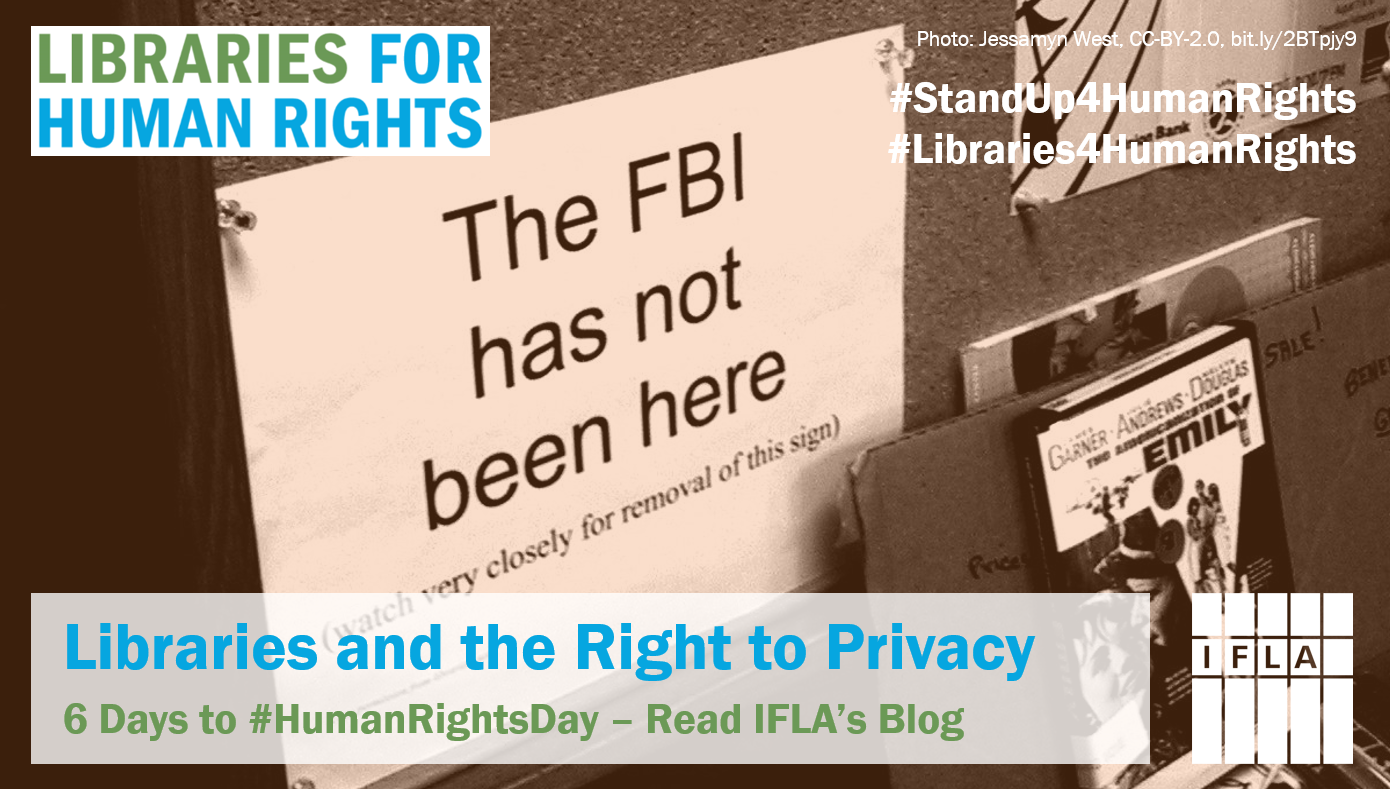
The third in our series of daily blogs leading up to the 70th anniversary of the Universal Declaration of Human Rights focuses on privacy. It underlines the vital role that libraries play in protecting and enhancing privacy for all.

Privacy is a fundamental human right enshrined in Article 12 of the Universal Declaration of Human Rights. On the 70th anniversary of its adoption by the United Nations in 1948, we are reminded that “no one shall be subjected to arbitrary interference with his privacy, family, home or correspondence nor to attacks upon his honour and reputation. Everyone has the right to the protection of the law against such interference or attacks”.

 Privacy is the human right that protects us from unwarranted intrusion, enhancing the autonomy of our actions. If we assume that no one is observing, our interactions are freer, more sincere. On the other hand, if we feel we are not completely free in our thoughts and actions, we may hold back crucial elements of ourselves.

 The right to privacy, therefore, “protects our subjectivity from the pervasive efforts of those actors that strive to render our actions fixed, transparent and predictable. For this reason, privacy is also an indispensable feature of a democracy” (Cohen 2016).

 Libraries play a powerful role in the promotion and protection of privacy. The anniversary of the Universal Declaration is a useful opportunity to remember their relevance. IFLA itself has a position on the integral role of privacy in protecting freedom of information and freedom of expression, through its Statement on Privacy in the Library Environment

 Other libraries have also published toolkits and guides on how institutions can protect the privacy of users against ongoing attacks. In their everyday work, libraries support this right. They look to follow best practices by limiting user data collection and pushing partners (commercial or otherwise) to narrow personal data collection.

 They also work to give their users the knowledge and skills required to protect themselves. And they partner with other organisations to advance relevant legislation and improve services and offers to users.

 This important anniversary should therefore remind us that privacy can and should be protected as an essential right for human beings and libraries can help supporting its realization through education, digital literacy, and tirelessly advocating on best practices. 

6 Days to Human Rights Day: The Right to Education is The Right to a Library

The second in our series of daily blogs leading up to the 70th anniversary of the Universal Declaration of Human Rights focuses on education. This is also the subject of a major global conference – the Global Education Meeting – taking place in Brussels on 3-5 December.

It underlines the vital and complementary role that libraries play to schools and other formal education institutions in ensuring that everyone has the possibility to learn and improve their life.


The right to education features in Article 26 of the Universal Declaration of Human Rights. It is a key enabling right, one that should give everyone the possibility to play a full part in society in the future. This is borne out by the evidence – some of the most spectacular stories of successful development in the last century have been based on investment in teaching and learning.

Yet when we discuss education, it is easy to focus on schools and universities – ‘formal education’. Indeed, many people associate learning with sitting in a classroom or lecture hall, and absorbing knowledge.

Of course, many libraries are based within schools and universities, providing students and teachers with materials and skilled support. They can even be the heart of their institutions, as is the case for some school libraries.

However, learning is much broader than this. And it needs to be. The world we live in, and the jobs we do, are evolve and become very different from those for which schools prepared us. Formal education can offer a valuable starting point, but it cannot be enough.

This is where the world’s 350 000 public libraries can come in. As was recognised in the original UNESCO Public Library Manifesto in 1949, libraries are ‘a living force for popular education’.

Many of the countries which do best in terms of formal education also invest heavily in their libraries, such as Finland and South Korea, in order to promote the right to education throughout life.

This is just as true today as almost 70 years ago. This blog looks at two ways in which libraries complement formal education.


Helping Young Learners in the Community

In many countries, libraries have a strong focus on supporting young learners. They are part of the ecosystem that ensures that children have access to books from a young age, especially when parents are not able to buy books themselves.

There are many examples, for example those run through Boekstart in the Netherlands, which provides valuable support to parents – and a complement to schools – in developing early years literacy.

As children grow, they offer a different environment – quieter often than school or home – which for some at least can make a real difference to their chances of success.

Libraries can also fill in gaps where schools are not able to offer the resources – or spaces – for young learners. Many of the projects run by EIFL’s Public Library Innovation Programme focus on giving young people access to tools, materials, and support they may not get elsewhere.

Libraries can also provide skills, for example media literacy or coding clubs, which help children grow, develop, and seize opportunities.

As set out in an IFLA article for World Teachers Day, librarians and teachers are natural partners.


Education Throughout Life

Of course education does not stop at any particular age. As highlighted in the introduction, changing technologies and changing jobs mean that people need to continue to learn.

Libraries can provide a vital gateway in this respect. Many offer basic education about how to make best use of the internet, for example to access eGovernment services or look for a job.

Some provide more advanced course in coding for example, or programmes aimed at personal fulfilment, such as creative writing or local history.

They can be attractive – and effective – as venues for learning precisely because they are public buildings, but are not as intimidating as formal education institutions.

They are particularly important for refugees, the focus of this year’s Global Education Meeting. For people arriving in a new country, at whatever age, there is always a need to learn, be it language, skills, or simply how the system works.

Libraries across host countries have looked to reach out, providing specific resources and support, especially around languages. And in refugee camps, actors such as Libraries Without Border are bringing these benefits to people who might otherwise struggle to carry on learning.


If the right to education is to be a reality throughout life, the need for libraries is clear. Libraries need to be a core part of education, training and lifelong learning strategies, engaged in conversations, and supported accordingly.

7 Days to Human Rights Day: Libraries and Freedom from Discrimination

In the first of seven daily blogs in the run up to Human Rights Day, and to mark the International Day of Persons with Disabilities, today’s post looks at Article 7: Freedom from Discrimination.


Article 7 of the Universal Declaration on Human Rights includes the statement that: ‘All are entitled to equal protection against any discrimination in violation of this Declaration and against any incitement to such discrimination’.

While discrimination comes in many forms, it is undeniable that people with disabilities are particularly exposed to it. Thanks either to active prejudice, or a failure to take account of their needs, they often experience less access to opportunities to learn and gain skills, and in turn greater levels of poverty and unemployment.

Libraries have a duty to all of their users. In a number of countries, library laws and policies underline that users with special needs deserve specific support.

This makes sense. Those facing greater difficulties to integrate into society may have greater need for information, for example to identify opportunities or support, or find guidance for dealing with health issues. They of course, also, have equal rights to education (Article 26), free expression (Article 19), and participation in the cultural life of the community (Article 27), all rights that libraries help realise.

The Convention on the Rights of Persons with Disabilities, of which 3 December is the anniversary, underlines these points, as a presentation from this year’s World Library and Information Congress stresses.

In order to deliver this, libraries are not only looking to ensure that their existing services are accessible, but in many cases are designing specialised programmes to reach out to users with disabilities. Such programmes, while ‘positively’ discriminating in favour of people with disabilities, can make an important contribution to ensuring ‘equity’ – i.e. that everyone enjoys the same outcomes.

This blog is necessarily short. A survey of libraries carried out last year by IFLA’s Section on Libraries Serving People with Special Needs (LSN) offers a wider view. And we know that there is still more taking place beyond this.


Library Services and Universal Design

The idea of Universal Design refers to the idea that spaces – and services – should be designed to make life easier for everyone.

Indeed, this was the subject of a session at the latest World Library and Information Congress, underlining the links between this and human rights, and the guidelines produced at both the national and global level to make a reality of it.

There are many examples of universal design in practice in libraries. At the Russian State Library for Young Adults, for example, there have not only been efforts to adapt buildings, but also to ensure that users with special needs can access them at will, just as any other user might.

In Catalonia, a project on universal design has seen innovative technologies used both to support physical accessibility, provide materials, and offer relevant training to staff. With a number of libraries based in historic buildings, this work is not simple.

In Latin America also, discussions around the Marrakesh Treaty have led to training initiatives aimed at raising awareness of disability issues and available tools to respond.

Of course, access to books remains a key reason for people to come to the library. IFLA sections have played a major role in helping to establish standards for accessible books and other media. Partners have emerged focusing on accessible format books for library users, and there are welcome steps in Australia, for example, to ensure that all books published are accessible from the start.

Finally, and within library associations themselves, there are welcome steps to ensure the accessibility of conferences, notably in the United States, Norway and Sweden.


Going Further

Clearly work to adapt library spaces, services and collections to make them accessible to all is necessary. It is a key principle of the Universal Declaration of Human Rights that everyone should be able to benefit from this.

But there is also an argument for specific efforts to ensure that everyone benefits from services. It may not be enough to ensure that everyone can access a building, when they may find it difficult even to leave their homes. As with others, users with special needs may well need books and materials that reflect their needs and experiences.

Such steps can be important in providing equity – fair outcomes, rather than just fair opportunities. Given that all have a right to education, access to information and participation in cultural life, ensuring that people with disabilities can also realise their rights has to be an objective.

Libraries around the world are therefore also looking to develop tailored services, to reach out to those with special needs, rather than wait for them to come through the doors. The opportunities provided by digital technologies can be particularly powerful in this respect, as experience from Kenya indicates.

Such activities can often involve partnerships, as a number of examples from the United States indicate. Here, library spaces and services combined well with external groups to allow for projects such as Autism-friendly book discussions, sensory-friendly Saturdays. The creation of targeted book-clubs also featured in the Catalonian initiative mentioned above.

In Guangdong Province, China, accessibility principles were introduced for library buildings some time ago. But after 2000, there was a new focus on efforts to offer ‘extended’ services, with more visits to the homes of people with special needs and dedicated clubs.

Finally, the Marrakesh Treaty allows for people with print disabilities and the libraries that serve them to bypass some of the copyright laws that lead to the ‘book famine’ – the chronic shortage of books in formats for people with print disabilities. Such laws are not (yet) in place for other library users, and so represent an effort to go further in order to help people with print disabilities achieve equity.


Clearly libraries are working to deliver their obligation under the Universal Declaration of Human Rights not to discriminate, in particular against people with disabilities. Clearly this is an ongoing process, as a study of Nigerian University Libraries underlines. IFLA’s Library Services to People with Special Needs Section is working hard to provide guidelines, and support training and other efforts to move forwards, with a summary of their work presented at the World Library and Information Congress.

There are also steps that others can take to help in this respect. Effective ratification of the Marrakesh Treaty, with no unnecessary or harmful costs or restrictions on libraries and users is crucial. IFLA encourages all countries to ratify and implement the Treaty, and to extend coverage (where possible) to people with other disabilities, so that all should benefit.

This week, tweet about #Copyright4Libraries: join our efforts at WIPO remotely

Help make libraries heard by using the hashtag #Copyright4Libraries

IFLA representatives are currently in Geneva at the World Intellectual Property Organisation (WIPO). They will take part in week of international discussions about copyright, alongside representatives of many of the United Nations Member States. There will be a particular focus on exceptions and limitations to copyright for libraries.

This, the 37th meeting of WIPO’s Standing Committee on Copyright and Related Rights (SCCR), will offer an important opportunity to shape actions planned around exceptions and limitations. After talks about broadcasting on the first two days of the meeting, Wednesday 28 November is likely to be the day where they focus on libraries. Member states are exploring what our institutions need to do their jobs, and how to move forwards.

We expect to hear Member States take positions on the topic, as well as receive presentations by renowned scholars to illustrate the issues. You can follow the discussion live here: http://www.wipo.int/webcasting/en/.

We published a call for action ahead of the meeting, but more can be done now: let your government representatives know that their citizens, and the libraries that serve them, care about the outcomes of the discussions. Ask them to support progress at the international level.

Post on social media using the hashtag #Copyright4Libraries.

Here are some examples of tweets or posts on other social media platforms:

Librarians in [country] need better #Copyright4Libraries, and exceptions and limitations are key to ensure this. We call upon our government @[twitter handle of the country’s copyright office] to support us at @WIPO #SCCR37

Cultural cross-border cooperation needs an international set of exceptions and limitations to #Copyright4Libraries. We call upon our government @[twitter handle of the country’s copyright office] to support us at @WIPO #SCCR37

Librarians shouldn’t have to face legal challenges for lending books and preserving our heritage. We call upon our government @[twitter handle of the country’s copyright office] to support progress on the topic of #Copyright4Libraries at @WIPO #SCCR37


****

Here’s an overview of positive things that WIPO member states said about libraries at the last meeting.

For a clear idea of what can come out of SCCR, it is the body that adopted the Marrakesh Treaty. This international instrument is proving to be very successful and it has been ratified faster than any other treaty in WIPO’s history.