Tag Archives: Libraries

Libraries at the African Youth SDGs Summit

Damilare Oyedele at the African Youth SDGs Summit

Damilare Oyedele at the African Youth SDGs Summit

By Damilare Oyedele, Library and You

Over 1,200 young people from across Africa gathered at Accra International Conference Centre, Accra Ghana from 7th – 9th November for the 2nd edition of the African Youth SDGs Summit.

The African Youth SDGs Summit is an annual continental summit that gathers young people from across Africa to deliberate and design solutions that will facilitate the gradual implementation and accomplishment of the United Nations Sustainable Development Goals and the African Union 2063 Agenda.

This year, the theme for the summit was “Partnership with Youth to Achieve the SDGs: Moving from Policy to Actions”. The 3-day continental gathering of young changemakers across Africa created blueprints, networks, and implementation plans for young people’s engagement and inclusion in SDG planning and implementation across the continent.

In view of this, the importance of access to information as a necessity to achieve the Sustainable Development Goals was also deliberated upon on the day 3 of the summit. To this Damilare Oyedele, Co-Founder & Chief Executive; Library and You had a parallel session where he made a presentation on; Libraries in our society: Prerequisite for the successful accomplishment of the Sustainable Development Goals in Africa. The presentation gave birth to a project launch called Library Impact Project: access to information for Africa’s development

Library Impact Project is an initiative designed to provide capacity, create awareness on how libraries can contribute to the United Nations Sustainable Development Goals with the view to facilitate partnerships and collaborations with policymakers, individuals, changemakers across Africa to engage libraries in their countries to accomplish the SDGs.

It is obvious that Africa’s future lies in the hands of her youths, and we all have the responsibility to take action and create sustainable solutions that will transform ‘Mother Africa’, to create the Africa we want, to create a better place for the current generation and generations unborn. However, for this to be a feasibility, access to information for all is eminent beyond comparison.

Reaching Further: Open Access and Public Libraries

Open Access and Public Libraries

Discussions around open access are often dominated by academic librarians and publishers. But given that open access is supposed to make research available for all, and that it is not only students and researchers attached to an institution who may need access, public libraries could have an important role to play. This blog sets out the arguments, and some examples.

Discussion around open access tends to be intense, but limited to a relatively limited group of publishers, researchers, research funders and librarians. It only rarely enters into the broader public debate, for example through George Monbiot’s article of 13 September this year The Guardian.

This is does make some sense – the people most likely to make use of academic articles currently are based in research institutions. They clearly do benefit from an alternative to the rising prices of subscriptions, although arguments continue around how to finance scholarly communications otherwise.

However, it also implies that the main potential beneficiaries – people outside of academic institutions who are highly unlikely to be able to afford subscriptions or individual article charges that can go up to €50 for a single paper – are not getting involved.

The Potential of Public Libraries

One means of ensuring that the impact of open access is felt as widely as possible, and so its benefits are widely realised, is through work with public libraries.

Unlike academic libraries, public libraries usually have a clear mandate to be open to everyone. They have a crucial role in ensuring that everyone can get access to the information they need to learn, and take decisions.

There is no reason why an ordinary person will not want to be able to access scientific information.

Prospective entrepreneurs wanting to develop a business concept, people suffering from medical conditions, those with a personal interest in local history or nature, researchers working for non-governmental organisations and former students with a continued interest in their subject – all may rely on their public library to access articles and books. Citizen science initiatives in particular can bring ‘ordinary’ people in contact with scientific literature.

Clearly public library budgets cannot support the cost of academic journal subscriptions, making open access essential. But they can, once access is assured, invest effort in supporting discovery and use of these materials. Given the wealth of materials available – and well-documented fears around deceptive journals – these skills are indispensable.

It’s Already Happening!

There are already good examples of public libraries using these possibilities. Toronto Public Library has focused on raising awareness of the availability of open access materials, and offers direct support to researchers who are not affiliated to an institution.

They work closely with the University of Guelph to bridge the gap between public and academic libraries, and encourage more people to access, and get involved in scholarship.

In the Netherlands, the Plusbibliotheken (Plus Libraries) network aims to ensure that the public are able to access academic-level literature. This covers a number of areas, from traditional science to heritage and music, and responds to public demand.

Their strategy recognises what open access brings to this work, and indeed they have organised training sessions on how to search for open access publications.

Elsewhere, there have been efforts to give access to subscription journals through partnerships between academic and public libraries. In Switzerland, where university libraries double up as public libraries, open access is helping overcome challenges around how to give access to walk-in users. Deals have also been struck to ensure that public library users can access academic works, for example through RERO.


Clearly, these are only limited examples, but offer an important example both of helping open access realise one of its key original goals, and using the specific skills and potential of libraries to make this happen.

Break the Cycle: Tackling Information Poverty as a Means of Eradicating Income Poverty

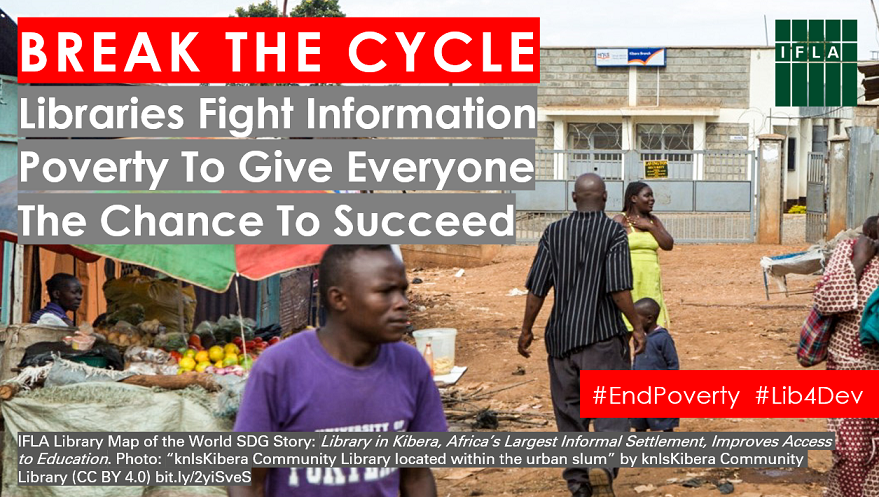
Break The Cycle

Poverty is complex. While it is often measured in simple income terms (i.e. a household is living on less than 60% of the national median or a fixed sum), its roots – and effective responses to it – have many dimensions.

For example, poverty is often associated with poor health, with the relationship going both directions.

Those living on little money may not be able to eat well, if at all. They may not be able to afford healthcare to deal with simple conditions early. But in turn, people in poor health will find it more difficult to find work or earn a living, and face higher expenses for drugs or treatment.

The same can go with poor housing or criminality for example. Bad conditions make it more difficult for people to find work or other sources of income. But then, low income can make it harder to find a place to leave, and increase the risk of being drawn into crime.

Information Poverty and Income Poverty: A Vicious Circle
Access to information is a particular concern for libraries. Too often, income poverty goes hand in hand with information poverty.

Information poverty has been defined as the ‘situation in which individuals and communities, within a given context, do not have the requisite skills, abilities or material means to obtain efficient access to information, interpret it and apply it appropriately. It is further characterized by a lack of essential information and a poorly developed information infrastructure’.

Just as with health, housing or criminality, the relationship between information poverty and income poverty also risks going both ways.

People without the money to buy internet connections or hardware, without access to means to develop the skills to make use of information, without the perspectives to want to go further will suffer from information poverty.

Yet when people lack access to information, they are cut off from possibilities to adopt new technologies, to innovate, and simply to take better decisions for themselves and those around them.

This can condemn people to information poverty.

Breaking the Cycle: The Role of Libraries
The mission of libraries is to fight against this – to break the link, and rather ensure that information is part of the solution to poverty, not part of the problem.

Access to information opens up opportunities, and supports people in improving their lives. And unlike hand-outs or top-down policies, it also empowers people to find their own paths.

Much of IFLA’s work on development has focused on this contribution, notably in the 2017 Development and Access to Information report, produced in partnership with the Technology and Social Change Group at the University of Washington.

There are examples of how libraries are helping small farmers adopt new techniques which boost productivity, of people in rural Indonesia receiving vital health advice, and of women in Chile being able to find out about employment and bustiness opportunities.

Libraries, as neutral, welcoming centres can also be particularly well placed to reach out to people who may feel unwanted in a commercial setting, or afraid to visit more formal public buildings.

Through providing information – and the spaces and skills to understand and use it comfortably – they are helping to break the link between information poverty and income poverty.


The fight to eradicate poverty will need to be as complex as poverty itself. Yet access to information clearly has a major role to play in this effort.

Libraries, as a key part of any country’s or community’s information infrastructure, are already hard at work.


* Britz, Johannes J. (2004), To Know or Not To Know: A Moral Reflection on Information Poverty, Journal of Information Science, Vol 30, Issue 3, pp192-204, https://doi.org/10.1177/0165551504044666

World Habitat Day 2018

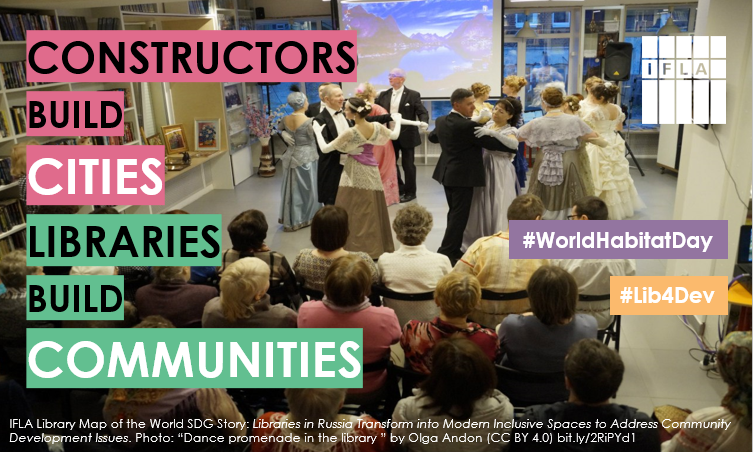
World Habitat Day

Urbanisation – the growing share of the world’s population living in cities – is a major feature of the world today. From 55% today, over two thirds of all people are expected to live in major built-up areas by 2050.

Yet urbanisation brings its challenges. Congestion, waste management, broken and re-formed social relationships, even loneliness. The United Nations and its members recognised the need to act in 2015 when they created Sustainable Development Goal 11 – Sustainable Cities and Communities, as well as when they agreed the whole New Urban Agenda.

The raises the question – how to make cities liveable. And indeed, how to make sure that cities are communities, with – as the word suggests – something in common between their inhabitants? Libraries can help in at least three ways.


Common Spaces

A first key contribution is in the space that libraries offer. As people live more and more of their lives online, there are fewer obvious reasons to come together in a single space. Yet this does not mean it is less necessary.

Indeed, the possibility to do things together – even go online – remains attractive. A police station, hospital or school does not offer this, nor – at least for people on low incomes – do private venues.

Libraries fill an important gap here, offering a neutral, welcoming space to all members of the community. Indeed, SDG 11.7 underlines this point, setting the following target: ‘by 2030, provide universal access to safe, inclusive and accessible, green and public spaces, in particular for women and children, older persons and persons with disabilities’. Similar language appears in Paragraph 13(c) of the Quito Declaration that launched the New Urban Agenda.


Common Opportunities

A second ingredient of a successful community is a feeling that everyone has their place there. Everyone should be able to access to same services, and have, as far as possible, equal chances of fulfilling their ambitions.

Having access to information – as well as the rights and skills to use it – is a key to this, giving the possibility to learn, find work, and develop both personally and professionally. SDG 11.1 underlines that Member States should, ‘by 2030, ensure access for all to adequate, safe and affordable housing and basic services…’. Again, the Quito Declaration makes the same point.

Once again, libraries help. Internet access on its own can be essential in countries that are less well off. But so too is the support – both formal and informal – provided by dedicated library staff, the access to books subject to copyright, and the fact – as highlighted above – that libraries offer a welcoming space.


Common Heritage

The power of a sense of a shared past is also important, especially at times of rapid change. While this may often be overlooked in favour of interventions with more immediate impact – health, policing, renovations, it is a key part of the mix of actions that help build communities.

 Once again, this is an issue recognised by the UN, which, in SDG 11.4, calls on Member States to ‘Strengthen efforts to protect and safeguard the world’s cultural and natural heritage’. IFLA itself has underlined this point in a statement. Paragraph 125 of the Quito Declaration underlines:  ‘We will support the leveraging of cultural heritage for sustainable urban development and recognize its role in stimulating participation and responsibility’.

This is not just a question of the ancient past. As highlighted in IFLA’s article for World Peace Day, libraries are also helping people to recognise the events of the more recent past – even traumatic ones – and through activities such as community archiving, are helping to bring people together.


It is not by accident that the SDGs talk about cities and communities. People need both in order to benefit from a sense of wellbeing. Where they are properly supported, libraries make this happen.

Of Nuts and Sledgehammers: Why MEPs Should Choose their Tools Wisely in Copyright Reform

Graphic for sledgehammers and nutsThe European Parliament’s vote on the draft copyright directive next Wednesday is likely to be the last chance for transparent discussion on the substance of a reform that has been years in the making. It is also a last chance for libraries to reach out to and influence Members of the European Parliament.

A key message will be that European law-makers must choose wisely, and ensure that they are creating rules that are targeted, proportionate, and respect the public interest.

The Draft Copyright Directive

The last wide-ranging piece of EU copyright legislation dates to 2001. Since then, we have seen new technologies and expectations from users, dramatic evolutions in the market for music and media, and an explosion in the amount of copyrighted material produced every day online.

The draft Directive seeks to take stock of these changes, addressing questions around text and data mining, digital education, preservation, use of works which are no longer on sale, rights of press publishers and the obligations of content-sharing platforms, amongst other issues.

The debate has been intense, with a particular focus on Google and YouTube. It has, often, come across as a dramatic struggle between big technology companies and creators.

The problem with this approach is that tends to lead to dramatic solutions – sledgehammers to crack nuts. This blog illustrates just two areas where such dramatic solutions are being proposed, and the harm that they risk doing to libraries and their users.


Repositories are not YouTube

Perhaps the most contentious part of the Directive has been Article 13, which deals with the responsibility of content-sharing platforms to remove copyright-infringing materials uploaded by users.

While this covers commercial operations such as YouTube, other sites, such as educational and scientific repositories run by libraries and others also help people share their work. As such, they risk falling under the same rules.

For example, scientific repositories are a vital part of the infrastructure for open access. They host copies of research articles – often pre-print (i.e. not final) versions – allowing people who aren’t registered at the wealthiest universities or research institutions to have access. For doctors, individual researchers, and people in developing countries, this can be essential.

Educational repositories play a major role in spreading Open Educational Resources (OERs). These offer exciting possibilities for teachers to find and use materials which may be better tailored to their needs than traditional textbooks.

The repositories that host these materials are clearly working in the public interest, and are often hosted by libraries, education or research institutions. As concerns their size, resources, and objectives, they have little in common with YouTube.

However, the draft Directive risks treating them in the same way, placing the same regulations and responsibilities upon them. While YouTube can deal with this, it is hard to imagine repositories working on small budgets, and a strong aversion to legal risk, doing the same. See our blog on the risks around Article 13 and filtering for more.


Libraries are not Pirates

The desire to fight piracy of copyrighted content extends beyond Article 13. Elsewhere in the directive, organisations representing certain rightholders have made major efforts to impose restrictions on what libraries can do, claiming that this will help limit infringement.

For example, proposals on text and data mining (TDM) could make it very easy to restrict access to materials on the grounds of security, or force researchers to delete the datasets they create as part of the process. Such steps would create a major disincentive to invest time and effort in TDM.

Why do so when access to materials is uncertain, when the work that goes into structuring data will be lost, and when others will not be able to verify the results? Libraries already take care to respect copyright, and do not need further restrictions.

Similarly, there have been major efforts to prevent libraries from taking preservation copies of works held on third-party servers. In a digital world, this is the case for a growing share of what libraries offer their users. Excluding these eBooks, articles and other materials undermines a core mission of libraries, and increases the risk that these works in question being lost in future.

Finally, an amendment proposed to Article 6 of the directive would stop libraries using more than one exception at once. In practical terms, libraries would have to choose between taking a preservation copy of a work, carrying out text and data mining on it, or using it for teaching.

This would be a bizarre situation, with libraries forced to select which of their public interest missions they want to fulfil with works in their collections. It is also unnecessary, as whatever libraries do is still governed by copyright law, and in particular the obligation not to cause unjustified prejudice to rightholders. Libraries should not be forced to choose.


There are other areas where misguided rule-making risks doing more harm than good. Indeed, there is a strong argument that it is competition law, not copyright, that provides the best response to the market dominance of just a few major platforms.

While we will have to wait to see if Europe’s competition authorities act in this area. In the meanwhile – and particularly next Wednesday, it will be important to ensure that European law-makers choose their tools wisely.


Unsafe, Untrue, Unhinged? Libraries, Internet Platforms and Difficult Content

The ongoing discussion over how Internet platforms should deal with Alex Jones has provided a test-case for how Internet platforms should approach the question of ‘fake news’.

Alex Jones – described alternatively as a performance artist and a conspiracy theorist, amongst other things – is known for making unsubstantiated claims.

He (or at least the persona he presents) is firmly right-leaning, in the American context. This of course makes the whole debate more complicated. In polarised times, dismissing Jones as ‘fake news’ only leads to accusations of left-wing bias from his supporters.

Jones also tests the boundaries between extreme speech and dangerous speech.

This is a critical line – extreme speech may be uncomfortable, but is also part of the deal with freedom of expression. Calls for universal suffrage or religious freedom were also considered to be extreme speech for much of history.

This has placed Internet platforms in a difficult position. They are, at their core, profit-making companies – or at least aim to be – and have come across as uncomfortable in having to take these sorts of decisions.

They were never likely to find it easy. In addition to the fundamental difficulty of moderating billions of people, they are bigger – and richer – than Jones, and a familiar target for commentators. Moreover, it seems likely that criticism is not something that matters much to Jones, making him a less interesting objective.

Some moved quickly to ban him once the pressure grew, such as YouTube and Facebook, although of course this was after years of posts. Twitter hesitated, with CEO Jack Dorsey admitting that they really didn’t have a simple response to the fake news issue.

And others, such as Google, have not banned him, but rather down-graded Jones’ ‘news’ to make it far less visible among the other information sources out there.


These are all questions that are relevant for libraries. Our institutions are strong defenders of freedom of access to information and freedom of expression, but acknowledge that this is not an absolute freedom, not least when it leads to limitations on the rights of others.

For example, in its statement on the Right to Be Forgotten, IFLA underlines that there is a balance to be found between the right of access to information, and the right of individuals to ensure that information that is untrue or unfairly damaging is not given prominent in Internet searches.

Crucially, these sorts of decisions are a question of professional judgement. What may work in one context does not necessarily in another. Moreover, and as the current discussion underlines, extreme views are a key part of public political debate, and there is an obligation to record them for posterity.

The sorts of decisions Internet platforms are trying to take now are not far removed from the decisions made regularly in libraries. The way they do it is crucial. Restrictions – as the word implies – restrict the scope of debate that can make up the historical record.

While mimicking the work of libraries in helping people to find the information they need, they risk pre-empting thes individual decisions taken by librarians and users individuals. They do this in a way that is not necessarily transparent or sensitive to the situations of different users either, encouraging suspicion. They cannot be asked, or challenged about this. And of course are trying to do so at a scale never attempted before.

Jack Dorsey’s hesitation is perhaps welcome – an admission that easy solutions are mistaken. The need for libraries, and the skills and values of librarians, is as strong as ever.