Tag Archives: Libraries

The 10-Minute Library Advocate #24: Think What Your Audience Wants to Hear

The 10 Minute Library Advocate number 24 - Think What Your Audience Wants to Hear. Picture of a person speaking at a lecternAdvocacy is about getting people to agree with you.

When you talk with someone, you want them to understand that you have shared goals, and that you can help them.

Especially for decision-makers, who often have to face problems, libraries should look like a solution.

To do this, you need to adapt your arguments, and select or prioritise them. But how to do this?

For our 24th 10-Minute Library Advocate Exercise, think what your audience wants to hear.

You can do this by looking at the issues they care about.

For example, a K-12 education ministry official wants children who are ready for class.

A health official wants people who can learn about how to live healthier lifestyles.

Parents may just want help in keeping children entertained and helping them develop their skills.

So pick someone – or a group of people – you want to talk to and think what they want to hear!

Good luck!


See the introduction and previous posts in our 10-Minute Library Advocate series and join the discussion in social media using the #EveryLibrarianAnAdvocate hashtag!

Professional Units and the SDGs – How IFLA’s Committees are Contributing to Work on the 2030 Agenda

Professional Practice and Sustainable Development: How IFLA’s committees support engagement on the Global Goals

IFLA has placed the United Nations Sustainable Development Goals at the centre of much of its work.

They are a regular reference in our advocacy for libraries, and have provided a great way of structuring our thinking about the role of our institutions in the world today.

At the national level, many library associations and library and information workers have taken up the resources provided through IFLA’s International Advocacy Programme to launch their own work.

This makes sense. The SDGs – and the wider 2030 Agenda that contains them – are the most comprehensive, ambitious policy agenda out there.

Many governments and development agencies have explicitly made them a key pillar of their activities. Others may not refer to them so openly, but will not disagree with the framework they set out, and the subjects they highlight.

But what can cross-border professional communities – IFLA’s professional units – do? There are already some great examples here as well! This blog offers some general themes, building on work already done in 2015.


Spreading the Word

A number of IFLA’s sections have embraced the Sustainable Development Goals in sessions at the World Library and Information Congress. This has provided a great opportunity to explain the Goals and their relevance to different parts of the global library field.

Taking the perspective of a specific type of library, a specific service, or a specific user group can be a means of making the SDGs relevant. At the same time, this provides an opportunity to show how the SDGs can be used by library and information workers in the area to advocate for the work they do.

Talking about the SDGs is important – indeed, it is a key UN objective. The more libraries can show that we are using our potential to spread the word, the stronger a partner we become.


Building the Evidence

In our work at the global, regional and national levels, real-life examples of how libraries deliver on the SDGs (and other policy objectives) play a key role. They appeal to decision-makers, given their human aspect. When accompanied by evaluation, they are even stronger.

Individual professional communities within IFLA can be excellent sources of these examples, given that they bring together some of the most knowledgeable people about particular library types or services, from different parts of the world (or something like that).

Already, a number of the stories featured on IFLA’s Library Map of the World SDG Stories page are based on examples from papers submitted to sessions at WLIC. But there is lots of potential for sections to use the rest of the year to find more , for example among nominees for prizes or awards!


Driving Delivery

As highlighted in IFLA’s Core Values, access to information, guaranteed by high quality library services, is a key means of improving lives and promoting equality.

It follows that the work done by IFLA’s sections to enhance professional practice also enhances the capacity of libraries to support users. This is central to fulfilling the role given to all stakeholders in the 2030 Agenda to do their bit to deliver on the SDGs.

Standards, guidelines, toolkits and collections of best practices help the field to achieve Goals, from safeguarding cultural heritage (SDG 11.4) through preservation standards to reducing inequalities through guidelines for services to people with special needs (SDG 10).


We’d love to hear your ideas about how different sections are working with the SDGs, or of course to answer any questions.

The 10-Minute Library Advocate #23: Find – and Use – Buzzwords

The 10-Minute Library Advocate #23: Find – and Use – Buzzwords

Choosing the right words can make a difference.

They can help people make connections in their heads with other issues, placing libraries in a broader context.

They can make your message seem more relevant to wider public debate.

For example, see our ‘Words of the SDGs’ series that explains some of the most used words at the United Nations!

So for our 23rd 10-Minute Library Advocate Exercise, find – and use – buzzwords.

A ‘buzzword’ is a word that is fashionable at a given moment.

Think about the words that journalists and politicians keep on using in articles and speeches.

If over-used, a buzzword can become a cliché, so be careful!

Share your ideas and good luck!


See the introduction and previous posts in our 10-Minute Library Advocate series and join the discussion in social media using the #EveryLibrarianAnAdvocate hashtag!

2019 World Refugee Day

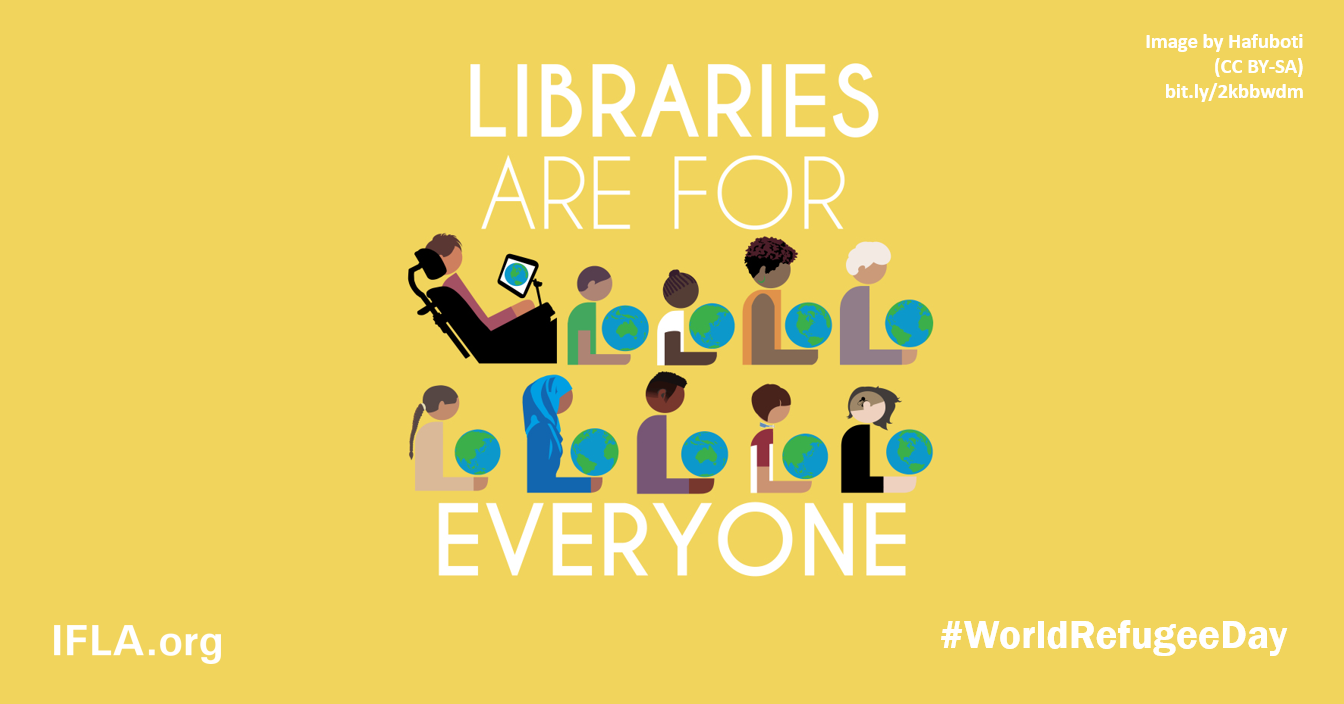
World Refugee Day 2019: Libraries are for everyone

20 June is World Refugee Day, a day to mark the support to the thousands of families who flee their homes every day. Around the world communities, individuals, schools, businesses and institutions such as the libraries are showing solidarity with refugees.

Arriving to a new country is never easy! A different culture and language can be a big challenge for refugees. Libraries can help make their arrival easier by welcoming them to the community.

Libraries opening their doors for refugees

Libraries such as The Multilingual Library in Norway have been actively involved in providing books in different languages. The library is a national centre of expertise for multicultural library services and has put together promo-packages that other libraries in Norway can borrow.

The packages include posters, postcards, bookmarks and balloons. It also includes books in many different languages that the borrowing library can use to make displays and to promote the fact that libraries welcomes people who speak languages other than Norwegian, a fact that many people still don’t know about.

The efforts by the Multilingual Library has been very successful. The materials and books have fed into about 160 promo-packages and are often reserved for months. The package has been strongly promoted on another international day, The International Mother Language Day, to highlight the variety of people that the library serves.

In Germany, Cologne Public Library has created a Sprachraum – literally a language room. The room is a meeting place for intercultural exchange and learning for refugees and people with a diverse background. It dedicated to hosting activities and events, book reading and to practice the German language.

The Sprachraum is run by volunteers, who actively engage with refugees, making sure that they feel welcomed to the community.

Libraries sharing experience and knowledge

Libraries worldwide serve diverse community interests, and function as learning, cultural and information centres.

This work is particular supported by the IFLA Library Services to Multicultural Populations Section, that brings together libraries and institutions who are interested in how libraries can take an active role in supporting refugees and library users with a multicultural background.

The Section is striving to share its experience in library services to ensure that every member of our global society has access to a full range of library and information services.

If you are interested in knowing more about how libraries are serving refugees, you can contact the MCULTP Section.

The 10-Minute Library Advocate #21: Test Your Arguments on a Friend

10 Minute Library Advocate Number 21 - Test out your arguments on a friend. Image: two people talking to each otherIt’s not always easy to prepare good arguments.
You need to get both the substance, and the style right.

But finding the right way to make your point, in the simplest, most convincing way possible can take time.

You don’t need to do this alone though.

To make sure you’re on the right path, it can be good to get the opinion of another person.

So for our 21st 10-Minute Library Advocate Exercise, test out your library advocacy arguments on a friend!

See if they’re convinced about the value of libraries, or of how you help tackle social and cultural issues.

They can offer you feedback or suggestions, point out where you can be clearer, or stronger, as well as congratulate you on your successes.

Make sure your friend knows to be objective and – if needed – critical. Your arguments will be better for it!

Good luck!


See the introduction and previous posts in our 10-Minute Library Advocate series and join the discussion in social media using the #EveryLibrarianAnAdvocate hashtag!

The 10-Minute Library Advocate #20: Do Your Background Research


The 10 Minute Library Advocate Number 10 - Do Your Background Research. Image: Person in a Magnifying Glass

In advocacy, the personal touch is important.

If you’re trying to convince a politician or other decision-maker to support you, you need to adapt to them.

And of course politicians and decision-makers are human beings, with interests, priorities and preferences.

If you can find a way of linking your message to their personal experience, you have a stronger chance of success.

So for our 20th 10-Minute Library Advocate Exercise, do your background research!

Before you meet someone, try to find out more about them.

Do particular issues matter more for them than others? You can then bring in how libraries help in that field.

Where do they come from? You can find an example from the library in their home-town.

Elected officials in particular will have campaign material you can use to find this out, for example.

Good luck!


See the introduction and previous posts in our 10-Minute Library Advocate series and join the discussion in social media using the #EveryLibrarianAnAdvocate hashtag!

The 10-Minute Library Advocate #18: Find and Use Hashtags and Handles on Social Media

10 Minute Library Advocate - Find and use hashtags and handles on social mediaAdvocacy is about getting attention.

You can produce great ideas, messages and materials, but how to ensure that you are heard?

Especially on social media many accounts get few followers. Even popular ones don’t always reach the people that matter.

It is possible to target what you’re doing on social media.

You can also make sure that your message appears when people are following key debates.

So for our eighteenth 10-Minute Library Advocate exercise, find and use relevant hashtags and handles.

Look on key social networks for the you’re aiming for, and write down their handles (for example @library_minister) or the hashtags used in impotrant discussions (for example #GlobalGoals).

By using these, you can ensure that your target audience – politicians, influencers, journalists – are notified about your messages.

You can also get your posts included in search results on popular topics.

Good luck!


See the introduction and previous posts in our 10-Minute Library Advocate series and join the discussion in social media using the #EveryLibrarianAnAdvocate hashtag!