Tag Archives: Libraries

The 10-Minute Library Advocate #17: Find and Remember a Great Library Quote

Image: Find and learn a great library quoteWhen you advocate, it’s important to choose your words.

Finding a great way of expressing the importance of libraries can make the difference when you’re trying to convince someone.

But it’s not always easy to find these – not all of us are poets!

You don’t always have to choose your own words through. Many famous people have said supportive things about libraries.

So for our Seventeenth 10-Minute Library Advocate exercise, find a great library quote and learn it.

You can then use this when you’re talking with people, post it on social media, or even print it on a piece of paper (or if you’re feeling brave, a t-shirt!).

There are plenty of sites with quotes on the internet – you should look for the one or more that you feel comfortable using.

Share your favourites here!

Good luck!


See the introduction and previous posts in our 10-Minute Library Advocate series and join the discussion in social media using the #EveryLibrarianAnAdvocate hashtag!

Development Accelerators: How Libraries and Access to Information Unblock Development

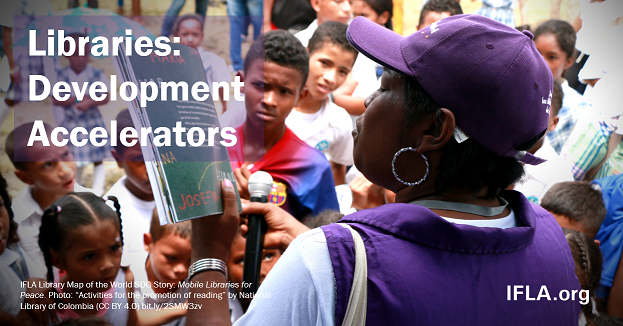
Libraries: Development Accelerators

The objectives set out by the United Nations’ 2030 Agenda are as ambitious as they are necessary in order to ensure the sustainability of our economies and societies.

A clear implication is that business as usual is not a possibility. Instead, there need to be both new resources and new policy approaches in order to accelerate progress and bridge divides. This in turn requires reflection on how best to invest time, effort and money for results.


The Role of Accelerators

This is what lies behind the concept of Development Accelerators, as promoted by the United Nations Development Programme (UNDP), as part of the Mainstreaming, Acceleration and Policy Support (MAPS) initiative. This was conceived as a means of planning the work of United Nations country teams, as well as supporting national and local action.

Within this framework, development accelerators ‘encompass key interventions, provisions, services, or programmatic areas (such as social protection or tobacco control) that simultaneously make positive impact across multiple SDGs (Sustainable Development Goals) or targets in a given context’.

Accelerators respond to ‘bottlenecks’ – situations or factors which slow down progress across a number of fronts.

The above quote comes from a study published recently in The Lancet, looking at examples of development accelerators in South Africa, with a specific focus on young people suffering from HIV.

The study highlights the contribution of policies such as promoting safety at school and direct cash transfers, which appear to lead not only to better mental health and freedom from abuse, staying in school, and sticking to treatment routines.


Access to Information as an Accelerator

The concept of development accelerators appears to describe well the contribution of access to information and libraries to social, economic and cultural progress.

Access is key to enabling better decision making – about education, employment, agriculture – at the level of individuals. It is also essential for the effectiveness of government initiatives targeted at the public – without it, programmes are unlikely to reach those who need them most.

Access at the governmental level enables better policy-making through the possibility to use evidence, and of course supports transparency and accountability to parliaments and people.

It also allows for the sort of international research collaboration that is needed to understand and respond to climate change.

It follows that a lack of access creates a bottleneck, with individuals unable to fulfil their potential and seize opportunities, governments taking poor decisions, and researchers producing incomplete or duplicative work.


Unblocking the Bottleneck: Libraries

Libraries a key means of delivering this accelerator, as places where everyone is welcome to come, read and learn.

One building, with the right resources and staff, can help one user find health information, another a job opportunity, and another fill in forms to access eGovernment services.

Others may come to read to their children, to improve their literacy skills, others may come simply to enjoy the company of other people, strengthening the inclusiveness of the community.

All of these outcomes correspond to SDG targets, underlining this potential.

Clearly strong libraries deliver even more in conjunction with other policies such as those in support of good internet infrastructure, equitable and effective education, equal societies and protection for fundamental freedoms. Indeed, together, these policies can reinforce the effectiveness of each other.


The second Development and Access to Information Report, due out in just over two weeks, will provide further examples of what access – and libraries – can do to contribute to success across the board.

We encourage UNDP and all others engaged in sustainable development policy planning to work with libraries to deliver the access that can help accelerate progress.

The 10-Minute Library Advocate #15: Develop Your Elevator Pitch

The 10-Minute Library Advocate Number 15: Develop your elevator pitch

Sometimes, you need to be convincing, quickly.

While a lot of advocacy is about patient effort over time, you might have an opportunity to spend a minute with a key decision maker – a mayor, a minister, a funder.

They’re likely to be busy, with many other things on their mind.

But if you can get them on your side, you can make major progress.

These moments can happen at any moment – at a reception, a public event, in a lift (or elevator!). You need to be ready!

So for the 15th 10-Minute Library Advocate exercise, prepare your ‘elevator pitch’.

This is the term for a very short speech you give which convinces someone else of your point of view – and in this case, of the importance of libraries.

Something you can deliver in an elevator between floors!

You need to focus your arguments, get rid of unnecessary information, and ensure you say what needs to be said, in the simplest, most convincing way possible.

Try writing out your speech, and then editing it, word by word, until it is as short as it can be.

Good luck!


See the introduction and previous posts in our 10-Minute Library Advocate series and join the discussion in social media using the #EveryLibrarianAnAdvocate hashtag!

The 10-Minute Library Advocate #14: Find a Journalist Who Can Write about Libraries

The 10-Minute Library Advocate Number 14: Find a Journalist  Who Can Write about Libraries

When you’re advocating, you don’t need to do it alone.

Sometimes, it’s even more powerful when you have someone else speaking for you.

And there are few more powerful voices than those in the media.

When a journalist speaks about libraries – and the great work they are doing – they can reach thousands, even millions of people.

So for our fourteenth 10-Minute Library Advocate exercise, find a journalist who can write about libraries.

They can work for a local newspaper or news-site, in print, on radio or on TV – whatever is most appropriate in your area or country!

You could do a search using a news aggregator like GoogleNews or similar to find out who may already be writing about libraries. They’ll often be keen to receive more good ideas for stories!

Let us know about your successes!

Good luck!


See the introduction and previous posts in our 10-Minute Library Advocate series and join the discussion in social media using the #EveryLibrarianAnAdvocate hashtag!

World Heritage Day 2019

World Heritage Day encourages us to celebrate the world’s cultures and to raise awareness of cultural heritage – and the importance of preserving it.

In the light of the tragic Notre Dame fire earlier this is week, it is clear that our cultural heritage is not only great, it is also fragile! Our heritage is our history, it unites us, and it identifies us. Keeping it safe should be a goal of us all.

But let us not forget that heritage is more than buildings.

What is Cultural Heritage?

It is easy to think that cultural heritage is something from the past, but it evolves with our engagement with it. It comes in many shapes and forms, and can be enjoyed in many ways.

Every day, people across the globe celebrate their cultural heritage by simply going to the cinema, paying their respects at a religious site, or by appreciating art and literature. It’s not just on this one day a year that we benefit from the joint history and heritage of humanity!

Documentary heritage is a fundamental inheritance of our culture and historical memory, and its preservation is a key task for libraries all over the world.

This is a question that is not standing still. Debates about the preservation of documentary heritage have found a new focus in digital heritage, understood as collections that are the result of the knowledge or expression of human beings that often has no physical support, but rather a digital one.

Recognising the importance of this component of our heritage, UNESCO passed a recommendation in 2015 which called on Member States to do more to recognise the importance of cultural heritage, to and to pass the laws and support the institutions that make its survival possible. You can read more about the recommendation in our briefing.

How to celebrate World Heritage Day

Of course there is no point safeguarding heritage it if cannot be celebrated, and there are many ways to do this. One way you can mark World Heritage Day is to search for locations near you and pay them a visit! Many key heritage sites are registered at the UNESCO World Heritage List. Others can be found by a simple search online, or by asking your local tourist office!

If you prefer celebrating World Heritage Day from the comfort of your home, you can visit one of the many digital libraries. Be inspired by the many manuscripts from antique to the early print era at the Europeana Collections or read about endangered cultural heritage from around the world registered in the Memory of the World Register.

Whether you chose to celebrate off- or online, you can also consider how we can protect our heritage! Spread awareness about our heritage and its importance – you can start by sharing this story on your social media. Support local partners and volunteer either by signing up for a beach clean up or by helping out in your local library when needed. Encourage international cooperation in preserving our world’s cultural heritage.

Our cultural heritage – tangible, intangible and digital – represents our past and our future. We can make a difference today.

Will Your Collections Be Next? Library Amongst Internet Archive Pages Flagged as Holding ‘Terrorist Content’

The news that the French Internet Referral Unit has flagged over 550 URLs on the Internet Archive as terrorist content is a serious concern for libraries, not least the Smithsonian Libraries, whose page there is among those singled out.

Clearly governments have a duty to protect against terrorism, as well as to ensure that the laws they pass are effectively enforced. The past two decades, however, have seen this move from being a duty to an obsession, with those agencies (and lawmakers) tasked with acting in these areas allowed to proceed with little if any regard for the other things that governments are supposed to protect, such as free speech and access to information.

This has already impacted upon the work of libraries, with requests from security agencies to access the records of library users. Some libraries have worked to minimise the impact of this by deleting user records as soon as legal retention obligations are finished.

However, it seems that the focus now is on content.  As institutions that also host and give access to a lot of this – either through their websites or through platforms – libraries have a major stake in any rules that determine their ability to collect, preserve and give access to material.

IFLA’s own Intellectual Freedom statement demands freedom in this, with professional judgement playing the key role, specifically underlining that: ‘Libraries shall ensure that the selection and availability of library materials and services is governed by professional considerations and not by political, moral and religious views’.

As before, there may well be situations where materials are not appropriate for the open internet (at least not without safeguards). However, decisions to block materials need to be taken in a responsible, transparent, and proportionate way.

The direction of travel indicated both by this move by the French Internet Referral Unit, as well as legislation due to be voted on in the European Parliament this week, does not do this. Here are three reasons why:


A claim of terrorist content can affect any library website, anywhere…: clearly the Internet Archive is an American organisation, although one that is famously creating a copy in Canada for fear of interference from the US government. New European legislation on terrorist content would also apply to any website to which EU internet users have access (which, by default, is all of them).

Libraries themselves are increasingly using the internet as a means of facilitating access to their collections, fulfilling their mission to spread information and knowledge. Many have invested heavily in building platforms, or in digitising works to be held elsewhere. There is no fundamental reason why this access should be blocked for users in some parts of the world.


… and any type of content…: one of the striking points in the Internet Archive case is the sheer breadth of the requests, with entire category pages for ‘Television’, ‘the Grateful Dead’ and of course ‘Smithsonian Libraries’. These pages contain thousands of pieces of material, all of which risk being taken offline at least temporarily.

As the Internet Archive itself points out, even if there are guidelines about what content can or should be defined as terrorist, it is not clear that the French Internet Referral Unit has even applied its own principles here.


… without any serious opportunities for appeal: the breadth of application of the French Internet Referral Unit’s own rules, as well as of upcoming EU ones, already massively fails any test of proportionality. The situation is made only worse by the very short deadlines given to websites to respond. In the case of the Internet Archive, this is 24 hours – a very short period of time to go through millions of items and carry out a proper check.

The new rules being discussed in the European Parliament would be worse still, with only an hour for response. And of course Europe’s new copyright rules imply that content suspected of infringement should not even appear at all. Without serious steps to protect the work of libraries – and their users’ right of access to information – it may be inevitable that sites need to comply first, and respect fundamental rights later.


Clearly the loss of any sense of proportion in applying rules around online content is not unique to Europe. Mexico has already passed laws which allow content to be taken online on the mere suspicion of infringement, and there are efforts to do the same in South Korea. The claims by the French Internet Referral Unit do, however, underline the risks that short-sighed national (or regional) decision-making can have on libraries everywhere.

The 10-Minute Library Advocate #12: Care about Copyright

The 10-Minute Library Advocate Number 12: Care about Copyright

Laws matter for libraries.

They can ensure that local governments have an obligation to run a library. They can decide whether libraries can give internet access or offer services. They can determine what libraries can do with their collections.

Copyright has a particular role in the last of these.

The right rules are essential for libraries to support research and education, to preserve, to lend books.

Clearly understanding copyright takes more than 10 minutes.

But as an important area for advocacy – especially if your laws now aren’t good enough – so it’s useful to know what the laws are.

So, and in the week of the World Intellectual Property Organisation’s (WIPO) Standing Committee on Copyright and Related Rights, our twelfth 10-Minute Library Advocate Exercise is to find the library provisions in your national copyright law.

Fortunately, you can do this in 10 minutes, thanks to a WIPO Report. This give an overview of what your law says about libraries. You can also look at what other countries do.

Does anything stand out for you? Do you see any problems? Any opportunities?

Good luck!


See the introduction and previous posts in our 10-Minute Library Advocate series and join the discussion in social media using the #EveryLibrarianAnAdvocate hashtag!