
Tag Archives: #LibraryStatOfTheWeek

Library Stat of the Week #4: Around the world, having more public libraries tends to be associated with higher literacy rates

A core function of libraries is the support they provide for literacy.

Traditionally, this has been through providing access to materials. Many librarians have brought their passion for books to their jobs, and encourage others to do the same.

In some cases, libraries are involved in more formal efforts to build literacy, in particular among people outside of the formal education system.

Clearly the capacity of libraries to promote literacy depends on how far they are able to reach people. If there is only one library covering a large area and/or population, this job may be harder.

Early analysis of figures from Library Map of the World allow us to take a first look at the correlation between numbers of libraries and adult literacy rates (taken from the World Bank).

They show that there is a correlation between these. The smaller the population individual public libraries need to cover, the higher the literacy rates of the country.
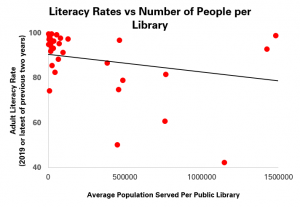
Graph comparing the average number of people served by each public library in a country and the adult literacy rate

Based on figures forcountries where both sets of numbers are available (numbers of public libraries per head and adult literacy in the past three years), it appears that for every 50000 people the average public library needs to serve, adult literacy falls by 0.4 percentage points.

Clearly it is necessary to be cautious in interpreting these figures, which cover only 32 countries. Moreover, correlation does not mean causality.

Finally, it may well be the case that below a certain threshold of people served per library, the connection disappears. However, it remains clear that countries with higher adult literacy are, in general, characterised by denser coverage of libraries.


Find out more on the Library Map of the World, where you can download key library data in order to carry out your own analysis! See our other Library Stats of the Week! We are happy to share the data that supported this analysis on request.
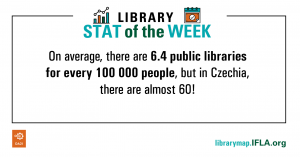
 

Library Stat of the Week #3: On average, there are 6.4 public libraries for every 100 000 people, but in Czechia, there are almost 60!

Library Stat of the Week: On average, there are 6.4 public libraries for every 100 000 people, but in Czechia, there are almost 60!A key strength of public libraries is their reach across cities, towns and villages around the world.
Focused on the needs of their communities, they aim to respond in their providing collections and services.

Clearly there will always, to some extent, be a trade-off between the number and size of libraries.

Focusing resources on just a few bigger libraries, serving more people each, may allow for more advanced services, but may come at the cost of proximity. The debate is similar to that in the health or education sector for example.

Thanks to the Library Map of the World, we can start to understand different national approaches in terms of the average number of people each library serves.

Looking across the 113 countries for which data is currently available, it is now possible to see that on average, for every 100 000 people, there are 6.4 public libraries – that’s one library for every 15 600 people.

Clearly this varies – at the top end, in Czechia, there are nearly 60 public libraries for every 100 000 people – that’s one for every 1700 people!

Find out more on the Library Map of the World, where you can download the data in order to carry out your own analysis!

See our other Library Stats of the Week!

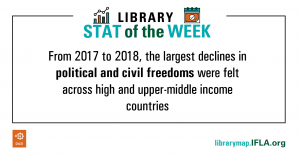
Library Stat of the Week #2: From 2017 to 2018, the largest declines in political and civil freedoms were felt across high and upper-middle income countries

Library Stat of the Week. Freom 2017 to 2018, the largest declines in political and civil freedoms were felt across high and upper-middle income countriesLibraries have a major role to play in delivering fundamental freedoms.
The possibility to access information is not only a human right in itself, but also an enabler of others.

Where people lack it, they will struggle to participate in democracy, to realise opportunities to improve their jobs and their health, and to enjoy the benefits of scientific progress.

Libraries help make this a reality, but in turn, also depend on the policies and practices adopted by governments. It is far harder for them to do their jobs when faced with censorship and other restrictions.

Given that these freedoms have so often been achieved at such cost, it is concerning when they are under attack.

The latest results on Freedom in the World, as reported in the Development and Access to Information Report 2019, underline, however, that this is the case.

Indeed, it is in richer countries – those classified as high or upper-middle income – where this has been worst.

It is a reminder that libraries everywhere need to be attentive to the state of the freedoms that they both promote and rely on.

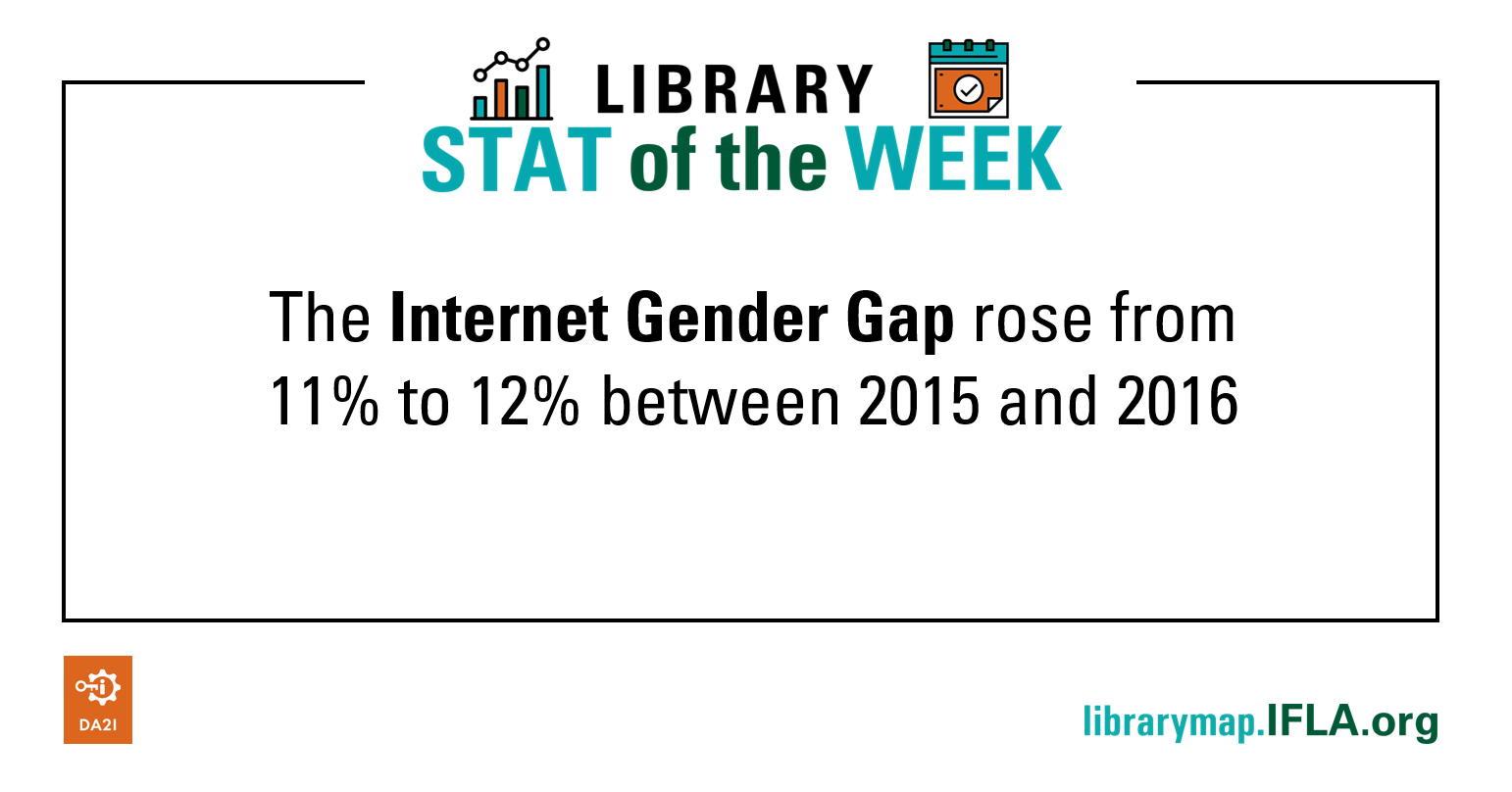
Library Stat of the Week #1: The Internet Gender Gap Rose from 11% to 12% between 2015 and 2016

Library Stat of the Week #1: The Internet Gender Gap Rose from 11% to 12% between 2015 and 2016

Libraries have a key mission to put people in touch with information.

The internet is increasingly essential as a means of achieving this. Thanks to digital technologies, more information than ever is being created, while many materials which used to be available on paper are now online only.

This makes the possibility to access the internet more important than ever. Inequalities in access can too easily translate into equalities in other aspects of life.

Worryingly, as the latest Development and Access to Information Report underlines, a crucial inequality – between men and women is not falling but growing.

Globally, not only are women less likely to be able to use the internet than men, but between 2015 and 2016, more men got online for the first time than women.

In short, the Internet Gender Gap Rose from 11% to 12% between 2015 and 2016.

What does this mean for libraries?: libraries have an active role in providing internet access, both in order to help people get online for the first time, and to complement access at home. Their unique characteristics, as public, non-commercial, welcoming spaces make them particularly suitable to contribute to efforts to close the Internet gender gap.  


Find out more in our Development and Access to Information Report.

Launching IFLA’s Library Stat of the Week

Image for Library Stat of the Week. Text: Library Stat of the Week. Images: a graph and a calendar. Logos: DA2I and Library Map of the World

Numbers give us a key means of understanding our world, and the trends and evolutions that are shaping it. They can help us make comparisons, identify successes, and make connections. They are also critical in making an effective case for providing support to libraries.

IFLA as an organisation is working hard to strengthen the availability of data about libraries and about issues related to their work through initiatives such as the Library Map of the World and the Development and Access to Information Report.

There’s already a huge amount of information available. With this series of weekly posts over 2020, we’ll be looking to highlight just a few examples and explanations.

We hope they will help you in your own work, and show you how much potential there is!

See you next week!