Tag Archives: SDGs

Words of the SDGs: Leave No One Behind

Continuing our series of blogs looking at the words (and phrases) which mark the United Nations’ 2030 Agenda, today’s edition looks at ‘leaving no one behind’.

Perhaps unlike some of our previous ‘words’ (intersectionality, resilience, participation), this feels like a refreshing step away from jargon. This has also made it particularly powerful as a term, although, as this blog will explore, it is not the subject of complete consensus.

As with our other ‘words’, it also has an impact on how libraries work with the Sustainable Development Goals, and can become a useful part of library advocacy in this area.
Leave No One Behind

A Vital Shift: From Focusing on the Poorest to Leaving No One Behind

At the heart of the Millennium Development Goals – the predecessor to the 2030 Agenda and its Sustainable Development Goals – was the notion that economic and social progress around the world had failed to make a difference to the poorest. Too many lacked education, sanitation, healthcare, or adequate income. The eight Millennium Development Goals (MDGs) therefore focused on the worst-off.

The measures of progress chosen focused on this group, but used global averages. As a result, thanks to rapid growth in countries like China, leading to falls in absolute poverty and improvements in services, it was possible to declare success on a number of the Goals.

This did not mean, however, that all countries or groups saw progress. Many of the most vulnerable – the targets of the MDGs – saw little improvement, or even went backwards.

The 2030 Agenda acknowledged this point head on by asserting that not only were the SDGs an indivisible whole (all had to be achieved, together), but that they could only be achieved if they were achieved for everyone. This is the basis of the concept of leaving no one behind.

More Complex than it Sounds

While the idea of achieving the Goals for all appears simple, it also raises questions. What does this mean about where governments – and the global community – should focus efforts? Does ‘no one’ refer to countries (i.e. developing countries), groups within countries or individuals? How does this relate to sustainability? All came up in a civil society debate on Sunday, as well as in previous research on the topic.

Fortunately, there is a relatively simple answer to the first question – the primary focus should be on those who need it most. This follows a concept known as ‘progressive universalism’ (for which the model was a Mexican healthcare reform that specifically served the most vulnerable before anyone else).

Yet debate remains as to ‘who’ is left behind. With the 2030 Agenda explicitly focused on the whole world, the implication is that it is citizens and groups within countries who run this risk. Nonetheless, there is also a strong argument that countries with low national income are also vulnerable, and so need support.

A further evolution in the 2030 Agenda is the recognition that being left behind is also a question of where you stand relative to the population as a whole. Even in a rich society, inequalities can have significant impacts on life chances and general wellbeing. The SDGs even include a focus on inequality (SDG10), underlining that even when (if) we can put an end to absolute poverty, there is still much work to do.

In turn, these inequalities are often the result of discrimination. This can come both in social and cultural forms (racism, sexism, etc), but also discrimination through lack of access to the same services as others. People living in rural areas do, arguably, run a higher risk of being unable to access health and education than those in towns and cities. The focus on fighting discrimination – a key notion from human rights – is also a novelty in the SDGs.

Finally, an ongoing debate surrounds whether bringing everyone up to the standard of living of the best off is a good idea as far as the planet is concerned. It seems clear enough that if all pollute as much as the highest polluting, climate change will only get worse. To avoid this, those lucky enough to live in richer societies either need to find much more energy and resource-efficient ways of living, or accept having to share.

What Impact for Libraries

As a universal public service, libraries can already make a strong case, within their communities, to be realising the concept of leaving no one behind. Given the importance of information, as highlighted across the SDGs (19 targets), this is a role worth championing.

In many countries, libraries have a specific mandate to reach out to those populations who are more at risk of being left behind, such as those with special needs. Evidence from the Pew Research Centre suggests that groups seen as minorities rate libraries as more important than others.

In effect, through providing a universal service, paired with additional support to those who need it, libraries both provide targeted assistance to those most at risk, and act as a force for equality in general.

Clearly there is still progress to make in some parts of the world. The idea of leaving no one behind provides a strong argument for investment by governments in libraries.

This is the case not only in terms of promoting physical accessibility (both for people with disabilities, and a wider network of libraries in rural areas), but also as concerns financial accessibility (where there are fees for access), and socio-cultural and legal accessibility (ensuring that citizenship status is not a barrier, as highlighted by the Mayor of Montreal in a session on Monday, and overcoming the belief in some communities that the library is not for them).

Libraries can be key players in fighting both information poverty and information inequality. The concept of leaving no one behind provides a valuable tool for advocacy to make this a reality.

Find out more about IFLA’s presence at the 2018 High Level Political Forum, as well as our broader work on libraries and the UN 2030 Agenda.

Further reading:

Words of the SDGs: Intersectionality

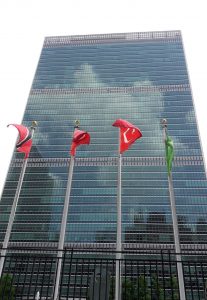
UN Headquarters, New York

Foreword

The High Level Political Forum is an overwhelming experience, with enough events taking place at the same time to make planning your day full of hard choices. But in addition to the number of events, getting to grips with the words, the vocabulary used in discussions can be a further barrier.

While it is easy enough to criticise such words simply as jargon, a key lesson of IFLA’s International Advocacy Programme has been if we want to convince experts and decision-makers of our message, we need to use this language.

Therefore, a number of our blogs during HLPF 2018 will focus on key words used in the SDGs, in order to explain how they are used, and what they mean for libraries. The goal – to help libraries feel ownership of these words, and use them in their own work.

Introduction

The idea of intersectionality is not unique the SDGs, but is particularly relevant in this context. It is the idea that while academic – and often policy – debate focuses on specific themes, at the level of individuals and communities, these themes come together.

Indeed, the crossing of different issues can have a variety of different outcomes, sometimes to make things worse, sometimes better. Sometimes a lack of progress in one area simply cancels out progress in another.

Intersectionality

Intersectionality in the UN Context

The concept of intersectionality is indeed at the heart of the 2030 Agenda. The Sustainable Development Goals are not just indivisible, but interconnected. Indeed, next year’s Global Report on Sustainable Development will focus on these linkages. By recognising these relationships, it becomes easier for governments and others to plan actions that will have a positive impact for individuals.

The importance of intersectionality – getting the right combination of measures to make a difference – has come up in a number of side events at the High Level Political Forum.

Intersectionality and Smart Cities

A first – a side event organised by the UNESCO Institute for Lifelong Learning and the Committee on NGOs – focused on inspiring examples of smart city initiatives from Korea, Mexico and the Philippines. Each of these had focused not just on ‘hard’ technology, but including people. The city of Suwon in particular had developed adapted opportunities for people of all ages to learn and be informed, provide necessary spaces, and change mindsets.

The key common trend across the examples – making use of libraries. Because as institutions focused on finding the best solutions in individuals, they can help not only with providing materials, but also comfort and motivation for learning. In the Philippines and Korea in particular, there had been strong investment in libraries, with the results already paying off.

Intersectionality, ICTs and Development

The second side event, organised by the International Telecommunications Union (ITU), brought together people focusing on how ICTs can support development. Here too, it was clear that there are a number of factors and trends at play in determining whether the Internet realises its potential, from physical connections to local content, from the financial to the psychological.

A major drive on public internet access could be undone by a failure to protect privacy, while changes to regulation to favour market solutions will have less effect if there is no work to develop skills and confidence online.

Here too, libraries stand at the point of intersection, offering not only Internet access, but also the support and training to make this meaningful.


For all of its apparently technical nature, the idea of intersectionality is at the heart of what libraries and librarians are doing when they look to support users in accessing information. As institutions which, by their nature, cross disciplines and information sources in order to focus on what works, libraries can take ownership of this word – and concept – in their own work.

Better physical places through smarter digital spaces: Day 0 of the Regional Forum on Sustainable Development

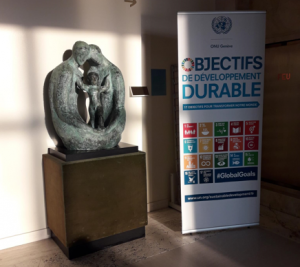
Sculpture at UN Headquarters, Geneva

UN Headquarters, Geneva

It’s begun! The UNECE Regional Forum on Sustainable Development is the first in a series of five, focusing both on delivering the 2030 Agenda at the regional level, and preparing for 2018’s High Level Political Forum.


It’s an opportunity for the key people involved in coordinating the Sustainable Development Goals (SDGs) from governments across Europe to come together and discuss how they are moving forwards. And it’s a chance for civil society organisations to build contacts and influence the message they will send to New York in July. IFLA is there.


Sustainable Communities, Included Citizens, and Access to Information

Day 0 focused on information-sharing, and creating statements to be delivered on behalf of all civil society in front of ministers the following day.


For libraries, 2018 is an important year, given that SDG 11 – sustainable communities and cities – is on the agenda. This SDG is clearly a priority for many other civil society organisations too, given how many joined the group working on the relevant statement.


Despite the potentially different focus of the representatives there – housing, older persons, youth, open government – there were two key points of consensus.


Firstly that sustainable cities depend on the wellbeing and inclusion of all citizens.


And secondly that for these citizens to be included, information plays an essential role, both in terms of getting and using statistics that help identify who may be falling behind, and in ensuring that everyone has access to information, technology and skills.


A great opportunity to talk about the work of libraries in empowering all members of societies – especially the least well-off – through information! IFLA highlighted that public services – and libraries in particular – remained essential if we are to leave no-one behind, and that without their support, new digital technologies would not necessarily serve the wellbeing of all of the community.


We’re looking forward to talking more with delegates today and tomorrow about how libraries can make the difference.


Reviewing the Reviewers: Updates on 2018 Voluntary National Reports


Setting goals is meaningless unless there’s a way of checking on implementation. One tool for this included in the 2030 Agenda is Voluntary National Reviews (VNRs), where Member States present a report on the progress they are making in front of their peers at the High Level Political Forum. The Regional Meetings are a chance to update on progress on these.


The civil society event brought together a number of NGOs already engaged in the VNR process. As the name suggests, these are voluntary, meaning that governments have a lot of space to work out how they are done. This was clear in the input from these NGOs. Some countries have formal platforms, giving civil society the opportunity to share views and meet with ministers and senior officials. Others take VNRs as an opportunity to advertise themselves.


We’re working with IFLA members in countries which are undertaking VNRs this year to understand how far they are involved, and to offer support and advice where we can. At their best, this can be a great way to get libraries higher up the agenda, and to celebrate how our institutions are making a difference.


More tomorrow from the first day of the formal meeting!

Achieving the Sustainable Development Goals – How to Keep a Promise

By Stephen Wyber, Policy and Research Officer at IFLA (stephen.wyber[at]ifla.org)
For those of us who struggle with multi-tasking, having seventeen different goals at the same time seems like a lot. However, this is what all the UN’s membership committed to in December 2015.

The Sustainable Development Goals cover a broad range of issues. Basic nutrition, high technology, gender equality, stronger institutional partnerships, are just a few. The breadth of the goals serves as a reminder that everyone can and must contribute. Government, businesses and civil society, have a role to play in building a better world ensuring that no one is left behind.

IFLA has been quick to set out how libraries are already doing their part, all around the world.

Libraries can and should be at the heart of delivering development at the national level. They bring a distinctive understanding of their communities’ needs. They are unique as safe, neutral, public spaces, and are often vital in providing access to the internet. And most fundamentally, they are central to the provision of access to information and knowledge. This is not only a specific target under Goal 16, but also underpins much of the rest of Agenda 2030.

But for libraries to fulfil this role, they need the right laws. Without limitations on the monopoly powers offered by copyright, the only thing that would determine whether a person can access, borrow, quote from, translate, copy, or use a work in the classroom would be their purchasing power. And as very first of the Sustainable Development Goals reminds us, we are a long way from eradicating poverty.


Access the knowledge
Limitations and exceptions to copyright for libraries help overcome this, offering a legal path to access to knowledge that at the same time ensures that right holders too receive an income.

Here are just some examples of how:

  • When libraries can lend out the books they own, they support literacy and a love of reading. This supports Goal 4: Ensure inclusive and equitable quality education and promote lifelong learning opportunities for all.
  • When libraries can make copies for their users, and share them with other libraries, including internationally, they promote innovation and international research networks. This supports Goal 9: Build resilient infrastructure, promote inclusive and sustainable industrialization and foster innovation.
  • When libraries are empowered to make and share accessible format copies of books, they ensure that the fact of having a reading disability does not mean that you lose your access to knowledge. This supports Goal 10: Reduce inequality within and among countries.
  • When libraries can let users undertake text and data mining on their materials, they open the door to new medical discoveries. This supports Goal 3: Ensure healthy lives and promote well-being for all at all ages.
  • When libraries can act to preserve books and other documents, they ensure that we will hand on a rich and diverse historical record to the next generations. This supports Goal 11.4: Strengthen efforts to protect and safeguard the world’s cultural and natural heritage.
  • When libraries can operate effectively, they act as community hubs, idea stories, that boost growth and equality. This supports Goal 8: Promote sustained, inclusive and sustainable economic growth, full and productive employment and decent work for all.

The WIPO Standing Committee on Copyright and Related Rights has the possibility to introduce the right laws for libraries around the world.

As underlined at a conference in the margins of the Organisation’s General Assembly last month, WIPO is part of the UN family and so committed to pursuing its objectives. All of the member states at the table have promised to meet these objectives. By promoting an effective set of limitations and exceptions to copyright for libraries, they have a great way of keeping this promise.