Tag Archives: SDGs

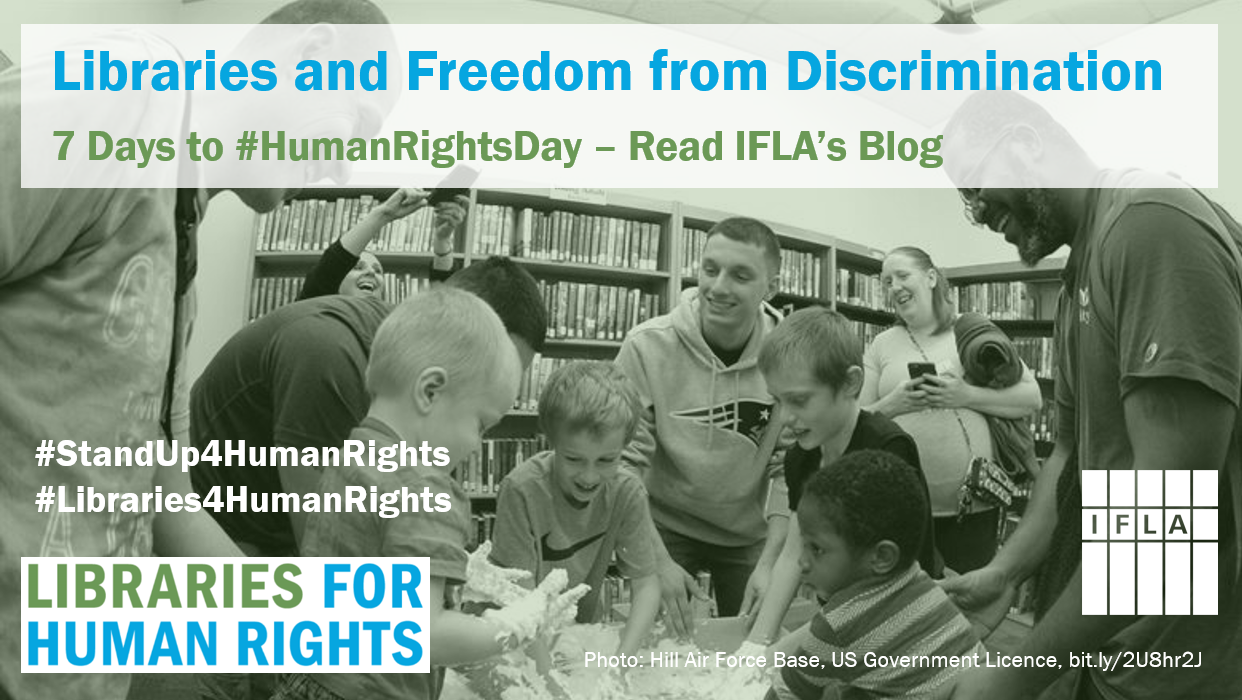
7 Days to Human Rights Day: Libraries and Freedom from Discrimination

In the first of seven daily blogs in the run up to Human Rights Day, and to mark the International Day of Persons with Disabilities, today’s post looks at Article 7: Freedom from Discrimination.


Article 7 of the Universal Declaration on Human Rights includes the statement that: ‘All are entitled to equal protection against any discrimination in violation of this Declaration and against any incitement to such discrimination’.

While discrimination comes in many forms, it is undeniable that people with disabilities are particularly exposed to it. Thanks either to active prejudice, or a failure to take account of their needs, they often experience less access to opportunities to learn and gain skills, and in turn greater levels of poverty and unemployment.

Libraries have a duty to all of their users. In a number of countries, library laws and policies underline that users with special needs deserve specific support.

This makes sense. Those facing greater difficulties to integrate into society may have greater need for information, for example to identify opportunities or support, or find guidance for dealing with health issues. They of course, also, have equal rights to education (Article 26), free expression (Article 19), and participation in the cultural life of the community (Article 27), all rights that libraries help realise.

The Convention on the Rights of Persons with Disabilities, of which 3 December is the anniversary, underlines these points, as a presentation from this year’s World Library and Information Congress stresses.

In order to deliver this, libraries are not only looking to ensure that their existing services are accessible, but in many cases are designing specialised programmes to reach out to users with disabilities. Such programmes, while ‘positively’ discriminating in favour of people with disabilities, can make an important contribution to ensuring ‘equity’ – i.e. that everyone enjoys the same outcomes.

This blog is necessarily short. A survey of libraries carried out last year by IFLA’s Section on Libraries Serving People with Special Needs (LSN) offers a wider view. And we know that there is still more taking place beyond this.


Library Services and Universal Design

The idea of Universal Design refers to the idea that spaces – and services – should be designed to make life easier for everyone.

Indeed, this was the subject of a session at the latest World Library and Information Congress, underlining the links between this and human rights, and the guidelines produced at both the national and global level to make a reality of it.

There are many examples of universal design in practice in libraries. At the Russian State Library for Young Adults, for example, there have not only been efforts to adapt buildings, but also to ensure that users with special needs can access them at will, just as any other user might.

In Catalonia, a project on universal design has seen innovative technologies used both to support physical accessibility, provide materials, and offer relevant training to staff. With a number of libraries based in historic buildings, this work is not simple.

In Latin America also, discussions around the Marrakesh Treaty have led to training initiatives aimed at raising awareness of disability issues and available tools to respond.

Of course, access to books remains a key reason for people to come to the library. IFLA sections have played a major role in helping to establish standards for accessible books and other media. Partners have emerged focusing on accessible format books for library users, and there are welcome steps in Australia, for example, to ensure that all books published are accessible from the start.

Finally, and within library associations themselves, there are welcome steps to ensure the accessibility of conferences, notably in the United States, Norway and Sweden.


Going Further

Clearly work to adapt library spaces, services and collections to make them accessible to all is necessary. It is a key principle of the Universal Declaration of Human Rights that everyone should be able to benefit from this.

But there is also an argument for specific efforts to ensure that everyone benefits from services. It may not be enough to ensure that everyone can access a building, when they may find it difficult even to leave their homes. As with others, users with special needs may well need books and materials that reflect their needs and experiences.

Such steps can be important in providing equity – fair outcomes, rather than just fair opportunities. Given that all have a right to education, access to information and participation in cultural life, ensuring that people with disabilities can also realise their rights has to be an objective.

Libraries around the world are therefore also looking to develop tailored services, to reach out to those with special needs, rather than wait for them to come through the doors. The opportunities provided by digital technologies can be particularly powerful in this respect, as experience from Kenya indicates.

Such activities can often involve partnerships, as a number of examples from the United States indicate. Here, library spaces and services combined well with external groups to allow for projects such as Autism-friendly book discussions, sensory-friendly Saturdays. The creation of targeted book-clubs also featured in the Catalonian initiative mentioned above.

In Guangdong Province, China, accessibility principles were introduced for library buildings some time ago. But after 2000, there was a new focus on efforts to offer ‘extended’ services, with more visits to the homes of people with special needs and dedicated clubs.

Finally, the Marrakesh Treaty allows for people with print disabilities and the libraries that serve them to bypass some of the copyright laws that lead to the ‘book famine’ – the chronic shortage of books in formats for people with print disabilities. Such laws are not (yet) in place for other library users, and so represent an effort to go further in order to help people with print disabilities achieve equity.


Clearly libraries are working to deliver their obligation under the Universal Declaration of Human Rights not to discriminate, in particular against people with disabilities. Clearly this is an ongoing process, as a study of Nigerian University Libraries underlines. IFLA’s Library Services to People with Special Needs Section is working hard to provide guidelines, and support training and other efforts to move forwards, with a summary of their work presented at the World Library and Information Congress.

There are also steps that others can take to help in this respect. Effective ratification of the Marrakesh Treaty, with no unnecessary or harmful costs or restrictions on libraries and users is crucial. IFLA encourages all countries to ratify and implement the Treaty, and to extend coverage (where possible) to people with other disabilities, so that all should benefit.
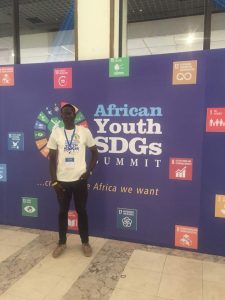
Libraries at the African Youth SDGs Summit

Damilare Oyedele at the African Youth SDGs Summit

Damilare Oyedele at the African Youth SDGs Summit

By Damilare Oyedele, Library and You

Over 1,200 young people from across Africa gathered at Accra International Conference Centre, Accra Ghana from 7th – 9th November for the 2nd edition of the African Youth SDGs Summit.

The African Youth SDGs Summit is an annual continental summit that gathers young people from across Africa to deliberate and design solutions that will facilitate the gradual implementation and accomplishment of the United Nations Sustainable Development Goals and the African Union 2063 Agenda.

This year, the theme for the summit was “Partnership with Youth to Achieve the SDGs: Moving from Policy to Actions”. The 3-day continental gathering of young changemakers across Africa created blueprints, networks, and implementation plans for young people’s engagement and inclusion in SDG planning and implementation across the continent.

In view of this, the importance of access to information as a necessity to achieve the Sustainable Development Goals was also deliberated upon on the day 3 of the summit. To this Damilare Oyedele, Co-Founder & Chief Executive; Library and You had a parallel session where he made a presentation on; Libraries in our society: Prerequisite for the successful accomplishment of the Sustainable Development Goals in Africa. The presentation gave birth to a project launch called Library Impact Project: access to information for Africa’s development

Library Impact Project is an initiative designed to provide capacity, create awareness on how libraries can contribute to the United Nations Sustainable Development Goals with the view to facilitate partnerships and collaborations with policymakers, individuals, changemakers across Africa to engage libraries in their countries to accomplish the SDGs.

It is obvious that Africa’s future lies in the hands of her youths, and we all have the responsibility to take action and create sustainable solutions that will transform ‘Mother Africa’, to create the Africa we want, to create a better place for the current generation and generations unborn. However, for this to be a feasibility, access to information for all is eminent beyond comparison.

The IGF is in Paris – but you can join us from everywhere!

The 13th annual meeting of the Internet Governance Forum (IGF) is taking place in Paris this year. The meeting is ‎hosted by the Government of France at the Headquarters of UNESCO, and runs from 12 to ‎‎14 November 2018.‎

This year’s session has more than a hundred sessions, including national, regional and youth IGF initiatives as well as seventeen ‎Dynamic Coalitions with inputs from communities and stakeholders. This multi-stakeholder approach, a key characteristic of the IGF, makes this an important opportunity to influence and shape public ‎discourse on internet governance themes and to discuss needed improvements. ‎

This year’s gathering stresses the importance of creating an Internet of Trust. To achieve this goal, the IGF in looking at best practices ‎in gender and access; cybersecurity; local content; AI, big data and the internet of things. ‎

IFLA is at the Internet Governance Forum in Paris to discuss the importance of public access in libraries. We will be part of two important events. The first is on the 13 November at the American Library in Paris, with more details available here. It will highlight the importance of public access as a means of getting the remaining billions online, alongside other promising initiatives such as community networks, as previously discussed at the IFLA President’s Meeting in Barcelona, and offline internet.

The second, on the 14 November takes place as part of the formal IGF programme. The session of the Dynamic Coalition on Public Access in Libraries in which IFLA plays a leading role will discuss and improve the toolkit on public access that IFLA has prepared for library associations. The toolkit looks at the key policy questions in the fields of technology, financing, regulation, as they affect libraries delivering public access.

You can find a list of the events on the IGF website and you can follow all the sessions remotely. Please, join us and be a part of this community!

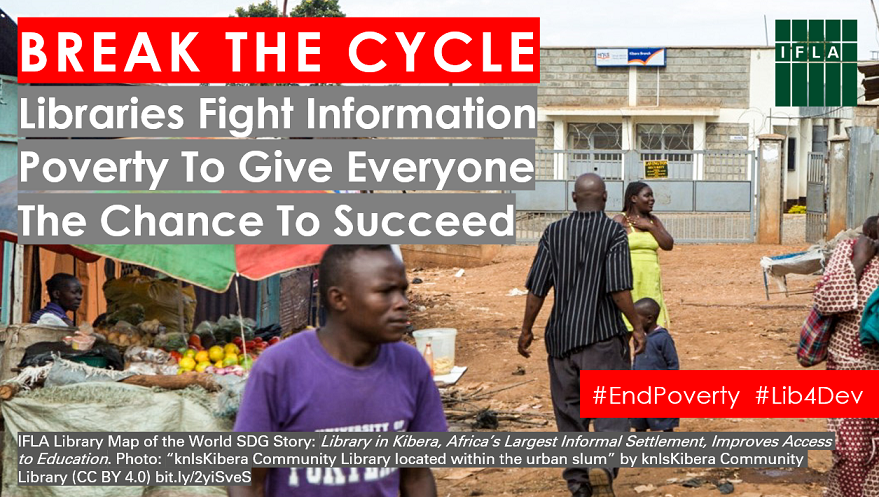
Break the Cycle: Tackling Information Poverty as a Means of Eradicating Income Poverty

Break The Cycle

Poverty is complex. While it is often measured in simple income terms (i.e. a household is living on less than 60% of the national median or a fixed sum), its roots – and effective responses to it – have many dimensions.

For example, poverty is often associated with poor health, with the relationship going both directions.

Those living on little money may not be able to eat well, if at all. They may not be able to afford healthcare to deal with simple conditions early. But in turn, people in poor health will find it more difficult to find work or earn a living, and face higher expenses for drugs or treatment.

The same can go with poor housing or criminality for example. Bad conditions make it more difficult for people to find work or other sources of income. But then, low income can make it harder to find a place to leave, and increase the risk of being drawn into crime.

Information Poverty and Income Poverty: A Vicious Circle
Access to information is a particular concern for libraries. Too often, income poverty goes hand in hand with information poverty.

Information poverty has been defined as the ‘situation in which individuals and communities, within a given context, do not have the requisite skills, abilities or material means to obtain efficient access to information, interpret it and apply it appropriately. It is further characterized by a lack of essential information and a poorly developed information infrastructure’.

Just as with health, housing or criminality, the relationship between information poverty and income poverty also risks going both ways.

People without the money to buy internet connections or hardware, without access to means to develop the skills to make use of information, without the perspectives to want to go further will suffer from information poverty.

Yet when people lack access to information, they are cut off from possibilities to adopt new technologies, to innovate, and simply to take better decisions for themselves and those around them.

This can condemn people to information poverty.

Breaking the Cycle: The Role of Libraries
The mission of libraries is to fight against this – to break the link, and rather ensure that information is part of the solution to poverty, not part of the problem.

Access to information opens up opportunities, and supports people in improving their lives. And unlike hand-outs or top-down policies, it also empowers people to find their own paths.

Much of IFLA’s work on development has focused on this contribution, notably in the 2017 Development and Access to Information report, produced in partnership with the Technology and Social Change Group at the University of Washington.

There are examples of how libraries are helping small farmers adopt new techniques which boost productivity, of people in rural Indonesia receiving vital health advice, and of women in Chile being able to find out about employment and bustiness opportunities.

Libraries, as neutral, welcoming centres can also be particularly well placed to reach out to people who may feel unwanted in a commercial setting, or afraid to visit more formal public buildings.

Through providing information – and the spaces and skills to understand and use it comfortably – they are helping to break the link between information poverty and income poverty.


The fight to eradicate poverty will need to be as complex as poverty itself. Yet access to information clearly has a major role to play in this effort.

Libraries, as a key part of any country’s or community’s information infrastructure, are already hard at work.


* Britz, Johannes J. (2004), To Know or Not To Know: A Moral Reflection on Information Poverty, Journal of Information Science, Vol 30, Issue 3, pp192-204, https://doi.org/10.1177/0165551504044666

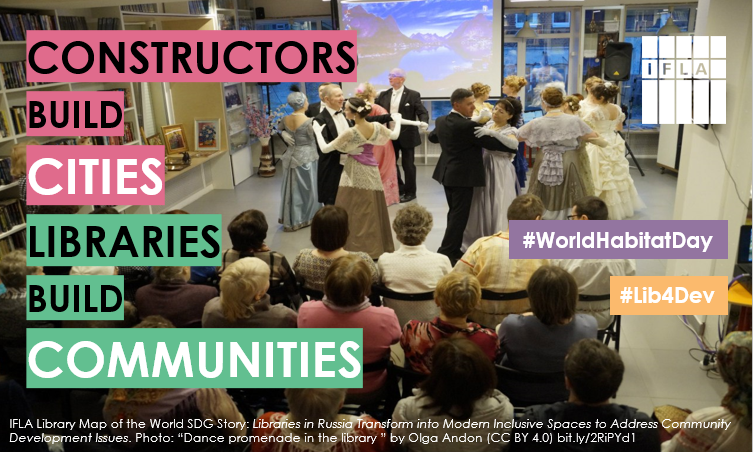
World Habitat Day 2018

World Habitat Day

Urbanisation – the growing share of the world’s population living in cities – is a major feature of the world today. From 55% today, over two thirds of all people are expected to live in major built-up areas by 2050.

Yet urbanisation brings its challenges. Congestion, waste management, broken and re-formed social relationships, even loneliness. The United Nations and its members recognised the need to act in 2015 when they created Sustainable Development Goal 11 – Sustainable Cities and Communities, as well as when they agreed the whole New Urban Agenda.

The raises the question – how to make cities liveable. And indeed, how to make sure that cities are communities, with – as the word suggests – something in common between their inhabitants? Libraries can help in at least three ways.


Common Spaces

A first key contribution is in the space that libraries offer. As people live more and more of their lives online, there are fewer obvious reasons to come together in a single space. Yet this does not mean it is less necessary.

Indeed, the possibility to do things together – even go online – remains attractive. A police station, hospital or school does not offer this, nor – at least for people on low incomes – do private venues.

Libraries fill an important gap here, offering a neutral, welcoming space to all members of the community. Indeed, SDG 11.7 underlines this point, setting the following target: ‘by 2030, provide universal access to safe, inclusive and accessible, green and public spaces, in particular for women and children, older persons and persons with disabilities’. Similar language appears in Paragraph 13(c) of the Quito Declaration that launched the New Urban Agenda.


Common Opportunities

A second ingredient of a successful community is a feeling that everyone has their place there. Everyone should be able to access to same services, and have, as far as possible, equal chances of fulfilling their ambitions.

Having access to information – as well as the rights and skills to use it – is a key to this, giving the possibility to learn, find work, and develop both personally and professionally. SDG 11.1 underlines that Member States should, ‘by 2030, ensure access for all to adequate, safe and affordable housing and basic services…’. Again, the Quito Declaration makes the same point.

Once again, libraries help. Internet access on its own can be essential in countries that are less well off. But so too is the support – both formal and informal – provided by dedicated library staff, the access to books subject to copyright, and the fact – as highlighted above – that libraries offer a welcoming space.


Common Heritage

The power of a sense of a shared past is also important, especially at times of rapid change. While this may often be overlooked in favour of interventions with more immediate impact – health, policing, renovations, it is a key part of the mix of actions that help build communities.

 Once again, this is an issue recognised by the UN, which, in SDG 11.4, calls on Member States to ‘Strengthen efforts to protect and safeguard the world’s cultural and natural heritage’. IFLA itself has underlined this point in a statement. Paragraph 125 of the Quito Declaration underlines:  ‘We will support the leveraging of cultural heritage for sustainable urban development and recognize its role in stimulating participation and responsibility’.

This is not just a question of the ancient past. As highlighted in IFLA’s article for World Peace Day, libraries are also helping people to recognise the events of the more recent past – even traumatic ones – and through activities such as community archiving, are helping to bring people together.


It is not by accident that the SDGs talk about cities and communities. People need both in order to benefit from a sense of wellbeing. Where they are properly supported, libraries make this happen.

Words of the SDGs: Sustainability

As highlighted in our previous blogs about #WordsOfTheSDGs, the vocabulary that marks discussion on the UN’s 2030 Agenda if often obscure or jargonistic.

A shared understanding of what these words mean does of course help governments and others communicate with each other in the corridors and meeting rooms of the United Nations. A key task for libraries, in getting into advocacy around the Sustainable Development Goals, is to ‘join the club’, to become familiar with these terms, and use them.

To end this series of blogs, we will tackle ‘Sustainability’. This is perhaps one of the most central ideas behind the 2030 Agenda, not least as it appears, more or less, in the name of the SDGs. It is also familiar from daily life within own institutions – ts a particular activity sustainable? A strategy?

Sustainability

The word is particularly charged in the UN context. Already in 1992 at the time of the original Rio Earth Summit, the Brundtland Report opened a new era of thinking about development at the global level.

This thinking took lessons not only from the environmental movement, but also new ways of thinking about economic and social policies. In bringing these elements together, it called for a way of living today that would not risk or limit the ability of future generations to do the same.

Within this, the idea of three ‘pillars’ of sustainable development remain. These are environmental (are we leaving enough resources – from natural resources to things like air or a favourable climate – for those to come), economic (are we putting tomorrow’s economic wellbeing at risk?) and social (are conditions within society sufficient to ensure cohesion).

It is worth noting some debate about the difference between sustainable development and sustainability. Some argue that true sustainability may need to come at the cost of development (i.e. growth). Others (including this blog) take ‘development’ in this context to mean the broad set of policies and actions taken by governments and others which can impact sustainability.

So how does this apply in the library context? This blog highlights how libraries contribute to sustainability in its three dimensions.

Libraries and Economic Development

There are many concerns today about whether we can expect continued growth in income per person, especially with a rising population, or even if this is desirable.

Yet for countries where many people are still in poverty, the idea of giving up on growth – and what this makes possible in terms of accessing healthcare or education – is absurd.

Fortunately, the key underlying factor behind growth is productivity. How can we get more out of the resources (both human labour, and physical resources) that we already have? This increases thanks to finding new and more efficient ways of doing things. In short, innovation.

This is an area where libraries have something to add. Ready access to research and other materials, as provided by libraries, can stimulate and support research. New efforts to connect collections, as well as new techniques for making use of them, promises a lot for science.

The result is just the new products, processes and ways of doing things that allow people to produce and earn more. Without libraries, research is weaker. As such, sustainable economic development relies extensively on libraries.

Libraries and Social Development

Social development is a question of maintaining cohesion – this is key to promoting cooperation and wellbeing.

Societies which are highly unequal risk losing this, with those at the wrong end of the scale resenting those at the other. Similarly, societies which are intolerant risk creating tensions, and missing out on opportunities to renew and refresh.

Equality (in provision of service) and equity (in the results achieved) both help provide for social development. They ensure that everyone has the possibility to move within society, and to feel confident in building networks and contacts. They do not have to feel trapped.

Libraries help with this too, and in one of the most powerful ways – through providing access to information. This opens up possibilities to learn and earn, as well as take better decisions about issues such as health or agriculture. When there is an information gap, there is a risk of a development gap.

Not only are libraries, in most places, a free service, available for all in an area, but they also have specific mandates to reach out to those hardest to help. In this way, no-one need feel excluded, or without the possibility to learn and move ahead, regardless of the initial challenges they may have faced.

Libraries and Environmental Development

Unlike many other sectors, libraries are fortunately not classed among major producers of CO2 or other gases. However, they have a dual role in promoting environmental sustainability.

The first has already been mentioned – the role of libraries in supporting research. As we look to help farmers, manufacturers, transporters and others find new ways of doing things, this will help significantly.

But libraries can also, crucially, act as exemplars. IFLA’s Green Library Award, coordinated by the IFLA Special Interest Group on Environment, Sustainability and Libraries, highlights great examples. Even recently, the nomination of an environmentalist in residence at Toronto Public Libraries highlighted how much attention this is getting internally. We need only to share this role externally.

The same Group is planning further work on education on sustainability at the 2018 World Library and Information Congress too – come along to hear more if you are interested.

Sustainability is therefore a useful term to bring up when advocating for libraries, both in terms of how libraries deliver it, but also how they can become exemplars and teachers for others on the subject.

Happy advocating!