Tag Archives: sustainable development

Measuring the Impact of Cultural Diversity on Development: how libraries can get involved

Without intercultural dialogue, peace and sustainable development are not possible. The UN World Day for Cultural Diversity for Dialogue and Development (21 May) calls for recognition of the essential role that cultural diversity plays in enabling dialogue, building mutual understanding, and supporting better outcomes for all people.

IFLA has long championed the cross-cutting role of culture in building a better, more peaceful, world. As a member of the #Culture2030Goal Campaign, we have called for the recognition of culture as the fourth pillar of sustainable development. We have further called for a dedicated goal for culture in the post-2030 development framework, see the Statement by the #Culture2030Goal campaign on UNESCO MONDIACULT 2022 for more.

The UNESCO Convention on the Protection and Promotion of the Diversity of Cultural Expressions (2005 Convention) helps policymakers strengthen their commitment to supporting cultural diversity by providing a framework by which these values are transformed into actions.

By monitoring the implementation of this Convention, we can both measure the impact of culture on development in concrete terms and find a wealth of good practice examples that can inspire further initiatives.

For a practical approach to Cultural Diversity Day, this article will introduce the monitoring framework of the 2005 Convention – especially its relationship to the Sustainable Development Goals (SDGs). It will highlight how libraries can get involved in reporting. Finally, it will introduce the methodology of an ongoing research project in which IFLA is mapping the role of libraries in the reports of the 2005 Convention, which will provide a clear picture of how libraries help achieve its goals.

Protecting and Promoting Diverse Cultural Expressions

Parties to the 2005 Convention have expressed a commitment to culture, in recognition of its importance for creating a rich, varied world and driving sustainable development.

The Convention provides a framework by which governments can strengthen international cooperation and work towards policy provisions that will protect and promote cultural diversity, as well support the creators, knowledge-holders, and institutions that make and share culture.

The Convention notably established the International Fund for Cultural Diversity (IFCD), which provides grants in support of a dynamic cultural sector in developing countries.

Note: the 2022 Call for Applications to the IFCD is currently open! Find out more here: 2022 IFCD Call for Nominations.

Another important aspect of the 2005 Convention is its article 11, which encourages active participation with civil society (including libraries and library associations). This provides a strong base on which to build future cooperation with national authorities who implement the convention and measure its impact.

Find out more: Get Into the 2005 Convention

Measuring Progress

In order to better monitor implementation of the Convention, inform evidence-based policymaking, and align with the UN Agenda 2030, UNESCO introduced a Monitoring Framework in 2015.

This framework is based around four goals, which are drawn from the Convention’s guiding principles:

  1. Support sustainable systems of governance for culture
  2. Achieve a balanced flow of cultural goods and services and increase the mobility of artists and cultural professionals
  3. Integrate culture in sustainable development frameworks
  4. Promote human rights and fundamental freedoms

Within each goal, the Framework determines several areas of monitoring, which are critical themes that support the goal. Each area of monitoring is assigned indicators which can be used to measure success, which are in turn confirmed through corresponding means of verification.
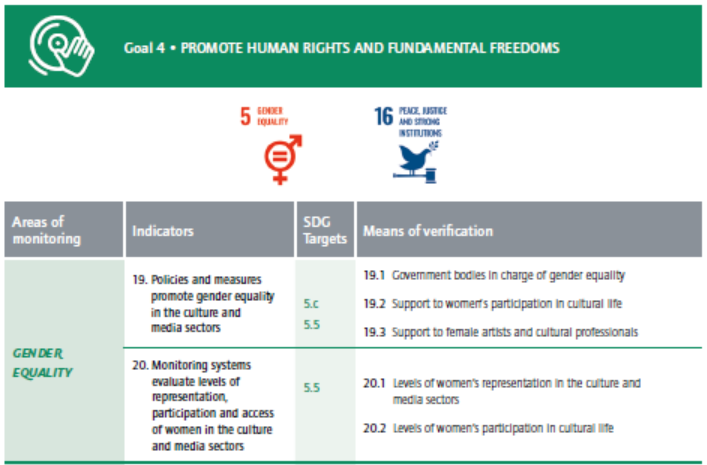
UNESCO 2005 Convention Monitoring Framework (2005 Convention Global Report 2022)

Example from the UNESCO 2005 Convention Monitoring Framework


Note that each goal is specifically linked to corresponding SDGs. Further, each indicator is linked to one or more SDG targets, which directly connect it to specific tasks or outcomes within the SDG framework.

From the above example, policies and measures which promote gender equality in the culture and media sector indicate progress towards the Gender Equality monitoring area. This supports Goal 4 (Promote Human Rights and Fundamental Freedoms), which aligns with SDG #4 (Gender Equality).

However, even more specifically, this indicator is linked to SDG targets 5.c, which concerns adapting policies and enforceable legislation to support women and girls, and 5.5, which concerns equal participation and opportunities for leadership.

Why is this framework important?

Evidence-based policymaking is key to successful implementation of the Convention. This framework helps policymakers and other stakeholders better understand how supporting cultural diversity can impact on sustainable development.

For IFLA’s members – looking at the Monitoring Framework is a practical way to envision how the work your library is already doing – or could be doing in the future – aligns with these goals.

To start, could you think of library initiatives that satisfy these indicators? 

  • Policies and measures support diversity of the media (Goal 1)
  • Policies and measures facilitate access to diverse cultural expressions in the digital environment (Goal 1)
  • Operational programmes support the mobility of artists and cultural professionals, notably from developing countries (Goal 2)
  • Policies and measures support equity in the distribution of cultural resources and inclusive access to such resources (Goal 3)
  • Policies and measures promote and protect freedoms of creation and expression and participation in cultural life (Goal 4)

Explore further: Monitoring Framework – UNESCO 2005 Convention (from the 2005 Convention Global Report 2022)

Making your Impact Known

Countries that are party to the 2005 Convention are required to submit a report on their progress once every four years. These are called Quadrennial Periodic Reports, or QPRs.

In 2019, UNESCO reformed the reports to align directly with the Monitoring Framework. This data collections allows UNESCO to take a holistic look at how the world is protecting and promoting diverse cultural expressions, and how this relates directly to sustainable development.

UNESCO’s most recent overview of the state of cultural policy was debuted earlier this year: Re|Shaping Policies for Creativity: 2005 Convention Global Report 2022

Why are QPRs relevant for libraries?

QPRs present an opportunity for libraries and library associations to make their impact directly known to national cultural authorities and beyond.

Since 2019, UNESCO invites civil society stakeholders to participate in reporting with a dedicated Civil Society Organisation form.  This form follows the reporting framework and allows civil society to share information on their initiatives for inclusion in the final national report.

UNESCO reports that 77% of QPRs submitted since 2019 included measures or initiatives undertaken by civil society organisations, so the willingness to include such input is clearly being demonstrated.

To make your impact known, follow these steps:

  1. Find out when your country’s next QPR is due: Periodic Reports
  2. Download the Civil Society Organisation form [download the word document here].
  3. Review the Monitoring Framework and determine relevant measures and initiatives your organisation/institution/ association has implemented in the last four years
  4. Get in touch with your National Point of Contact [list and contact details here], who is responsible for coordinating reporting in your country. Let them know you are completing the Civil Society Organisation form.
  5. Share the completed civil society organisation form with your National Point of Contact roughly six months before the deadline for submission

Coming Up

In September 2022, the UNESCO World Conference on Cultural Policies and Sustainable DevelopmentMONDIACULT 2022 – will bring cultural policymakers and stakeholders from across the world together in Mexico City.

This conference will accelerate the global dialolgue on culture’s role in sustainable development and define immediate and future priorities.

Watch IFLA discuss ways in which libraries fit into these discussions here: ResiliArtxMondiacult 2022  

To prepare for these discussions, IFLA is using insights collected through the 2005 Convention monitoring and reporting scheme to map ways in which libraries are being recognised as contributing to the goals of the Convention – and corresponding sustainable development goals.

There are myriad examples included in this body of information. For example, the 2005 Convention Global Report 2022 already provides some insight:

Goal 1: Supporting sustainable systems of governance for culture

  • “Several countries, including Egypt, Norway, Qatar and Slovakia, have begun extensive work to digitize their national libraries, thereby facilitating access to, and the discoverability of, local cultural content in several languages” (UNESCO, 2022, pg. 107)
  • “National Library for the Disabled [Republic of Korea] increased its membership by 84% in 2021 alone, as it expanded its provision in Braille, voice over and sign language” (UNESCO, 2022, pg. 105)

Goal 2: Achieve a balanced flow of cultural goods and services and increase mobility

  • “China and Niger signed a cultural cooperation agreement to exchange information and expertise in the areas of audiovisual, publishing, libraries and exhibitions” (UNESCO, 2022, pg. 178)

Goal 3: Integrate culture in sustainable development

  • “Developing and developed countries all implement a variety of measures for ensuring access to culture outside of the main urban areas… [for example] mobile libraries and bookstores deployed to stimulate reading (China, Egypt, Iraq).” (UNESCO, 2022, pg. 222)
  • “Given that the COVID-19 pandemic has highlighted the challenge of digital exclusion, it is encouraging to see the reporting of measures aimed at ensuring greater connectivity in libraries across national territories (Argentina, Costa Rica).” (UNESCO, 2022, pg. 222)

IFLA will continue reviewing the body of reports submitted since 2019 to collect quantifiable data on the number of library-related measures and initiatives within each of the Convention’s four objectives. This study with further provide qualifiable data regarding innovative library initiatives that can serve as inspiration for the future.

Stay tuned for more in the lead up to Mondiacult 2022!

For questions or assistance: [email protected]
Amplifying Library Stories: How Libraries are Taking Climate Action

In the leadup to the UN Climate Change Conference (COP26), IFLA asked the Standing Committee of the Environment Sustainability and Libraries Section (ENSULIB) to share examples of libraries educating, connecting and empowering their communities to take climate action.

We were happy to share some guest articles on IFLA’s Policy and Advocacy blog to highlight library initiatives that promote climate action and empowerment in their communities.

 Green FUBib: Sustainability at the University Library

This article offers a look at the GreenFUBib group, a permanent working group that is committed to promoting sustainable action in everyday library life at the University Library of the Freie Universität Berlin.

“GreenFUBib wants to contribute to filling the strategic terms of sustainability and responsibility with life in everyday library activities. In line with the 17 global sustainability goals, it keeps not only the ecological, but also the economic, social and cultural dimensions in mind.”

The working group seeks to address the following questions through their activities:

  • Where can something be done for sustainability and climate protection in the everyday work at the library?
  • Which measures are low-threshold and effective?
  • Which ideas can be implemented for all, or at least most, library locations?

Readers can find an overview of activities carried out by the GreenFUBib group, including choosing more sustainable library practices, like finding plastic-free options, organising educational events, and establishing a library garden. The author also offers a look at future plans on the group, and partners within the university community with whom the working group cooperates to achieve their goals.

This article could be a helpful reference for those who might be interested in establishing similar working groups in their libraries, or in implementing more sustainable everyday library practices.

Contributed by Janet Wagner, Librarian at the Universitätsbibliothek der Freien Universität Berlin (Germany).

Read the full article here: Green FUBib: Sustainability at the University Library

Climate Change in the Spotlight of RECIDA, the Spanish Network of Green Libraries

This article offers a glimpse into recent actions of the Spanish Network of Green Libraries (RECIDA).

This includes participation in the 12th Seminar of Environmental Documentation Centers and Protected Natural Areas, held in October 2021. This Seminar brought together state and regional institutions, universities, researchers, representatives of natural spaces and NGOs in a multi-stakeholder forum for collaboration and exchanges through the RECIDA network.

RECIDA, the Spanish network of green libraries, has been working for sustainability for 20 years. Included in RECIDA’s Action Plan are actions to raise awareness and mitigate climate changes and work towards impacting on the Sustainable Development Goals (SDGs).

Some experiences highlighted by the RECIDA network during this conference which implement their Action Plan include:

  • Establishing reading clubs in environmental information centers which introduce environmental reading material to the public and raise awareness of the climate emergency
  • The initiative Literary Ecomenu, which encourages users to read, gaze, feel and marvel at nature through words and books.
  • Creation of educational materials for eco-social education aimed at addressing social, economic and ecological challenges

Readers may be interested in the approach of this network, which highlights how library and information professionals can have an impact on climate empowerment. In addition to ideas for action, this article also provides resources shared during the RECIDA network’s recent conference. Further, it provides an example of a multistakeholder approach to integrating libraries in climate action – especially through establishing relationships with academia, other NGOs, and government agencies, especially representing national parks.

Contributed by Rosario Toril Moreno, Documentalist at the National Center of Environmental Education, (Spain).

Read the full article here: Climate Change in the Spotlight of RECIDA, the Spanish Network of Green Libraries

Green Library Awards

During IFLA’s engagement in COP26 (read more on that here), we also drew inspiration from recent winners and runners-up of the IFLA Green Library Awards.

Although we only had time to share a few during COP26 events, we invited the audience to explore the many more examples of excellent library initiatives available on our website.

Have you revisited the Green Library Awards lately? Find inspiration here: IFLA Green Library Awards.

Do you have a similar example to share? Please reach out: [email protected]

Learning, Encountering, and Exploring: Libraries Making Space for Cultural Diversity

On World Day for Cultural Diversity for Dialogue and Development (21 May), the UN invites reflection and recognition of the importance of ensuring the ability to create and access diverse cultural expressions.

This is critical for implementing the UNESCO Convention on the Protection and Promotion of the Diversity of Cultural Expressions (2005). Libraries have an important role to play in fostering an environment where diverse cultural expressions are encouraged, valued, shared, and protected. Find out more about the 2005 Convention through IFLA’s Get into Guide here.

The COVID-19 pandemic has made it more important than ever to reflect on the value that access to and engagement with culture has for society. It also is an urgent call to work collaboratively to identify the gaps which must be addressed to ensure this access.

In 2020, IFLA marked this day by helping launch the #culture2030goal Statement on Culture and the Covid-19 Pandemic, a joint effort by IFLA and partners organisations. This statement called for culture to be at the heart of the COVID-19 response and reaffirmed the value of culture in the 2030 Agenda.

To build on this statement, we will take a deeper look at some examples of how libraries contribute to socially sustainable development by enabling culture to be accessed, explored and shared – including in the virtual space. Thank you to IFLA’s Library Services to Multicultural Populations Section, as well as to the wider library field, for sharing your stories!

Culture, Dialogue, and Social Inclusion

Promotion of a diversity of cultural expressions also includes creating space for dialogue among people and cultures, building respect and mutual understanding.

Many libraries offer programmes to inspire this dialogue in a literal way – through language learning programmes. These are often targeted at the most vulnerable members in society, and act as a means to promote social inclusion and cultural exchange. See examples from Norway and Germany for more.

The Bibliothèque Publique d’Information (BPI) Paris, France found that forging connection through language learning could continue despite closures due to the pandemic. A series of online FLE (français langue étrangère / French as a foreign language) workshops arranged by the library in 2020 connected French learners from both within France and beyond, including participants from Brazil, the United States, the Czech Republic, and Colombia [more here].

Like language learning, arts and art education can also be a tool for social inclusion – a vital aspect in towards the development goal “leave no one behind”.

The Invisible Youth Project (Finland) is one such example of an art-based initiative that targeted youth at risk of social exclusion by promoting creative self-expression.

Through this project, public libraries in the cities Jyväskylä, Seinäjoki, and Turku created space for participants to learn about a variety of creative activities such as design, cartoons, creative and therapeutic writing, digital storytelling, rap music, and video producing.

As social exclusion can stem from a variety of social issues, including poverty, disabilities, limited education, and migrant/marginalised backgrounds, addressing this is an aspect of sustainable development.

Libraries reaching out to those at risk of exclusion, while also promoting cultural expression as a means for social inclusion, can therefore be a driver of sustainable social development. 

Cultural Dialogue Through Library Programming

During the pandemic, many libraries were faced with the challenge of connecting with their communities in the virtual space. For more, see our blog: Virtual Engagement / Actual Connection: building community around digital collections.

We can find many examples of virtual programmes that seek to help their audiences learn about different cultures and traditions through storytelling, such as this recent example from Qatar National Library: Eid Around the World: Unique Traditions from Different Countries.

These programmes can also help connect people to arts and cultural expressions – despite physical distance.

Connections through Poetry

In 2019, Bremen Public Library (Germany) established the project, Lyrik grenzenlos (Poetry without Borders). The goal of this programme was to create an open space for people to come together and enjoy poetry from all over the world.

In addition to building appreciation for the art form, this event included an element of cross-cultural exchange, as participants were invited to recite poetry in their mother tongue, and were accompanied by local musicians with international backgrounds. Poetry was shared in Arabic, Turkish, French, Spanish, Bulgarian, Igbo, Persian, Russian and a variety of German dialects during the in-person event.

The library did not want to lose this community they had built in the face of the outbreak of COVID-19. Therefore, they went digitial, asking participants to create short videos of recitations. You can view the final video online [introduction in German].

As literature like poetry can be a vehicle for cultural exchange, it can also be a means to establish and celebrate a cultural common ground.

Recent hybrid in-person/virtual events at the State Public Library of Guadalajara included a celebration of poetic improvisation as a creative expression shared by Spain and Latin America.

This event explored the tenth, a form of poetry which originated in the Spanish Golden Age and has since become an important poetic-musical phenomenon, uniting Spanish-speakers on both sides of the Atlantic [more here].

Cultural Heritage and Modern Creators

Libraries can help connect unique expressions of intangible cultural heritage to contemporary creators, helping enable the continuation of tradition, while opening the door to modern interpretations.

The National Library of New Zealand Te Aotearoa included in its recent lecture series an event featuring researcher Michael Vinten, and his project collecting and publishing pre-1950 New Zealand art-song. The goal of this project, and the library’s session, was to help facilitate exposure to this form of traditional music to help modern musicians and music students include New Zealand material into their repertoire.

Another example of this was the National Library of France (BNF) participation in the Europeana Sounds project [more here]. The BNF provided metadata to help increase opportunities for access to and creative re-use of Europeana’s audio and audio-related content.

These examples showcase how libraries can help their communities discover and share diverse cultural expressions. Moreover, they exemplify how this goes beyond enjoyment of culture itself. Cultural programming in libraries can be a platform to build connections, facilitate cultural exchange, and enable the creation of new cultural expressions.

GLAM collaboration and cultural education

For International Museum Day (18 May), IFLA reaffirmed the importance of the GLAM (galleries, libraries, archives, museums) sector working together to achieve goals relating to sustainable development (see more on our blog).

One example of libraries and galleries collaborating to connect contemporary art to library users, and find new audiences for both institutions, is the project How to Speak Art (Croatia). This was a cooperative initiative between Silvije Strahimir Kranjčević Library, part of Zagreb City Libraries, and Windows (Prozori) Gallery.

This project combined the curatorial expertise of the gallery with the library’s position as public community space to build exposure to and appreciation of contemporary art. It included an educational aspect for school children, which developed artistic literacy, and fostered an understanding of the role that art can have in their life.

Collaboration between cultural actors can present new opportunities for enhancing the social capital of the arts and those institutions which provide access to it.

Community Heritage Grants

Connecting resources to cultural actors and helping build capacity for community-level cultural activities is an important aspect of access to diverse expressions of culture. Libraries can play a key part in ensuring they achieve their goals.

Australia’s Community Heritage Grants are administrated by the National Library of Australia and funded by the Australian Government through the Department of Infrastructure, Transport, Regional Development and Communications (Office for the Arts); National Library of Australia; the National Archives of Australia; the National Film and Sound Archive and the National Museum of Australia.

These grants are aimed at helping community collections-holding organisations such as libraries, archives, museums, historical societies, and Indigenous groups make their materials more publicly accessible.

Past grant recipients have included community galleries, arts and creative communities, such as the Anangu Uwankaraku Punu Aboriginal Corporation’s Maruku Arts Collection, the Papunya Tjupi Arts Indigenous arts gallery, and the Naracoorte Regional Art Gallery – all community-based galleries showcasing unique cultural heritage and contemporary creative expressions.

Through such programmes, libraries, especially National Libraries, who have the ability to collaborate with national and regional governments can have a real impact on the ongoing accessibility of arts and diverse cultural expressions.

****

Libraries are key components in a sustainable ecosystem for creators and cultural actors. They are platforms for the arts to be experienced, enablers of multicultural and multilingual exchange and learning, and facilitators of initiatives that connect creators to opportunity.

IFLA will continue our work in advocating for the library field’s role in preserving and providing access to cultural heritage during the Third Civil Society Forum of the 2005 Convention (31 May 2021).

Get involved! As 2021 is the International Year of Creative Economy for Sustainable Development, we welcome more examples of libraries creating space for diverse cultural expressions! You are invited to share your own.

Libraries at the Heart of Educational, Social, Cultural, Innovation and Democratic Infrastructure

When we talk about infrastructure, it’s easiest to think of things like roads, railways, bridges.

Things that connect us together, allowing economies and societies to work. Things that serve many people, and many purposes, providing a basic service that you may take for granted when you have, but that you miss when you don’t.

They combine with other activities – production of goods, provision of services, engagement between people – in order to support growth and social cohesion.

While traditionally, as mentioned, we tend to see infrastructure as being about transport, it is also clearly applicable to other types of connection, such as energy or connectivity.

Again, these are clearly essential for allowing all sorts of different activities – economic and otherwise. They make it possible for more focused interventions – such as business support, training programmes or other initiatives – to create healthy and equitable economies and societies. We have already blogged about the role of libraries in connectivity infrastructure.

This idea of infrastructure as a basic service supporting the delivery of wider success can also apply to other policy areas. They also rely both on there being structures in place, as well as ongoing services or other activities.

This blog explores this idea for a number of policies, and underlines how libraries are, arguably, a core part of these other infrastructures.


Educational infrastructure: ensuring that everyone has the chance to learn and develop throughout life should be a clear priority for any economy or society. Core to achieving this are of course great teachers, helping children and others.

But they in turn rely on having access to adequate schools, with the facilities and resources to make their job easier. Within schools, libraries represent a crucial resource, not only helping teachers with materials, but also helping develop key skills, and providing a space for students to extend their learning.

Looking beyond people of school age, there is a key role for further education colleges, but also for community institutions such as libraries which provide both a portal and a platform for learning.

By putting potential learners in touch with opportunities, providing a space for education initiatives, and enabling self-led learning, a strong library network can provide a crucial infrastructure for education providers for people of all ages.


Social Infrastructure: social policy is most often associated with a combination of targeted benefits or supports, and interventions and programmes focused on individuals, in order to promote inclusion, equality and cohesion.

But achieving this goal in a lasting fashion requires more. Eric Klinenberg has of course already popularised the idea of libraries representing a form of social infrastructure – a key basic service on which successful societies can be built.

They do this by providing a space, and a reference point, for communities. They also enable the achievement of the goals of other programmes through providing a space where everyone can feel welcome, and supporting the education and development that is often at the heart of reintegration.

Once again, this support can come simply through the presence of welcoming libraries, through their own programming, or through their role in providing a portal to, or platform for, services provided by others.


Cultural Infrastructure: culture can be both a goal in itself, and instrumental in supporting wider policy objectives such as cohesion, innovation, and wellbeing. It should also, clearly, be egalitarian, giving everyone the possibility both to benefit from the ideas of others, and to come up with their own.

While plenty of creativity happens everyone, including of course in people’s homes, there is nonetheless a need for infrastructure. Especially for the performing arts, the existence of theatres and other venues is clear in order to allow creative individuals and groups to connect with audiences.

Yet literature too has its venues, in the form of libraries, bookshops and other places that allow people to discover and enjoy writing. Indeed, these are often the most local cultural centre that many people have!

Indeed, especially for those who many not benefit from having their own quiet space at home, the possibility to visit a library in order to read, and discover new ideas, is clear. Libraries can also provide a gateway to other forms of culture, encouraging users to express their creativity in other ways through hosting events or providing access.


Innovation Infrastructure: research and innovation too benefit from being able to count on a core infrastructure. Governments can invest in things like super-computers (to provide the computing power for advanced analysis), venues for carrying out tests and experiments, or open science infrastructures. These allow researchers and innovators to go further, and faster, than would otherwise be possible.

Libraries, too, are arguably essential parts of the innovation infrastructure of any country, providing access to existing knowledge, and supporting the production and dissemination of new ideas. They have also, clearly, been at the heart of advocacy for open access and open science.

It is worth noting the importance of special collections and specialised knowledge which may only exist in one or a few places within a country, or even globally. Even relatively small libraries can be irreplaceable parts of the innovation infrastructure.


Democratic Infrastructure: democracy, first and foremost, is about people using their rights to decide who should be in power, or indeed what those who are in power should do. This happens through voting, in person, by post or proxy, or even online.

Yet for the choice people make on election or referendum days to be meaningful, more is needed than polling stations and vote-counting offices. Democracy also relies on informed individuals, and a sense of shared belonging.

Achieving this also relies on infrastructures – spaces and programmes to build an understanding of issues and debates, as well as simply where people can see and feel that they are part of the same community as their neighbours and others.

Libraries contribute to this, through acting as a social infrastructure (see above), through giving space for discussion and debate, through hosting and supporting engagement with open government data and beyond. They can also simply help by being a symbol of public service within the community, reminding people of what governments do, and why this matters.


Conclusion

The blog has looked at just five areas where, arguably, policy success benefits from – or even depend on – the existence of an infrastructure enabling more focused activities to take place.

Of course, the problem is that when the benefits created by such infrastructures are widely spread, it can be difficult to convince any single individual or business is likely to want – or be able – to pay for such infrastructure on their own. Why should they pay when others benefit?

This is why governments often have such an important role in supporting infrastructure, ensuring that it is part of any wider plan, either policy area by policy area, or in wider sustainable development strategies.

In each of the areas set out here – and beyond – there is a therefore a case to be made to governments that libraries need to be seen, and supported, as vital infrastructures, and accordingly integrated into plans and strategies for success. Indeed, given the unique cross-cutting role of libraries, our institutions arguably need to be integrated into plans at the highest level, to ensure that their potential to facilitate progress is fully realised.

Building Your Evidence Base Across the SDGs

Today marks the beginning of SDG Action Week, a celebration of the work currently taking place to deliver on the Global Goals, and an opportunity to reflect on what more needs to be done.

Clearly, with the consequences of the COVID-19 Pandemic, reaching the Sustainable Development Goals seems as challenging as ever, as highlighted in the Gates Foundation’s Goalkeepers report earlier this week.

The Week will see great ideas being shared on how to ensure an effective response to the pandemic now, and a rapid and equitable recovery afterwards. We have already encouraged libraries to take part in the events, and share their own ideas.

Of course, it’s not just during SDG Action Week that it’s important to share these ideas! Governments are taking decisions related to sustainable development all the time.

In order to ensure that libraries are fully recognised and integrated into policy planning, it is important to have examples and ideas to hand

IFLA already makes two great resources available for this. First of all, the SDG Stories on IFLA’s Library Map of the World provide a growing set of examples. Those who have shared examples there not only help colleagues in their advocacy, but receive profile for their own work.

Secondly, we have a collection of national awareness raising materials, produced by library associations and groups of libraries, illustrating how our institutions are contributing to achieving the SDGs.

It can help to prepare your own list of such stories. This doesn’t need to be formally presented (although of course, it can be powerful if you do!), but even having it ready when preparing meetings, news stories or other events can be useful?

How to go about this?

Sometimes, contributions are clear. Libraries have an obvious and traditional role in supporting literacy (SDG4), connectivity (SDG9 and SDG17), and the safeguarding of heritage (SDG11). There are already lots of great examples on the Library Map of the World about these.

But of course libraries contribute across the board.

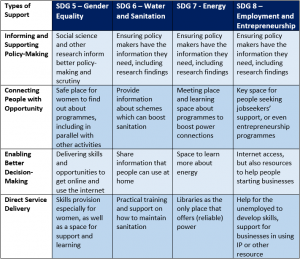
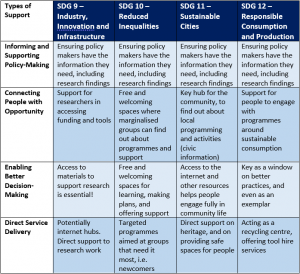
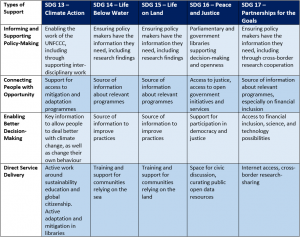
In order to help you think about your library, or libraries in your country, here are four ways which – in the case of each of the SDGs – libraries are contributing:

1) How are libraries informing and supporting policy-making? For example, in all of the policy areas across the SDGs, libraries are likely to be supporting research and other efforts to build understanding of the world around us. Within governments, they are helping deliver evidence-based policy making, while those in parliaments are helping legislatures holding those in power to account.

2) How are libraries connecting people with opportunities? Public efforts to support development are often only as effective as the communication about them. Work to promote knowledge of, and access to public benefits, programmes or services can make a real difference, for example through internet access, noticeboards or proactive advice and support for users. This is particular the case for users who are unconnected at home, or unwilling to visit official buildings.

3) How are libraries enabling better decision-making at the individual level? Of course, not all support comes from government sources! For people to make decisions about their own lives and work, there are plenty of other places to find information, both in library collections and on websites accessible at (or thanks to) libraries. Librarians of course do help people develop the skills and confidence to make full use of this information to improve their lives.

4) How are libraries delivering services directly? As highlighted, libraries are involved in directly providing services such as literacy, internet access, access to research or preservation and conservation. Increasingly, there are also programmes supporting other SDGs. But it’s not just about what librarians themselves do! Libraries can also be platforms and facilitators, helping others to deliver programmes that help make change happen – and indeed, this can be a great way of increasing impact!

Below, we set out a grid sharing some ideas for first answers to each of these questions, for each of the SDGs.

Grid showing how libraries contribute to achieving each of the SDGs in different ways


Grid showing how libraries contribute to achieving each of the SDGs in different ways


Grid showing how libraries contribute to achieving each of the SDGs in different ways


Grid showing how libraries contribute to achieving each of the SDGs in different ways

If you are trying to put together your own database of examples to use in your advocacy, we hope these help you to identify where to look! And of course, once you have found your examples, you can use our SDG Storytelling Manual to develop them into full stories!

SDG Success in the Balance: Lessons from the 2020 Goalkeepers Report

As world leaders prepare to participate in the United Nations General Assembly, the Gates Foundation has released its 2020 Goalkeepers Report.

Focusing on a subset of indicators and themes featured in the UN’s 2030 Agenda, it looks to trace progress on key issues linked to the work of the Foundation, in particular health, poverty, education and equality.

These are, of course, also areas which can be determining for overall development – illness, low-education, and the exclusion of whole parts of any population represent a serious drag on progress in any society.

The Report has received widespread attention in the media, especially that focused on development, with its warnings around the risks that the COVID-19 pandemic poses to progress towards achievement of the Sustainable Development Goals (SDGs).

For libraries, as institutions committed to promoting progress in the communities they serve, the report is worth reading in order to understand the state of the world now. A number of conclusions in particular stand out – this blog explores just five:

The COVID-19 Pandemic stands to send us backwards in delivering on the 2030 Agenda: the first five years of the SDGs had, at least until the arrival of the pandemic, seen useful progress in fighting poverty and disease around the world. However, as the Report underlines, this progress has stopped in many areas. Indeed, we risk seeing 25 years of progress disappear in the space of 25 weeks when it comes to vaccinations. This needs to serve as a wake-up call for all those working to deliver stronger, fairer, more sustainable societies – we need to be careful to ensure that this set-back is not permanent.

We are facing a set of ‘mutually exacerbating catastrophes’: the Report underlines that the crisis is a complex one. While the immediate challenge is of course to restrict the spread of the virus until a vaccine can be found and deployed, there are already economic, social and educational catastrophes. Indeed, the loss of livelihoods, closure of schools and other steps may in turn create new health challenges outside of COVID-19, not least as concerns other vaccination and public health programmes.

The risks are highest for those already facing marginalisation: the Goalkeepers initiative, from its creation, has focused strongly on the situation of those most at risk of marginalisation. The 2020 edition underlines emerging signs that the pandemic will make inequality worse. For example, reduced demand and rules on distancing have made impossible many of the jobs – often informal – on which people facing poverty, and in particular women, depend. There are also concerns that when children start to return to school, girls will be held back, and of course children living in households without broadband access have been unable to benefit from distance learning in the same way as better connected peers.

In tough times, we cannot necessarily count on more money: the Report makes the stark warning that it is often the countries that need help most that are least able to provide it. Whereas already rich countries can borrow money for stimulus programmes, poorer ones face much higher interest rates, reducing their options. Yet even in richer countries, debts incurred today will need to be paid back tomorrow. Part of the response will, as the Report suggests, need to be a new mobilisation at the international level to get help to where it is needed. But implicit in this also is the need to make best use of the resources and infrastructures that we already have.

Libraries are in a position to help: in many of the areas highlighted by the report, the potential for libraries to contribute to the response is clear. Indeed, the support offered by the Gates Foundation over many years to libraries has made it possible to show what can be done. As pre-existing, familiar institutions around the world (there are 430 000 public and community libraries, one for every 15 000 people in countries for which we have data), working through libraries represents low-hanging fruit.

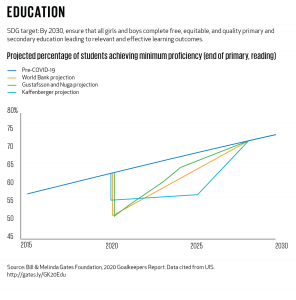
Graph from Goalkeepers Report showing risk of regression in literacy levels among childrenThe most obvious area where libraries can support progress is on education, where different projections all anticipate a drop in the share of children at the end of primary education able to read and understand a simple text. Clearly schools are at the heart of the response, but libraries can complement this by helping children engage with language from a young age, drawing on well-established expertise, as underlined by UNESCO.

Another potential area is reproductive health. Again, this is an area where health professionals themselves will take the lead, but where information – and access to this – is a key part of the response, as set out in IFLA’s response to a consultation by the UN’s Human Rights Council.

A third area is around financial services to the poor. Clearly, libraries themselves are not in a position to offer loans or protect savings, but can help provide the connectivity necessary for any digital banking services to reach people. The role of libraries in providing public access to the internet is well-recognised, and was even, in 2015, identified as the single most cost-effective way of bringing the next billion online.


There is much more in the Report, as well as great tools for exploring the data and understanding where your country stands on the indicators selected. There is also strong potential to draw on the key messages highlighted above, both to focus reflection within the library field, and underline how libraries can be part of the solution, if they are properly included in policy planning.

What’s on the Agenda for Libraries and the SDGs in the Rest of 2020?

2020 has been a big year for the Sustainable Development Goals (SDGs). A third of the way into the time Member States gave themselves for their implementation, there is only a decade left to deliver.

Clearly, this is not the only way in which 2020 has not been a normal year.

Following the African Regional Forum on Sustainable Development in February, all other regional meetings on the SDGs were held virtually or simply postponed. Similarly, the 2020 High Level Political Forum took place online.

However, work has continued, and indeed is as important as ever as the world looks to make progress while also dealing with the consequences of the pandemic.

This emphasis on the need to accelerate efforts to make a reality of sustainable development will therefore mark the last four months of the year, and bring with it opportunities for libraries to highlight the role they can play.

Here are just a few of those opportunities:

18 September – SDG Moment: in the context of the United Nations General Assembly, there will be a morning where heads of state and government will underline their commitment to the SDGs. For those countries participating (the list is not yet available), this could be an opportunity to underline your work around the SDGs on social media. Find out more here.

18-25 September – Global Goals Week: also taking place at the time of the UN General Assembly, Global Goals Week offers a programme of events and activities, online, that run from the 18 September SDG moment to the anniversary of the agreement of the UN 2030 Agenda on 25 September. In particular, look out for the global day of factivism on 25 September, where people will share facts that set out how the world is doing towards achieving the SDGs – a perfect opportunity for the library field to show what it can do! Find out more here.

28 September – International Day for the Universal Access to Information: September is a busy month! Following four years as a UNESCO international day, last year, the UN General Assembly upgraded the International Day for the Universal Access to Information to a UN-level observance. With a strong focus on the power of information to improve lives, it’s a great opportunity to share how libraries make a difference, through social media, op-eds, or letters to newspapers, radio or TV shows. Find out more here.

October – Urban October: the month of October opens with World Habitat Day on 5 October, and ends with World Cities Day on 31 October. With libraries playing a major and acknowledged role in promoting inclusion and social cohesion, it’s a great time to be highlighting how libraries build communities. IFLA will be planning communications around the celebrations and will share information in due course, but you also can register events on the Urban October website. Find out more here.

19-21 October – World Data Forum: while it will not be possible to meet in person, the virtual World Data Forum provides a great learning opportunity for anyone interested in how statistics are being – or can be – used to strengthen efforts to deliver the SDGs. IFLA will be highlighting its own statistical outputs – and what you can do with them – with a special focus on World Statistics Day on 20 October. Find out more here.

24 October – UN Day/World Development Information Day: another opportunity to highlight how libraries and information contribute to sustainable development is World Development Information Day. This can be an opportunity to show how libraries are supporting research addressing major development challenges, and so accelerating progress towards the SDGs! Find out more here.


There are also ongoing projects where you can play a role:

Gather stories and data to power your advocacy! You can help both yourself and colleagues elsewhere in the world by contributing stories, data and country profiles to the Library Map of the World. Find out more on the website.

Establish or refresh your contacts with SDG leads in your country: do the people responsible for delivering on the SDGs in your country know about what libraries can provide? Try to find out who is in charge in government and parliament, as well as among civil society organisations. There are great examples from Brazil and Costa Rica of the benefits of forming these links.

Get involved in preparing your country’s Voluntary National Review: for the countries which will undertake Voluntary National Reviews (VNRs) of progress towards the SDGs in 2021, it is useful to try and understand early what the process will be. A provisional list is already available, and will be finalised soon. If your country is on there, find out how the process will be run, and consult our guide on engaging in VNRs.


Good luck, and please do share your plans, either in the comments below or by e-mailing us at [email protected]!