Tag Archives: sustainable development

The Right to the City is the Right to a Library

A key theme at the World Summit of Local and Regional Leaders, taking place this week in Durban, is how action at the local level contributes to building a better world for everyone.

The Summit’s organisers – United Cities and Local Government – have strongly and successfully made the case for the role of regions and cities in delivering the Sustainable Development Goals, both through a dedicated Goal (SDG11), and contributions across the 2030 Agenda.

In this context, they have placed a strong emphasis on the concept of the ‘Right to the City’ as a framework for thinking through how to develop local policies, and so deliver on the commitments made.

Given the focus on the idea, this blog offers an explanation of what the Right to the City means, and how libraries fit in – both as an example of this right in action, and as a means of making a reality of other policy goals.


What is the Right to the City?

As a support to the session focusing on the subject at the World Summit, the Global Platform for the Right to the City has prepared a background paper.

This discusses the emergence of the idea, defined as ‘the right of all inhabitants (present and future; permanent and temporary) to use, occupy, produce, govern and enjoy just, inclusive, safe and sustainable cities, villages and settlements defined as common goods’.

In effect, it covers all existing economic, social, cultural and human rights, but does so from the perspective of place.

This marks it out from approaches that look only at national law-making, or the individual perspective, in order to take account of the impact of the environment where people live.

In doing this, it implies that the villages, towns and cities in which people live – and so the people and bodies that govern them – have both the possibility and the duty to change lives, and deliver global goals.

According to the Global Platform, the Right to the City has a number of dimensions: the idea that cities have a social function, that public spaces are important, that rural-urban linkages need to be strengthened and made sustainable, that economic and civic life should be inclusive, that political participation should be enhanced, that people should not be subject to discrimination, and that cultural diversity should be preserved and promoted.

In each of these areas, the background paper sets out recommendations and actions for local, national and global decision-makers.


Libraries as an Example of the Right to the City at Work

The thinking behind the Right to the City will be familiar for anyone interested in libraries.

As documents such as the Public Library Manifesto set out, libraries serving communities are founded on a belief in the importance of public services dedicated to enabling and empowering all members of society.

Public libraries in particular are often the only free, non-commercial indoor public space in a community, giving people a context and setting for realising their own potential and creating links with others. In doing so, they help develop social capital, as well as being a source of civic pride.

Libraries also have a specific mission to take steps to reach out to those members of the community who would otherwise risk exclusion. This is essential. While possibilities may officially be open to all, without a specific focus on groups vulnerable to exclusion, those who need them most may struggle to seize them.

As set out in the Public Library Manifesto, as well as in laws in many countries, libraries have a mission to develop programming for specific groups, or otherwise take the steps needed to reach everyone meaningfully.

Through this, libraries provide a service with a strong spatial dimension, illustrating the Right to the City at work.


Libraries as Partner for Delivering the Right to the City

The potential contribution of libraries stretches beyond simply being an example of the Right to the City at work. Yet the services and support that libraries provide can be as much of an enabler as an end in themselves.

This is easy to see when it comes to cultural diversity, given libraries’ role in giving access to collections that reflect the diversity of their communities, in preserving this creation for the future, and in stimulating new creation.

But it also applies to other areas, such as economic opportunity, political participation, and allowing for social mobility. This is down to their role in delivering access to information and the skills that allow everyone to use it – a vital first step for almost any other policy.

For example, through the equitable provision of information, libraries are connecting people with employment and training opportunities. This is the case in Tunisia, where women in rural areas are using skills developed at the library to create economic opportunities.

They are also making it easier for people to break out cycles of poverty, such as in Zagreb, Croatia, where libraries have proved to be ideal (and stigma-free) places to reach out to people experiencing homelessness and facilitate their economic and social reintegration.

They can also help citizens hold governments accountable, such as in Chattanooga, US, where the library hosts the city government’s open data platform, and has helped to make it as accessible and usable as possible.

Libraries also support engagement in policy development, such as in Medellín, Colombia, where libraries not only host pollution sensors, but also provide the skills to allow users to interpret the data received and reflect on what this means for local transport policy.

In short, libraries have the potential to be key partners for local governments on delivering on the Right to the City for their citizens.


Recommendations

This week’s meetings in Durban will be a great opportunity for local leaders from around the world to discuss how to turn the concept of the Right to the City into a reality.

In libraries, they not only have a pre-existing illustration of the Right at work, but also a key partner for delivering on it across the board. It’s now time to realise this potential!

Therefore, in order to deliver on the Right to the City, the following recommendations could be made:

  • Use libraries as a means of demonstrating what the right to the City means in reality
  • Enable libraries to use their potential as a public space to bring communities together
  • Integrate consideration of the importance of information and the skills to use it in any strategies for the implementation of the Right to the City, and make sure that libraries are part of delivery
Knowledge for Development: Libraries and the Global Sustainable Development Report

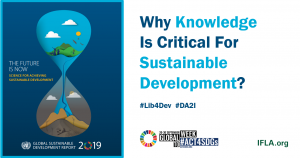
Image: hourglass shape with image of the sky and earth. Text: Why knowledge is critical for sustainable developmentThe Global Sustainable Development Report was released last week in time for discussions around progress on the United Nations 2030 Agenda at the UN’s General Assembly. The result of a collaboration between experts from different disciplines, from different parts of the world, is arguably the most complete knowledge contribution to work on the SDGs.

It is an effort to make the most of ideas and insights in order to build an understanding of where we stand in the effort to promote sustainable development. Crucially, and in coherence with the SDGs themselves, it aims to look across the board, and identify cross-cutting actions that are necessary to accelerate success.

As the prologue by Gro Harlem Brundtland underlines, it was by bringing together knowledge that it was possible to develop the concept of sustainability in the first place, and put the world on the way to the SDGs. And, as this blog sets out, the new report stresses that the role of knowledge is as great as ever.


Sustainability Insights

Thanks to the variety of perspectives brought by its authors, the report offers insights into the threats and opportunities which will determine whether we achieve the SDGs. Alongside climate change – the subject of the summit that ends today – loss of biodiversity, and increase in both waster and inequalities are particular concerns.

In response, coordinated policies focusing on human capacities and well-being, sustainable and just economies, food systems and nutrition, energy access and decarbonisation, urban and peri-urban development and the global environmental commons.

In all of these areas, as highlighted by IFLA’s Library Map of the World and Development and Access to Information report, libraries have much to contribute.

The Report stresses that underpinning the success of work in these areas will four levers –governance, economic and financial policies, individual and collective action, and science and technology. If used effectively, these can accelerate progress. The key to effectiveness, the authors argue, is having the knowledge and understanding of how our societies are working at all levels:

‘Decision makers need to act based on current knowledge and understanding of the linked human-social-environmental systems at all levels. That knowledge also needs to be more widely available to all countries and actors, motivating innovative coalitions and partnerships for success’.


Knowledge Matters

This emphasis on the importance of knowledge serves to underline the contributions that libraries can make. The need to gather, organise, give access to and apply information is as great as ever.

This is true, first of all, in the research context, where the report underlines concern that academics in developing countries too often cannot access the same range of materials as those in richer countries. This makes them less able to support local development, risking deepening global inequalities.

It also makes it harder to take the findings of research and apply them to real-world situations. As the report suggests, there is a need to intensify the science-policy interface, but this is made more complicated when paywalls stand in the way.

The authors therefore make a clear call on libraries, alongside governments, universities and research consortia, to take additional steps in order to provide open access not only to research, but also to underlying data (Recommendation A15). This, it argues, is a key way of addressing inequalities.

Linked to this, it also calls for efforts to promote cross-border research collaboration between countries in order to support knowledge flows, and suggests that development agencies should invest more in building science and research capacity in beneficiary countries. Libraries, inevitably, are a key part of this.


Among the many reports and papers released around the SDGs – and in particular the discussions at the General Assembly – the Global Sustainable Development Report is to be welcomed for its clear advocacy for the role of knowledge, and those who produce and give access to it.

What Makes Libraries Unique in Achieving… SDG17

DA2I means building and scaling up partnerships to transform knowledge into sustainable developmentThe final Sustainable Development Goal being reviewed in 2019 – and indeed every year at the High Level Political Forum is SDG17 – Partnerships for the Global Goals.

This is another broad goal, but makes the crucial point that cooperation and collaboration will be necessary for success. In more detail, it calls for a drive to strengthen the means of implementation and revitalise the global partnership for sustainable development.

The topics covered by different targets are diverse – trade, tax, development assistance, and statistics, technology, skills, policy-making – and there is a lot in there for libraries. On a more general level, libraries are well placed to participate in partnerships.

But how to explain this to decision-makers? This final blog in the series sets out three arguments around how libraries are unique in achieving SDG17:

  • Because technology transfer should be based on knowledge transfer: there is a major risk of a knowledge divide in the world, with richer countries better able to create and apply innovations. The SDGs stress that these good ideas should also spread across borders, in order not to leave whole countries or regions behind. Information is the basis of innovation, and by ensuring everyone, everywhere can find and use it, libraries not only help good ideas spread, but also support the creation of locally specific solutions.
  • Because places are necessary for partnership: when working to help people on the ground, we cannot only trust in apps and other technology. Building collaborative solutions, especially in order to include more vulnerable groups, requires spaces where actions can be discussed, adapted and owned by communities. Libraries, often the only public space in a community, can provide this, enabling other players to come together and deliver progress.
  • Because capacity building requires access to information: development cannot only be about donations or loans from rich to poor countries. In the long run, every country must have the capacity to take the best possible decisions and follow the best possible path. Information has to be a starting point and a foundation for improving the ability of governments at all levels to improve their effectiveness.

For more information about libraries’ potential in delivering partnerships for development, please see the 2019 Development and Access to Information (DA2I) Report.

What Makes Libraries Unique in Achieving… SDG 16

DA2I means engaged citizens, informed societies, and better governance The fifth Sustainable Development Goal under review at the 2019 High Level Political Forum is SDG 16 – peace, justice and strong institutions.

It is certainly one of the broader goals, covering promoting peaceful and inclusive societies for sustainable development, providing access to justice for all and building effective, accountable and inclusive institutions at all levels.

Crucially, it’s also the SDG that refers to the importance of access to information. IFLA has of course placed a major emphasis on this goal, promoting access as necessary for progress in so many other areas.

But how to promote the libraries to people – and in particular decision-makers – who care about peaceful, fair and well-governed societies? Here are three arguments for why libraries are unique in achieving SDG16:

  • Because democracy depends on informed societies: SDG 16 focuses strongly on the importance of giving citizens the possibility to participate in decision-making. To do this, and so build a successful and sustainable democracy, people need to have a strong knowledge of current issues and the choices that any society faces. Libraries are ideal places for people to engage in civic life, and to learn about and discuss key subjects.
  • Because open government is about more than just a website: there is growing acceptance of the value of transparency as a means of fighting corruption and ensuring accountability. Yet simply creating websites or apps, or passing laws will not make a difference if no-one is using them. There is a real need to give people the encouragement and the skills to make the most of these. Libraries have both an expertise in helping people make the most of information, and increasingly are supporting open government initiatives explicitly.
  • Because the best decisions are based on the best information: people who are taking decisions, both in government and parliaments rely on the best possible evidence and support in order to get things right. This matters, as the choices they make may well affect millions of citizens. Government and parliamentary libraries play an essential role in ensuring that those in power can access the latest research and ideas, and to do the best by their citizens.

For more information, please see the chapter on SDG16 in the 2019 Development and Access to Information (DA2I) Report by Dorothy Gordon, Chair of the Intergovernmental Committee of UNESCO’s Information for All Programme.

Libraries at the African Youth SDGs Summit

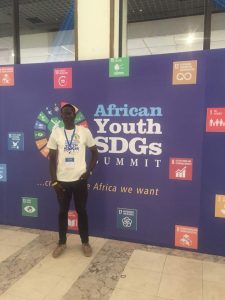
Damilare Oyedele at the African Youth SDGs Summit

Damilare Oyedele at the African Youth SDGs Summit

By Damilare Oyedele, Library and You

Over 1,200 young people from across Africa gathered at Accra International Conference Centre, Accra Ghana from 7th – 9th November for the 2nd edition of the African Youth SDGs Summit.

The African Youth SDGs Summit is an annual continental summit that gathers young people from across Africa to deliberate and design solutions that will facilitate the gradual implementation and accomplishment of the United Nations Sustainable Development Goals and the African Union 2063 Agenda.

This year, the theme for the summit was “Partnership with Youth to Achieve the SDGs: Moving from Policy to Actions”. The 3-day continental gathering of young changemakers across Africa created blueprints, networks, and implementation plans for young people’s engagement and inclusion in SDG planning and implementation across the continent.

In view of this, the importance of access to information as a necessity to achieve the Sustainable Development Goals was also deliberated upon on the day 3 of the summit. To this Damilare Oyedele, Co-Founder & Chief Executive; Library and You had a parallel session where he made a presentation on; Libraries in our society: Prerequisite for the successful accomplishment of the Sustainable Development Goals in Africa. The presentation gave birth to a project launch called Library Impact Project: access to information for Africa’s development

Library Impact Project is an initiative designed to provide capacity, create awareness on how libraries can contribute to the United Nations Sustainable Development Goals with the view to facilitate partnerships and collaborations with policymakers, individuals, changemakers across Africa to engage libraries in their countries to accomplish the SDGs.

It is obvious that Africa’s future lies in the hands of her youths, and we all have the responsibility to take action and create sustainable solutions that will transform ‘Mother Africa’, to create the Africa we want, to create a better place for the current generation and generations unborn. However, for this to be a feasibility, access to information for all is eminent beyond comparison.

Latest trends in open access: looking back at OpenCon

The Open Access movement is not standing still. Alongside the successes, there are also major questions and even concerns about inclusion, sustainability and whether it is achieving its original goals. OpenCon may not provide the answers, but provides an excellent opportunity to share ideas and hear new ones, and explore potential ways forwards.
The conference is held annually, organised by SPARC, and looks at open access, open science and open education. It is the only conference of its kind, gathering a small number of selected early career researchers, NGOs and government officials, as well as other actors involved from all over the world. This year’s OpenCon took place in Toronto from 2 to 4 November, and once again, it was an unforgettable experience.

Everything is set up in a way that makes every participant chat at least once with every one of the other participants. Panels take place in between story circles, do-a-thons, unconferences and regional workshops in which the audience takes over. This is what makes it so unique: a conference made, to a large extent, by its participants.

Given that it is difficult to summarise what happened at OpenCon altogether, here is a recap of some projects and topics that were discussed during the conference:

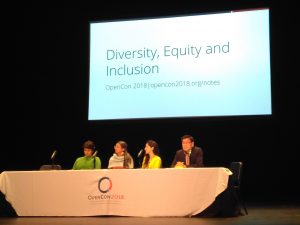
The panel on diversity, equity and inclusion in open research and education

This is one of the most-favoured panels in OpenCon, which goes back to its very essence. It is based on the fact that “while the Open Access, Open Data, and Open Education movements often lean on rhetoric around social justice, equity, and the democratization of knowledge, in many ways, the movements continue to marginalize underrepresented scholars and students. Mainstream efforts to advance Open centre digital solutions and dominant (often Western) ways of knowing”.
Panellists Jasmeen Patheja (Founder/ Director of Blank Noise), Leslie Chan (Associate Professor, University of Toronto Scarborough), Denisse Alboronoz (The Knowledge GAP, University of Toronto Scarboorugh) and Alexis C. (Pineapple Laboratories) introduced different perspectives and projects, that are all impacted by a lack of diversity, equity and inclusion or that could benefit from it. All panellists underlined the opportunity that the open access movement has to make change happen through knowledge sharing.

Denisse for instance talked about what it could mean to re-imagine open science from a feminist perspective, which she has been exploring at OCSD.net. Leslie looked into the global north and how institutions there could ensure that the open access movement fosters inclusion, diversity and equity.

Presentations are available online (see this video, starting on minute 48).

IFLA’s research on International Governmental Organisations

IFLA used this opportunity to share its recent research on the topic of open access in intergovernmental organisations. As already presented at the Creative Commons summit, while much of the discussion around open access focuses on scientific research, free and meaningful access to reports and data produced by public bodies is an important part of the picture. In the case of intergovernmental organisations (IGOs) in particular, there are four main benefits from open access to the works they produce: greater transparency around decision-making; support for research, jobs and growth; the moral justice of the public being able to access works for which they have paid; and the example set to national governments.

Some IGOs, such as UNESCO or the World Intellectual Property Organisation (WIPO), have been leading the way with open policies. However, there are still many IGOs whose policies are far from being open.

IFLA will soon release a statement on the topic and make the background research available on a user-friendly platform.

The OpenAccess button and copyright librarians

OpenCon was attended by many “copyright librarians”, or librarians whose position within the university involves dealing and giving advice on copyright to library users, faculty staff and researchers. They all insisted on the importance that copyright plays in the library, the amount of request for advice they receive, and the lack of trained staff on the matter.

One of the key things in their role is to guide researchers throughout the publication process, and encouraging the deposit of a pre- or post-print on the library’s repository for it to be available to other researchers. Natalia Norori and Joe McArthur have been working on a project in the framework of the open access button that seeks to make this easier for researchers. The discussion started through a do-a-thon that tried to answer the question “self-archiving and copyright: How might we help researchers be more conscious of what versions of their work they can/can’t share online?”. More information is available on the github page.

OpenCon satellite events

Every year, SPARC also offers support to people who wish to organise meetings on open access, open science and open education in their regions. Previous editions of OpenCon have gathered people willing to do so from Latin America, a group that has successfully organised two OpenCon “Latam” satellites both in Mexico (2017) and in Argentina (2018).

Another successful OpenCon satellite was celebrated in the United Nations Headquarters in New York on October 2018. The UN Headquarters library brought the discussion on open access, open science, open data and open educational resources to the UN. The event was co-hosted by SPARC, and was attended mainly by librarians and higher UN officials. Panellists highlighted on the contribution that open access can bring to the achievement to the Sustainable Development Goals. Part 1, part 2 and part 3 of the session can be watched on the UN Web TV webpage.

Next Generation Leadership Award

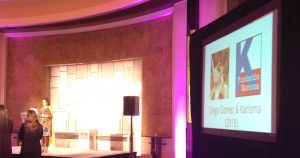
The next generation leadership award is given each year to a person who helped advance significantly open access, open science or open education in its country, region or internationally. This year’s award went to Diego Gómez, a biologist who faced criminal charges for sharing an article. Fundación Karisma, who offered him support throughout the trial and spread the word internationally, collected the award. More information is available in Karisma Foundation’s webpage.

Several other projects: the Darakht-e Danesh Online Library for Educators

OpenCon is also a gold mine of information on local initiatives with great impact. One good example is the Darakht-e Danesh Online Library for Educators, a project initiated by Jamshid Hashimi that aims at using OER to foster education in Afghanistan. It “is a repository of open educational resources for teachers, teacher trainers, school administrators, literacy workers and others involved in furthering education in Afghanistan. These open source resources include lesson plans, pedagogical tools, exercises, experiments, reading texts, work books, curricula and other resources for use in Afghan classrooms”.

Conclusion

OpenCon means going back home with more questions than answers, which is also a sign of a healthy movement that questions its own foundations. Participants want to ensure that the open movement does not end up creating the same burdens that triggered it, that it benefits every region in the world equally, and that it is sustainable in the long-term.

And if you weren’t there, you haven’t necessarily missed it – the main sessions are available on their YouTube page (see for day 1, day 2 and day 3).

The IGF is in Paris – but you can join us from everywhere!

The 13th annual meeting of the Internet Governance Forum (IGF) is taking place in Paris this year. The meeting is ‎hosted by the Government of France at the Headquarters of UNESCO, and runs from 12 to ‎‎14 November 2018.‎

This year’s session has more than a hundred sessions, including national, regional and youth IGF initiatives as well as seventeen ‎Dynamic Coalitions with inputs from communities and stakeholders. This multi-stakeholder approach, a key characteristic of the IGF, makes this an important opportunity to influence and shape public ‎discourse on internet governance themes and to discuss needed improvements. ‎

This year’s gathering stresses the importance of creating an Internet of Trust. To achieve this goal, the IGF in looking at best practices ‎in gender and access; cybersecurity; local content; AI, big data and the internet of things. ‎

IFLA is at the Internet Governance Forum in Paris to discuss the importance of public access in libraries. We will be part of two important events. The first is on the 13 November at the American Library in Paris, with more details available here. It will highlight the importance of public access as a means of getting the remaining billions online, alongside other promising initiatives such as community networks, as previously discussed at the IFLA President’s Meeting in Barcelona, and offline internet.

The second, on the 14 November takes place as part of the formal IGF programme. The session of the Dynamic Coalition on Public Access in Libraries in which IFLA plays a leading role will discuss and improve the toolkit on public access that IFLA has prepared for library associations. The toolkit looks at the key policy questions in the fields of technology, financing, regulation, as they affect libraries delivering public access.

You can find a list of the events on the IGF website and you can follow all the sessions remotely. Please, join us and be a part of this community!