
”If libraries can loan out books – why not a citizen science project?” Dr. Josep Perelló, Open Systems, Barcelona.
A perspective from Denmark and beyond, by Kent Skov Andreasen, Bertil Dorch and Thomas Kaarsted
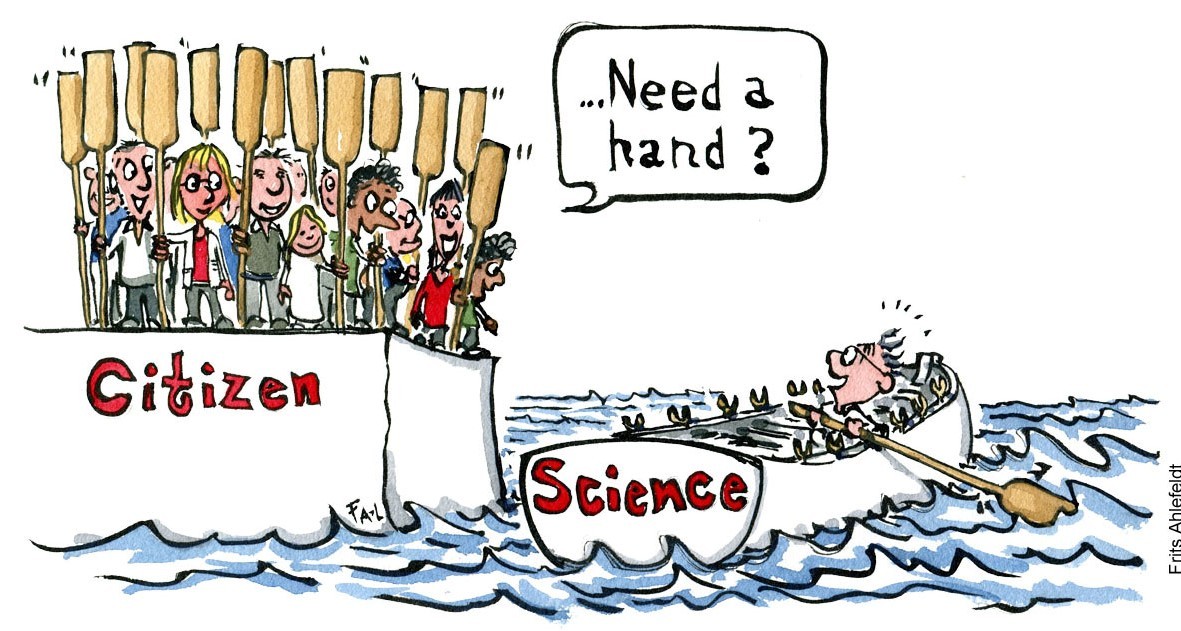
Drawing: Fritz Ahlefeldt
Citizen Science – the participation of citizens as contributors and co-creators of research – is spreading. Academic, public and research libraries libraries are already taking upon themselves to coordinate and contribute. Building on examples from Denmark, and with perspectives from other countries, we investigate how libraries can assist researchers, provide infrastructure and engage the public.
The BIG Why?
Why should libraries get involved in Citizen Science? We got a zillion of other tasks. Maybe limited budgets. The list is long. In order to answer that, we’ll take our own medicine. Two of our authors here (Bertil and Thomas) work at SDU Library (University Library of Southern Denmark), a research library in Denmark. Crucially. We’re also a public library with the obligation not only to provide materials and services to students and researchers – but also to the citizens of our region.
SDU Library have a commitment to digital literacy, promoting democracy and informed decision making. We are also committed to the United Nations sustainable development goals (SDGs) agenda. We also happen to represent +3.000 researchers and we see the facilitation of Citizens Science as a means to work for the UN SDG’s, work with citizens including public schools and high schools to introduce science, and also fight “post-factual” society and fake news.
This we have in common with the Odense Public Libraries where Kent work. Odense Public Libraries are a major player in Denmark, they work for the same purpose, and have a long and proud tradition of outreach to society. This includes being partners and a hub for a Citizen Science project within dementia and the elderly.
The roles of libraries
In some sense we’re probably not different from the most other libraries. But we do, perhaps, have a stronger obligation and platform. Our libraries have a strategic partnership. One of the pillars is collaboration within Citizen Science. Also, Bertil and Thomas run a Citizen Science Knowledge Center that provide services to researchers, students and the public and strives at building communities.
So yeah, in that sense we probably ARE different. But we’re still public libraries, and we aim at working with society around us. Thus, the examples and trend below COULD be applied to other libraries. Or maybe the quote at the top of this blog post says it all. Libraries loan out stuff!
Two examples from Denmark
A while back we did a joint Citizen Science project within Narrative Medicine (1). This included literature (books again!) as a tool of dialogue between doctors and patients (or in this case: citizens). SDU Library organized the project, but Kent’s library played a crucial role in recruiting and retaining citizens, organizing reading groups, and drumming up interest and organizing a public hearing that was aired on local TV. Libraries and librarians know their communities. This was a plus here for such a project.
Currently we’re working together on the ‘The Lakes Project’ (2). Biologists at SDU are in the process of mapping the water quality of lakes around Denmark. A massive task. Unsurprisingly, they can’t do it alone. In connection a huge partnership has been built including 22 public libraries. The libraries recruit citizens, lend equipment, collect water samples and importantly Kent’s library puts the researchers in touch with citizens and assists in building up the community. And again: Libraries lends stuff. Yes, this can really be a component in Citizen Science.
Other (really good) examples of libraries and Citizen Science
Luckily, we’re not alone in this field. Citizen Science is spreading, and libraries are involved.
- Several times a year the Toronto Public Library is housing an “Environmentalist in Residence” for Citizen Science and organizes events, write articles and a blog on various topics. This very special concept is part of the “Our Fragile Planet Programme“. (3)
- The Tredyffrin Township Libraries are running a tree planting project, called “Tree Tenders”, in which the participants are trained on trees and their care. (4)
- The Barcelona Network of Public Libraries has done a training programme for staff in order to facilitate and promote Citizen Science. (5)
- SciScarter have published The Library and Community Guide to Citizen Science. The guide offers manuals, tips, tricks and templates to assist community-based research. (6)
This is merely the tip of the iceberg. Citizen Science as a new platform for dialogue is making tremendous progress. Currently an estimated +5.000 projects are available online through SciStarter, Zooniverse and other platforms. So, yes! There really are good reasons to get involved.
Who we are:
Kent Skov Andreasen: [email protected]. Kent is director of Odense Public Libraries and a member of the IFLA FAIFE Advisory Committee – Freedom of Expression – as well as a former member of the IFLA Governing Board.
Bertil Dorch: [email protected] @astronerd. Bertil , PhD in astrophysics, Associate Professor and Director of the SDU Library at the University of Southern Denmark, is a standing committee member of the IFLA Academics & research libraries Section.
Thomas Kaarsted: [email protected] @TKaarsted. Thomas, MA in both History and Public Governance, is Deputy Library Director as well as Director of the SDU Citizen Science Knowledge Center.
References’ links
- https://www.sdu.dk/en/forskning/forskningsformidling/citizenscience/afviklede+cs-projekter/litteraert+vaerksted
- https://www.sdu.dk/da/forskning/forskningsformidling/citizenscience/soer-i-fritiden
- https://www.torontopubliclibrary.ca/programs-and-classes/featured/environmentalist-in-residence.jsp
- https://www.tredyffrinlibraries.org/tree-tenders/
- https://lab.cccb.org/en/citizen-science-and-public-libraries
- http://media.scistarter.org/curated/The+Library+and+Community+Guide+to+Citizen+Science.pdf
Further reading:
Cavalier, Darlene & Tiberius Ignat (2019). ”Citizen Science and libraries. Waltzing towards a collaboration.”
Cigarini, Anna, Isabelle Bonhoure, Julián Vicens & Josep Perelló (2021). Public libraries embrace citizen science: Strengths and challenges. Library & Information Science Research, 2021, 1. https://doi.org/10.1016/j.lisr.2021.101090.
Schwerin, Theresa & Vivienne Byrd. Citizen Science at home: Public Libraries and Family Science
https://connect.citizenscience.org/posts/citizen-science-at-home-public-libraries-and-family-science