Author Archives: Jérôme

ARL Highlights and Themes, 2015-2021: looking back and forward

The Academic and Research Libraries (ARL) section of IFLA brings together librarians from around the globe and together we “monitor current and emerging issues and their relevance to academic and research libraries … and …. disseminate information and recommendations, including results of relevant research and experiences of practitioners.” (IFLA, Academic and Research Libraries ). There are many ways in which we do this. Examples include WLIC sessions, webinars, and through this blog. Another forum available to members is the annual exercise of submitting “Regional Updates” of issues and initiatives from the members’ countries. These are packed with ideas and information that can inspire all kinds of action for us collectively or in our home institutions and countries. As this year approaches to its end, let’s a tour of some of the themes and highlights that emerged over a longer period of time: 2015-2021.

There is a wealth of information contained within these years and likely deserving of a much longer piece, but I have pulled out some of the emergent themes across the period and around the globe. Over the seven years covered, we have regional input from 29 different countries – with a certain bias, as these notes are disproportionately representative of regions in the geographic global North with most from Europe, the United Kingdom, and North America.  The themes I’ve identified are ones that emerge across all members’ regions.

With so much data, I started the following visualization:
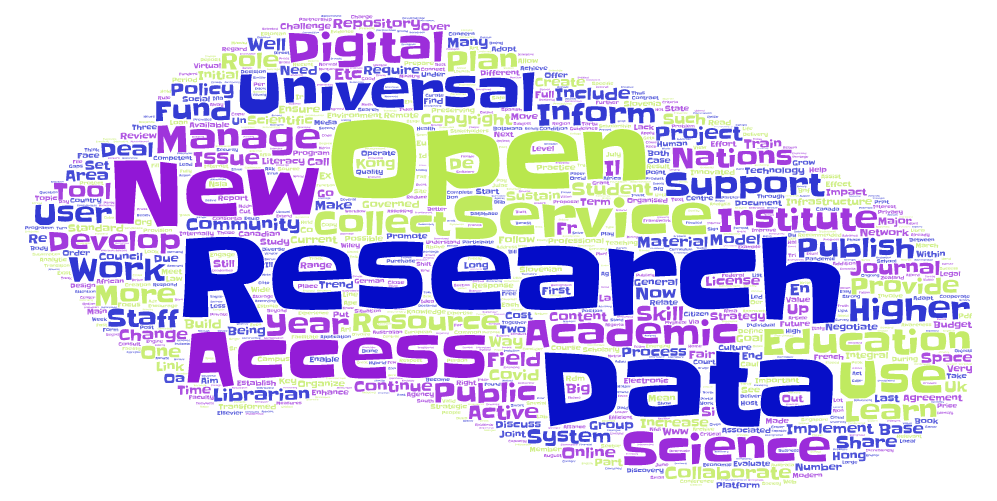
These words speak to us: research, open, service, access, data, universal, and new. I’ve clustered our updates into the following “large tent” themes: collaboration; digital libraries, open scholarship; equity, diversity & inclusion; and learning.

Collaboration:

Libraries collaborate regionally, nationally, and internationally building infrastructure, preserving content, and advocating.  A common way we do so is through national consortia. The National and State Libraries of Australasia (NSLA) commit to shared digital systems for collection access (NED) and in Nigeria, The Association of University Librarians of Nigerian Universities (AULNU), is a forum for policy formulation and resource sharing. We also participate in our universities’ partnerships (e.g. Enlight) and with other national research infrastructure agencies (e.g. The Digital Research Alliance of Canada ; Nationale Forschungsdateninfrastruktur in Germany)

Digital Libraries:

2020 was designated as the Year of Digital Culture in Estonia and this is indicative of the ever growing role of libraries in digital research and scholarship. Our collective activities encompass Digital Humanities, Artificial Intelligence (AI), data management, and digitization and preservation. Our updates are replete with examples of activity in all of these areas as well as a recognition that we need to be growing our knowledge and skills.  Arising from this are concomitant issues regarding privacy, security of data, complex copyright issues, and the ongoing problem of the digital divide both between and within countries.

Open Scholarship:

From 2015 to 2021 there were increasingly rich updates about open scholarship including open science, open access to research data and publications, open education resources, and citizen science.  Slovenia’s National Strategy for Open Access to Scientific Publications and Research Data, 2015-2020 is a standard example of national and regional requirements for open access to publicly funded research. Similarly, the Botswana Open Data Open Science (ODOS) national committee’s mandate of facilitating open data readiness was a common response at national levels to open data imperatives. The November 2021 ARL blog post is a great read on citizen science in Denmark.

Equity, Diversity, and Inclusion:

EDI is a shared value which is evident throughout the ARL member updates. In Australia, New Zealand, Canada, and the United States there is ongoing action to decolonize libraries and work towards reconciliation. The National and State Libraries of Australasia (NSLA) hosts the Culturally Safe Libraries Program and The Canadian Federation of Library Associations (CFLA) released The Truth and Reconciliation Committee Report and Recommendations.  An EDI lens is being applied to collections, services, and staffing in all countries. The 2020 update from the United States describes how the “senseless killing of Black Americans called for research libraries in the U.S. to address inequality and systemic racism”.

Learning:

Academic and research libraries are learning institutions and as such we devote a lot of attention to our own development and to that of our students and researchers. Many countries report on the need to develop sophisticated digital skills within library staff and the importance of being able to recruit people with them. An update from Germany reminds us that we increasingly will have to compete with the private sector for such individuals. Attention is also paid to the skills needed by library leaders to facilitate the future digital library.

In an age of prevalent disinformation and misinformation, information literacy has taken on a new edge and critical urgency.  Academic libraries are addressing this in curricular and extra-curricular teaching. A creative approach from South Africa is an initiative to reimagine information literacy mapped against the research lifecycle – a perfect melding of learning and research.

Finally, about COVID: the last two years of submissions were filled with the challenges and the opportunities that the pandemic brought us. Many countries had robust digital infrastructure to rely on, while others experienced more acute challenges. There is a sense though that the pandemic is ultimately another catalyst to keep us moving faster towards the digital, open, and equitable libraries we strive to build.

These themes are just a sampling of our activities and truly the tip of the ARL iceberg. They demonstrate our common values and our commitment to work together to achieve them.


Sharon Murphy
Associate University Librarian
University of Alberta
Edmonton, Canada
[email protected]
GO JOIN! Citizen Science and the role libraries

”If libraries can loan out books – why not a citizen science project?” Dr. Josep Perelló, Open Systems, Barcelona.

A perspective from Denmark and beyond, by Kent Skov Andreasen, Bertil Dorch and Thomas Kaarsted


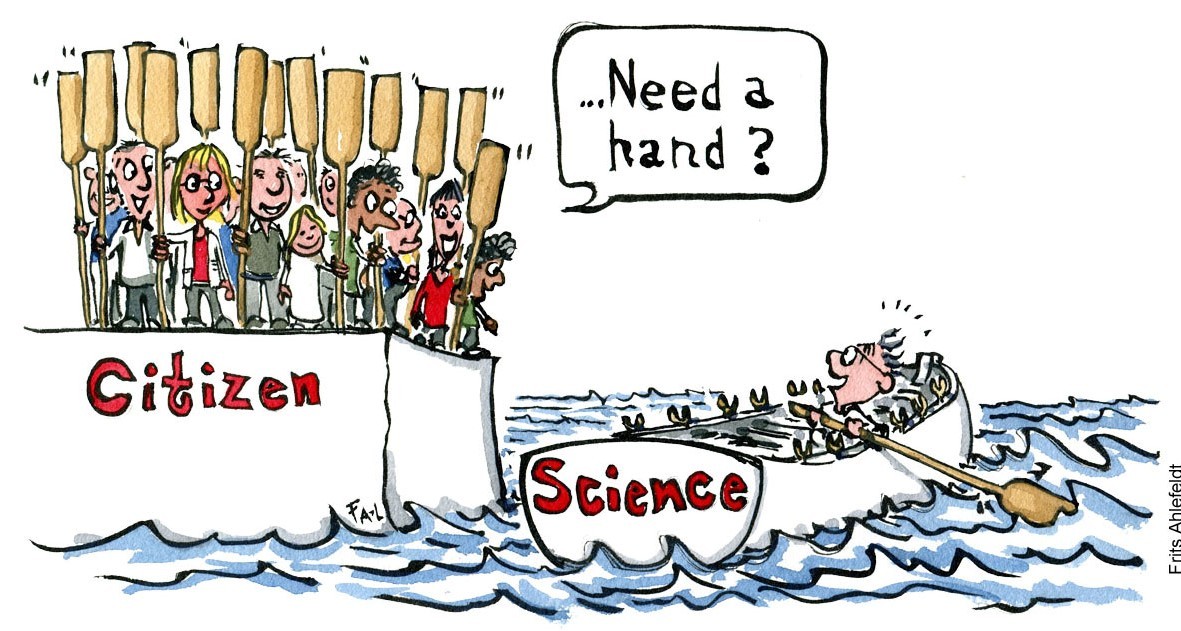
Drawing: Fritz Ahlefeldt

Citizen Science – the participation of citizens as contributors and co-creators of research – is spreading. Academic, public and research libraries libraries are already taking upon themselves to coordinate and contribute. Building on examples from Denmark, and with perspectives from other countries, we investigate how libraries can assist researchers, provide infrastructure and engage the public.

The BIG Why?

Why should libraries get involved in Citizen Science? We got a zillion of other tasks. Maybe limited budgets. The list is long. In order to answer that, we’ll take our own medicine. Two of our authors here (Bertil and Thomas) work at SDU Library (University Library of Southern Denmark), a research library in Denmark. Crucially. We’re also a public library with the obligation not only to provide materials and services to students and researchers – but also to the citizens of our region.

SDU Library have a commitment to digital literacy, promoting democracy and informed decision making. We are also committed to the United Nations sustainable development goals (SDGs) agenda. We also happen to represent +3.000 researchers and we see the facilitation of Citizens Science as a means to work for the UN SDG’s, work with citizens including public schools and high schools to introduce science, and also fight “post-factual” society and fake news.

This we have in common with the Odense Public Libraries where Kent work. Odense Public Libraries are a major player in Denmark, they work for the same purpose, and have a long and proud tradition of outreach to society. This includes being partners and a hub for a Citizen Science project within dementia and the elderly.

The roles of libraries

In some sense we’re probably not different from the most other libraries. But we do, perhaps, have a stronger obligation and platform. Our libraries have a strategic partnership. One of the pillars is collaboration within Citizen Science. Also, Bertil and Thomas run a Citizen Science Knowledge Center that provide services to researchers, students and the public and strives at building communities.

So yeah, in that sense we probably ARE different. But we’re still public libraries, and we aim at working with society around us. Thus, the examples and trend below COULD be applied to other libraries. Or maybe the quote at the top of this blog post says it all. Libraries loan out stuff!

Two examples from Denmark

A while back we did a joint Citizen Science project within Narrative Medicine (1). This included literature (books again!) as a tool of dialogue between doctors and patients (or in this case: citizens). SDU Library organized the project, but Kent’s library played a crucial role in recruiting and retaining citizens, organizing reading groups, and drumming up interest and organizing a public hearing that was aired on local TV. Libraries and librarians know their communities. This was a plus here for such a project.

Currently we’re working together on the ‘The Lakes Project’ (2). Biologists at SDU are in the process of mapping the water quality of lakes around Denmark. A massive task. Unsurprisingly, they can’t do it alone. In connection a huge partnership has been built including 22 public libraries. The libraries recruit citizens, lend equipment, collect water samples and importantly Kent’s library puts the researchers in touch with citizens and assists in building up the community. And again: Libraries lends stuff. Yes, this can really be a component in Citizen Science.

Other (really good) examples of libraries and Citizen Science

Luckily, we’re not alone in this field. Citizen Science is spreading, and libraries are involved.

  • Several times a year the Toronto Public Library is housing an “Environmentalist in Residence” for Citizen Science and organizes events, write articles and a blog on various topics. This very special concept is part of the “Our Fragile Planet Programme“. (3)
  • The Tredyffrin Township Libraries are running a tree planting project, called “Tree Tenders”, in which the participants are trained on trees and their care. (4)
  • The Barcelona Network of Public Libraries has done a training programme for staff in order to facilitate and promote Citizen Science. (5)
  • SciScarter have published The Library and Community Guide to Citizen Science. The guide offers manuals, tips, tricks and templates to assist community-based research. (6)

This is merely the tip of the iceberg. Citizen Science as a new platform for dialogue is making tremendous progress. Currently an estimated +5.000 projects are available online through SciStarter, Zooniverse and other platforms. So, yes! There really are good reasons to get involved.

Who we are:

Kent Skov Andreasen: [email protected]. Kent is director of Odense Public Libraries and a member of the IFLA FAIFE Advisory Committee – Freedom of Expression – as well as a former member of the IFLA Governing Board.

Bertil Dorch: [email protected] @astronerd. Bertil , PhD in astrophysics, Associate Professor and Director of the SDU Library at the University of Southern Denmark, is a standing committee member of the IFLA Academics & research libraries Section.

Thomas Kaarsted: [email protected] @TKaarsted. Thomas, MA in both History and Public Governance, is Deputy Library Director as well as Director of the SDU Citizen Science Knowledge Center.

References’ links

Further reading:

Cavalier, Darlene & Tiberius Ignat (2019). ”Citizen Science and libraries. Waltzing towards a collaboration.”

https://www.researchgate.net/publication/335701786_Citizen_Science_and_Libraries_Waltzing_towards_a_collaboration

Cigarini, Anna, Isabelle Bonhoure, Julián Vicens & Josep Perelló (2021). Public libraries embrace citizen science: Strengths and challenges. Library & Information Science Research, 2021, 1. https://doi.org/10.1016/j.lisr.2021.101090.

Schwerin, Theresa & Vivienne Byrd. Citizen Science at home: Public Libraries and Family Science
https://connect.citizenscience.org/posts/citizen-science-at-home-public-libraries-and-family-science

The Art of Virtual Conference Attendance: WLIC 2021

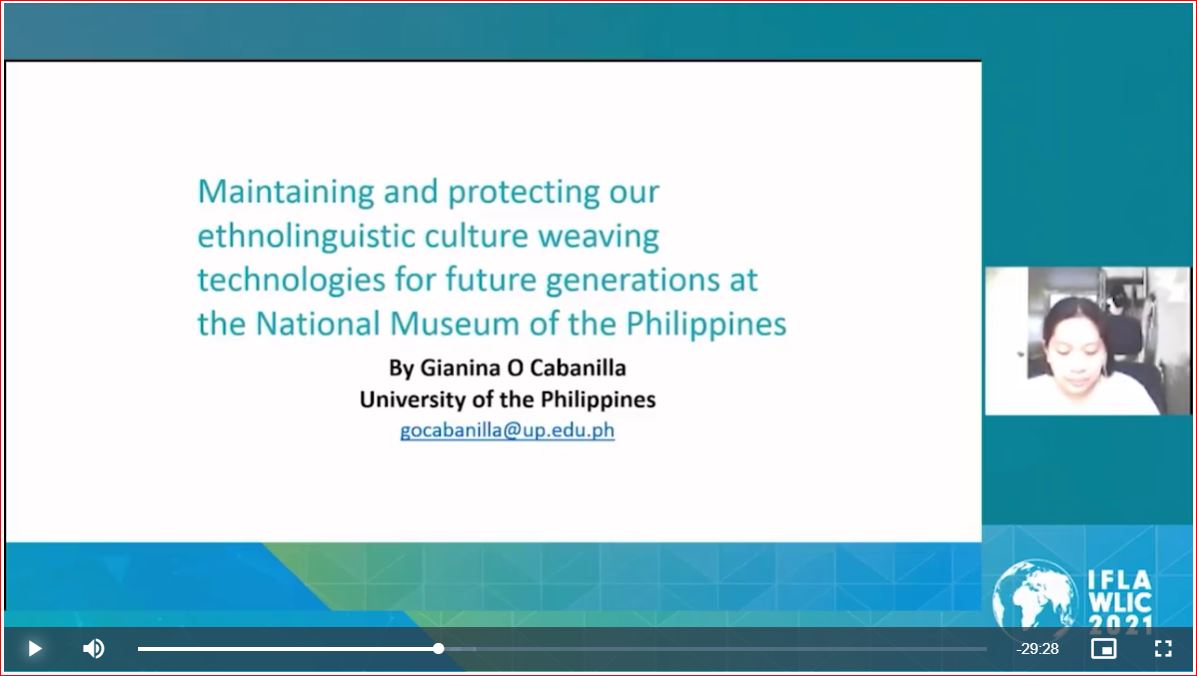
Last August, I attended my first-ever IFLA WLIC virtual professional conference. As one of the speakers in the session “Why authentic relationships matter with indigenous communities”, I was giddy at the prospect of attending the conference and interacting with fellow speakers, especially under the Indigenous librarianship section. Even though I’m not a member of an Indigenous group in the Philippines or pursuing a related degree, I wanted to experience a virtual conference and be in an environment where books, writing, research, and library advocacy were the focus.

I attended the conference with library colleagues from the University of the Philippines – Diliman Campus, and we had a blast. Spending the days listening to fellow librarians talk about themes such as Indigenous librarianship and Mozart in music libraries; and exploring library projects in Sint-Jans-Molenbeek in Brussels and the Image Permanence Institute, lived up to my expectations. But as with anything in life, I realized after further reflection that I have a lot to learn about the art of virtual conference attending. Here are some areas I learned I need to improve on from my first virtual WLIC conference experience.

  1. Rest

The crowds were a bit overwhelming even though it was a virtual conference! I did not realize how packed the conference schedule was. Some days, we were in a zoom presentation at 8 a.m. and left at almost midnight. Sure, there are breaks for Q&A sessions, but it’s really hard when you’re an overachiever to feel like you can skip a session if you need a rest. I felt like I needed to attend every session because I was awarded to be there, but that’s pretty taxing. Maybe at future in person WLIC conferences, I’m going to be a bit more strategic about planning breaks throughout the day, even if it means skipping a session to sit alone in a corner somewhere and refresh.

  1. Make time for regular life

In addition to needing time to rest amid the crazy conference schedule, I also learned that in the future, I need to make time for certain aspects of my everyday life. For example, I didn’t sleep normally since some sessions started super early or ended late in the evening due to our difference in time zones. I finally made time to rest after it was over and had to prepare for a 30 hour flight from the Philippines to the USA for my graduate studies for Fall 2021. I learned that I can’t just focus solely on the conference; I need to also schedule time to talk to family, work colleagues, and people from my university.

  1. Session Schedules

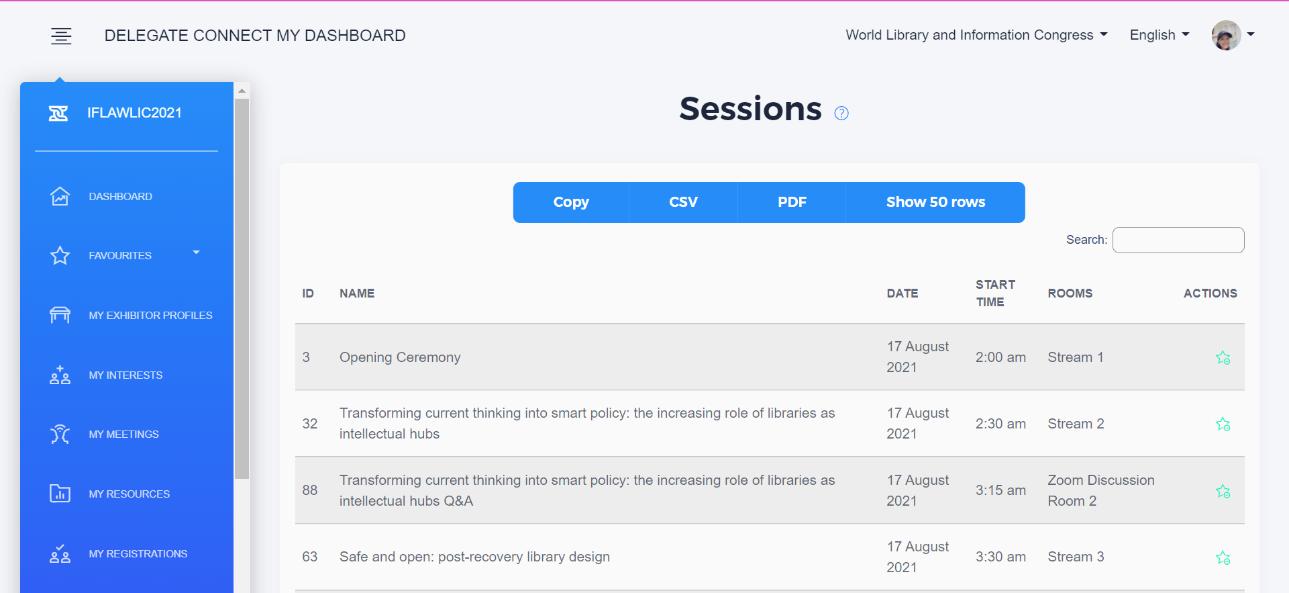
I don’t regret spending time on this amazing virtual conference. I do regret not planning ahead more carefully with my preferred sessions. When you attend a virtual conference and have no idea what you want to attend, you end up staring at your computer a lot, scrolling through sessions and topics after topics. Next time I attend a virtual conference I’m going to have a list of a few topics and sessions I want to attend before I click on that zoom link and join.

  1. Internet Connection

It’s super challenging to join a zoom meeting and connect live for every single session when you’re at a virtual conference. Part of the problem here in my country was that I didn’t have a fast internet connection, especially if the session fell in the morning when a lot of people are also using lots of bandwidth. As a result, I couldn’t attend some of the sessions smoothly due to internet connectivity issues. For future virtual conferences, I’m going to plan out a few locations with good internet connectivity where I can set up beforehand. That said, some of the best parts of the conference were spent at late evenings and super early mornings (10pm until 4am in the morning in my time zone). It was also worth it to have a few snacks and drinks at hand while attending the Q and A sessions; it made hanging out with the attendees and exploring the conference platform even more fun.

  1. Explore

Luckily, the platform was user friendly. This is something I actually did explore when I had dry run sessions for my Indigenous librarianship talk and I’m so glad the help desk team made time to teach us to walk around or navigate the platform and get to know it a bit prior to attending the virtual conference.

  1. Network

I’ll admit that I didn’t really talk to a lot of people at the conference. The only people I talked to included my work colleagues, the registration help desk people, the panelists at the Indigenous librarianship session, and some people at Q&A sessions. I recognize how this is not ideal. One of the main opportunities of virtual conferences is to mingle (email, chat), network, and to meet people who can later connect you to your dream job, career, research, etc. But, I had no idea what to expect in this virtual environment. There were a lot of people in various sessions at various times. And I didn’t really have anything to say to anyone other than asking questions during the Q&A or during the dry run and live session with my panelists at the Indigenous library session. That’s not a great excuse though; at future events, I’m going to push myself and set goals to talk to more people.

  1. Notes

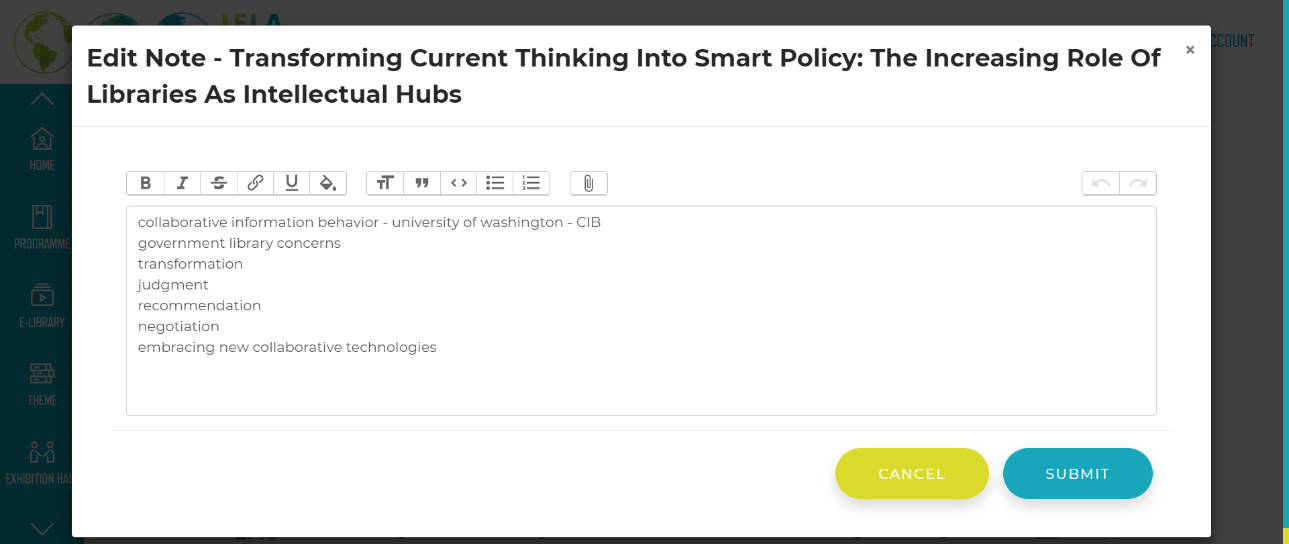
I did take notes consistently throughout the sessions I attended, and I can’t imagine attending a virtual conference and NOT taking notes. I’m not the best at remembering verbal presentations, so scribbling stuff down helps keep it in my memory. After all, there’s really no point in paying to go to hear people talk about various themes such if you aren’t going to remember any of it a week later.

In conclusion, I enjoyed my first virtual WLIC 2021 conference experience. I could have planned a better experience using the takeaways above, but overall, it was an excellent week, and I learned so much. I’m excited to put these takeaways into action for my next conference in WLIC, hopefully in person, and I can’t wait for next year’s IFLA WLIC 2022

Gianina Angela Celine Cabanilla, University Researcher – University of the Philippines

[email protected]