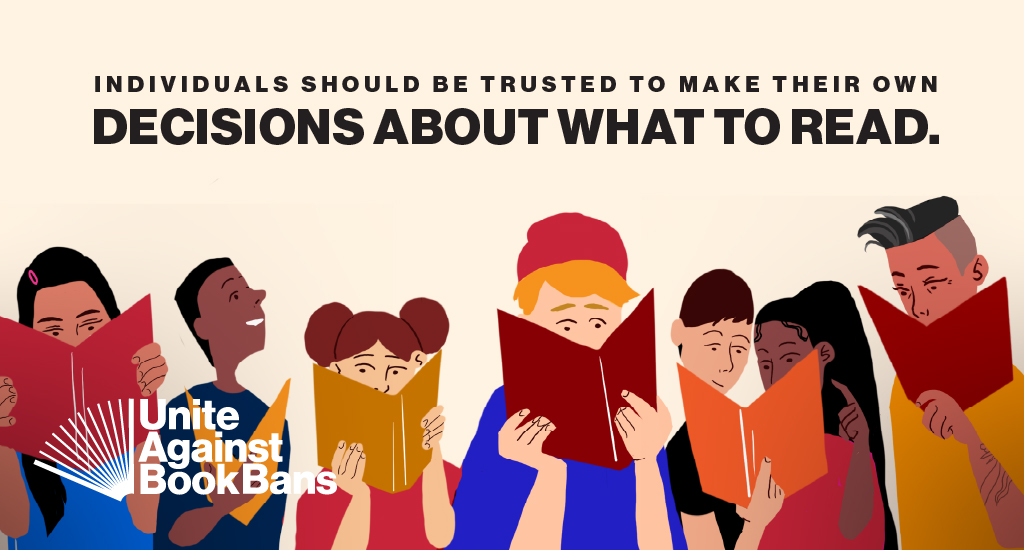
Unfortunately, many libraries, bookstores, and schools around the world are seeing an increasing wave of book banning and challenges. Book banning and challenges impacts our readers’ rights to access books. Book banning and challenges creates censorship culture in our communities which is against IFLA’s values. “Because censorship prevents the enjoyment of several generally recognized human rights, as expressed most fundamentally in the Universal Declaration of Human Rights, IFLA emphatically argues for principles of freedom of expression and freedom of access to information” (see IFLA Statement on Censorship).
In the United States, book banning and challenges have been increasing over time, specific right wing extremist groups have been targeting books by and about people of color, LGBTQ+ people, and people who belong to religious minorities, and claiming that there are “inappropriate” content that children are reading or being taught. Their outrage and allegations are amplified on social media where they are actually determining the school curriculum or library collection and deciding who gets to read what and disregarding the expertise of teachers and librarians. According to Kelly Jensen from Book Riot, “Since the start of the 2022-2023 school year — July 1 through December 30, 2023 — PEN America recorded 1,477 separate instances of book bans across the country. This includes 874 unique titles in 182 school districts and 37 states.” Furthermore, an Iowa School District used ChatGPT, the generative artificial intelligence tool, to ban books because such books may contain discussions on sexuality and gender identity that may be viewed as inappropriate for the school curriculum (see Wired).
This is not only a United States issue but a global one. Intellectual freedom is being threatened and overturned as a right, and many libraries are facing this issue. In Australia, the graphic memoir, Gender Queer by non-binary author and artist Maia Kobabe, is being considered to be censored by the Australian Classification Board. Conservative groups have pushed for this title to be banned either for certain age groups or completely banned from access in schools or libraries. In Hungary, the government has ordered bookshops to seal and wrap books that promote or contain gender identities and transition, and sexualities before sale for people under 18 according to a Reuters report and Book Riot.