Author Archives: gillian

My reflections on receiving IFLA’s Scroll of Appreciation

contributed by Gill Hallam
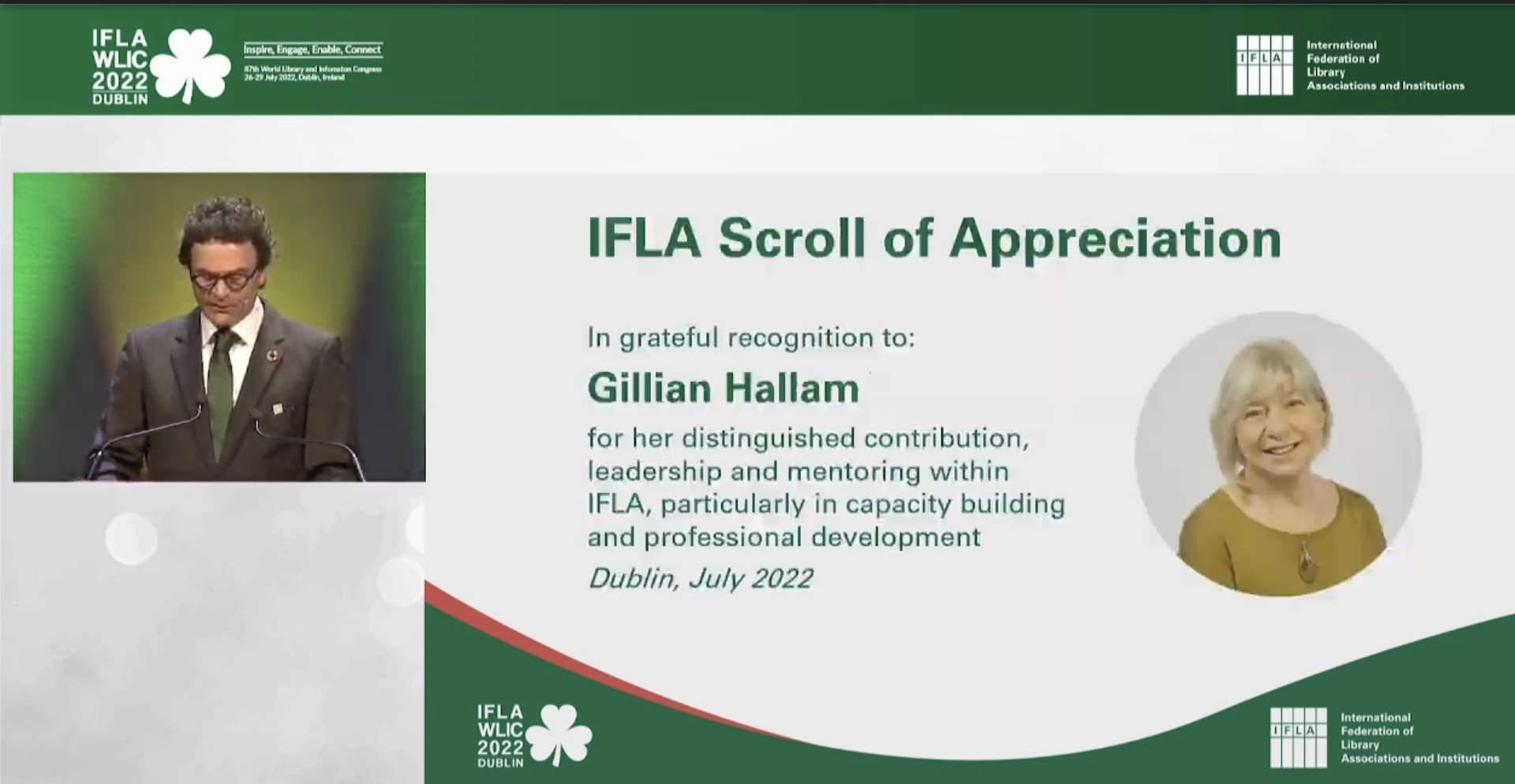


The IFLA Scroll of Appreciation is awarded in recognition of the contribution of “an individual who has given distinguished service to IFLA as a volunteer engaged in a committee or group, in addition to efforts in fostering IFLA values” [1].  At the closing ceremony of the WLIC in Dublin last month, three IFLA Scrolls of Appreciation were conferred: to Sanjay Kumar Bihani, to Sueli Mara Soares Pinto Ferreira, and to me. To be nominated for such a prestigious award was, firstly, an incredible surprise, and secondly, an incredible honour.

Very sadly, 2022 was the one year that I could not attend the WLIC, but I thank Christine Mackenzie, past-President of IFLA, for receiving the award on my behalf.

The citation states that this IFLA Scroll of Appreciation recognises “Gillian’s distinguished contribution, leadership and mentoring within IFLA, particularly capacity building and professional development. Her achievements have maximised the potential of individual librarians, as well as those involved in IFLA’s committees and in library associations across Asia and Oceania”.

These words are very humbling, because – just like all my friends and colleagues across the IFLA community – I have simply been doing what I love doing! Nevertheless, I am over the moon to know that through this award, IFLA  acknowledged the imperative for learning and development for  everyone working in the library and information profession!

I would argue that, for many years now, IFLA has been ‘my tribe’: my involvement in the organisation has provided  me with so many wonderful opportunities to connect and work with talented and passionate library and information professionals across the world. My own career has in fact been a very international one (I have been fortuntate to live and work in the United Kingdom, Europe, Africa, Asia, the Pacific Islands and Australia), so when I was introduced to IFLA’s activities by my colleagues with the Australian Library and Information Association (ALIA), Jennefer Nicholson and Christine Mackenzie, new energy was injected into my professional life.

My first job after migrating to Australia in the early 1980s was as a special librarian in the corporate sector in Brisbane. It was an exciting role, but as the solo librarian in the firm, I felt that the need to actively seek out like-minded LIS colleagues with whom I could explore and discuss professional issues. After becoming a member of ALIA as a new graduate, I discovered plenty of rewarding avenues to network and to contribute productively to the profession, and as my career evolved through the different roles as LIS practitioner, educator and researcher, there were opportunities to lead and to mentor others.

Certainly, my involvement with IFLA represented the chance to explore new and interesting activities. After initially serving as a member of the Standing Committee for the Section for Education and Training (SET), I joined the Section for Continuing Professional Development and Workplace Learning (CPDWL). Since 2015, I have served as ALIA’s nominee on the CPDWL Standing Committee.

It is really very hard NOT to get engaged with the work of CPDWL! Along with other members of the Standing Committee, I have been directly involved in so many great activities:

  • developing and updating of the IFLA Guidelines for Continuing Professional Development: Principles and Best Practices
  • translating the Guidelines for CPD poster into over 30 languages
  • planning and running the CPDWL open sessions at the WLIC, in partnership with other IFLA sections and SIGs
  • participating in the IFLA Coaching Initiative with the Management and Marketing Section
  • hosting a table at the Knowledge Café at the WLIC with the Knowledge Management Section
  • contributing to the New Librarians Global Connection webinars with the New Professionals SIG, supported by the American Library Association.
  • and much, much more…

Importantly, CPDWL’s satellite meetings have always provided smaller groups of people within and beyond IFLA to work closely together to plan and coordinate the specialised conference program, the most recent event held in Zagreb, Croatia (2019), in partnership with the Croatian Library Association.

The CPDWL team communicates to the world about all these activities through the CPDWL Newsletter and through its social media channels. In 2018, CPDWL was the inaugural winner of the IFLA Dynamic Unit and Impact Award, which recognises a section’s achievements in engaging members, developing strong identity and leadership, and communicating its activities within and beyond IFLA. Building on this success, in 2020 CPDWL received a special mention for the section’s excellent planning and clear and effective communication.

Beyond CPDWL, I also had the remarkable opportunity to contribute to IFLA’s  Building Strong Library Associations (BSLA) program, generously underwritten by the Bill and Melinda Gates Foundation. My involvement included preparing 20 case studies to support and expand the workshop materials, and to develop the BSLA Train the Trainer program. As one of the core trainers in the BSLA program, I was exceptionally fortunate to work with enthusiastic and committed LIS professionals with:

  • the Ukrainian Library Association (ULA)
  • the Arab Federation of Library Institutions (AFLI)
  • the Sri Lankan Library Association (SLA)
  • the Nepal Library Association (NLA)
  • the Pacific Islands Association of Libraries, Museums and Archives (PIALA).

In addition I was able to collaborate with colleagues from across the world at IFLA’s own BSLA convenings held in Berlin, Manila and The Hague.

Over the years, I have learnt so much from other IFLA members and officers, from other BSLA trainers and from IFLA staff members: you have all helped me grow and develop personally and professionally. Without doubt, the amazing journey I have travelled has been a shared experience with you, all the friends I have in ‘my tribe’.  You all know who you are: you have brought so much richness to my career and to my life, and therefore I dedicate the IFLA Scroll of Appreciation I have been awarded to each and every one of you. See you all in Rotterdam next year to celebrate!

[1]  https://www.ifla.org/ifla-scroll-of-appreciation/
Curious, confident & committed: Transforming libraries into learning organisations


On 13 October 2021, CPDWL and NPSIG hosted the webinar entitled ‘Curious, confident & committed: Transforming libraries into learning organisations’. Our invited speaker was Clare Thorpe, Director, Library Services at Southern Cross University in Australia.


Clare is an award-winning library leader and practitioner-researcher who has worked in Australian academic and state libraries since 2001 and she is currently a Director on the Board of the Australian Library and Information Association (ALIA). She is passionate about engaging library and information workers in professional development (PD) and has a track record of fostering a culture of learning in the teams that she leads.

This blog post provides a brief review of the webinar which we hope will inspire you to listen to the recording – see the links to our resources at the end of the post.

The focus of Clare’s presentation was on the strategies library leaders and managers can use to foster a culture of learning in their organisation, drawing on her own experience working in multi-campus university libraries in Australia. The key message was that if library staff and their teams were encouraged to engage in learning as part of their everyday work, so much more will follow.  These ideas were discussed in Clare’s recently published journal article “Transforming a university library into a learning organisation” [1].

The webinar opened with a brief introduction to the concept of the learning organisation, so that Clare could then discuss how she put these theories into practice. We can thank Peter Senge for the ideas that he explored in the book The fifth discipline: The art and practice of the learning organization [2][3]. The ‘five disciplines’ refer to the five principles and practices that Senge had identified to help people to appreciate the value of individual leaning, to understand the ways other people think, to develop a shared vision for the future, to learn together to achieve their common goals, and to comprehend the interconnections between elements in the world that lead to productive outcomes for all involved.

Senge argued that the inevitability of change meant that people need to consistently challenge their traditional beliefs and practices. He believed that, in a learning organisation, staff across the organisation can work together to find novel ways to solve problems and to implement positive change. The workplace therefore becomes a playground for creative ideas and a safe place where people can take risks and test out new ideas. Everyone’s ideas are valued, regardless of the position they hold in the organisation.  Karash [4] concluded that it is simply more fun to work in a learning organisation!

Clare opened her presentation with the challenge that work should become ‘learningful’ (Senge, p.4) [3]. It was critical that learning was viewed as a natural part of the working day, not as something staff were expected to do in their own time. Responsibility for this did not only lay with library managers, but also with the individual staff members themselves. She explained that there were three key building blocks for a learning organisation: a supportive learning environment, well defined learning practices and processes, and leadership that reinforces learning [5]. She outlined her own principles of workplace learning:

  • Learning agency and autonomy: staff can construct their own learning path and focus on topics important to them
  • Flexibility: staff can draw on different tools for different learning tools
  • Social connectedness: staff can find ways to participate, value each others’ expertise and share learning with others
  • Experimentation: staff can find space to foster creativity and exploration.

Clare stressed that workplace learning was definitely more than just ‘going to conferences’… it is all about consuming, creating and engaging. Importantly, today there are so many opportunities for people to discover new ideas: through reading journal articles, books, blogs, through listening to podcasts, and through watching webinars and videos. Equally well, there are so many ways to create and present their new ideas, for example through textual, audio and visual channels, and by connecting and interacting with other people to share these ideas and to develop up them further.

Learning is often viewed as an individual activity, but Clare pointed to Senge’s principle of ‘shared understanding’. She felt that it is critical for the individual staff member’s professional development activities to support their career growth, but they should also be relevant to and aligned with the library’s own future directions. There needs to be a common vision for the future and common goals to work towards, so that everyone, regardless of their role in the library, understands that their personal learning journey will contribute to the attainment of the common goal. Accordingly, professional development goes beyond being an individual activity to become a collaborative one. People should confidently share what they have learnt so that the colleagues in their work team, and across the whole library, can build new skills and capacity together.

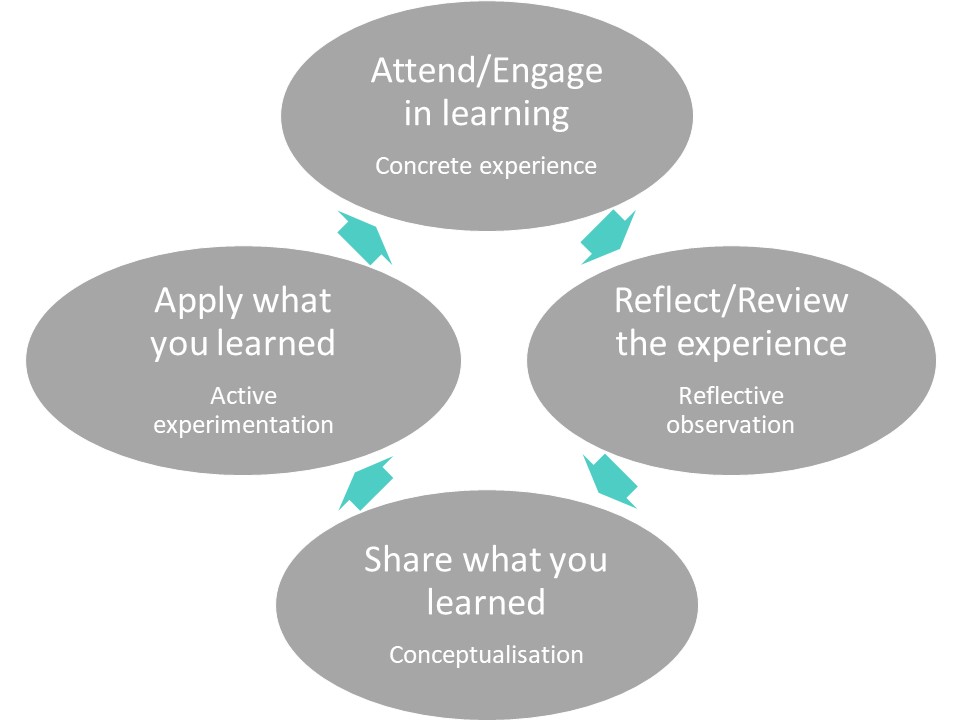
Kolb’s experiential learning cycles [6] offer a really good model to help library staff to conceptualise the learning journey. This starts with a person attending a PD event or engaging in a learning activity, then they take time to review the experience and reflect on their learning, which encourages them to share with their colleagues and ultimately to apply the learning through active experimentation – which in turn opens up the next cycle of learning.


Thanks were extended to Michael Stephens from San José State University in California, USA, for a very simple strategy for reflecting-sharing-applying the learning, referred to as the 3-2-1 approach. Clare suggested that, after participating in a learning activity, you should identify three things you were introduced to that amazed you, two concepts that you will focus on, and one idea that you will apply immediately.

It was important for staff members to demonstrate curiosity by reflecting on their job and thinking about what they may need to learn now, to do their job better, as well as to look to the future to consider what they hope to learn so that they continue to grow and develop the new skillsets that will shape their career. They also need to recognise where help and support is needed to build greater confidence.

Over the past couple of years, the COVID-19 pandemic has drastically reduced the chance to attend face-to-face PD events, but it has not stopped people learning. Instead, it has opened up fresh opportunities to optimise the use of digital tools and channels such as blogs, podcasts, Twitter, videos, webinars, and the amazing array of resources published online. While digital workplace learning activities can be self-driven, they can also be undertaken by two or three colleagues together, there can be a team approach, or guidance and direction can come from the library leaders.

Commitment to learning can be demonstrated in a number of ways that benefit the individual, all colleagues in the library, the wider library and information community, and our profession as a whole. Reflective and critical practice can deepen the impact of learning activities, improve decision making and planning, and build confidence. Social learning builds a culture of learning by fostering an environment where colleagues share their experiences with each other, especially in a multi-campus institution.  Contributing to personal learning networks and online social media communities results in a far stronger sense of community engagement, while engaging in evidence based practice adds to the body of professional knowledge and contributes to the advancement of the library and information profession.

In closing her presentation, Clare shared six recommendations to guide anyone interested in exploring the idea of the library becoming a learning organisation more deeply:

  • View learning as a natural part of the working day
  • Define the value of learning and articulate the responsibilities of the individual and the employer
  • Encourage enquiry, curiosity and exploration, and create a safe space to take risks and make mistakes
  • Encourage staff to share stories and to work together to build competence, confidence and career development
  • Promote independent learning through online resources and social media channels
  • Recognise and reward the effort staff put into their learning and the outcomes they achieve.

The webinar then continued with an active Q&A session which allowed Clare to provide more details about specific approaches and strategies she had mentioned. Plenty of people were really keen to transform their library into a learning organisation! To gain further insights, we encourage you to visit the CPDWL webinar page and access the full recording of the webinar, as well as Clare’s presentation slides. Her published article [1] is also a great read!

Resources

CPDWL Webinars webpage

Curious, confident & committed: Transforming libraries into learning organisations

References

[1]  Thorpe, C. (2021). Transforming a university library into a learning organisation. Library Management, 42(6/7), 436-447. https://doi.org/10.1108/LM-01-2021-0003
Open access version.

[2]  Senge, P. (1990). The fifth discipline: The art and practice of the learning organization.
New York: Doubleday.

[3]  Senge, P. (2006). The fifth discipline: The art and practice of the learning organization. Rev.ed. Milsons Point, NSW: RandomHouse.

[4]  Karash, R. (1995). Why a learning organization?  

[5]  Garvin, D.A., Edmonson, A. C., & Gino, F. (2008). Is yours a learning organization?
Harvard Business Review, 86(3), 109–116.

[6]  McLeod, S. (2013). Kolb’s learning styles and experiential learning cycles. https://www.simplypsychology.org/learning-kolb.html

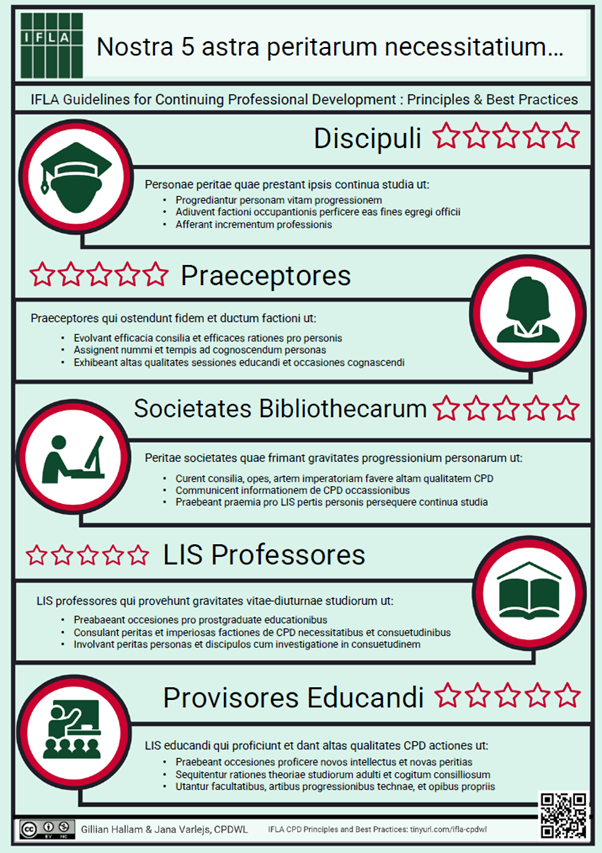
Did librarians in Ancient Rome know about the importance of continuing professional development? Maybe yes, maybe no – but the IFLA Guidelines for CPD poster is now available in Latin!

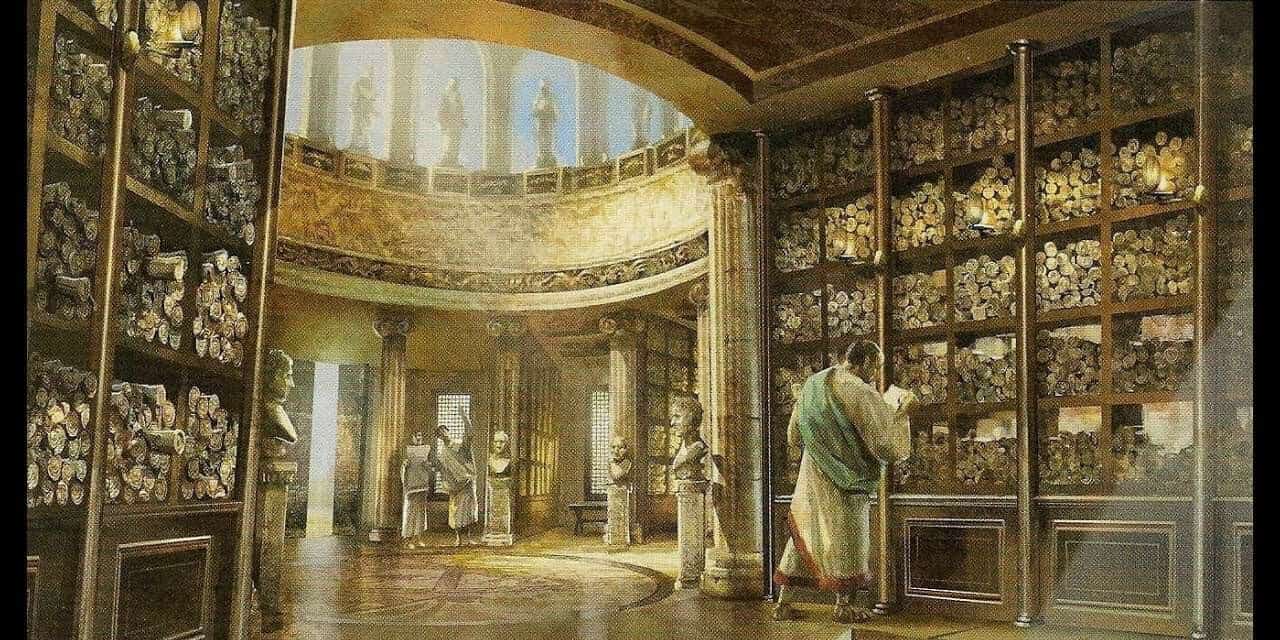
History tells us that one of the first libraries in Rome resulted from the looting of collections of classical Greek literature. After the conquest of Macedonia in 168 BC, the Roman general Aemilius Paullus removed volumes of text from the royal palace to establish a library for his sons in Rome (Affleck, 2012). This led to a growing interest amongst Roman nobles in the study of Greek philosophy and literature; some years later Lucius Cornelius Sulla seized the library of Apellicon of Teos in Athens and transported the collection back to Rome.

Around 44 BC Julius Caesar chose Marcus Terentius Varro to develop his vision for a ‘public library’. Varro’s qualifications included being the only known person in the Roman era to write a ‘library manual’, De Bibliothecis. This text has sadly not survived and poor Caesar died before the construction of his library began.

One of the more important owners of a private library was Cicero: it is recorded that he had libraries in his city residence, as well as in many of his country villas. While Cicero apparently employed trained ‘library-slaves’ (librarioli) to manage and maintain his libraries, there is documentary evidence to show that by the end of Roman Republic in 27 BC, the sophistication of Roman libraries had led to need for a diversified staff of library professionals.


Image: History Collection

Of course, we actually know very little about the education and training of these library professionals in Ancient Rome. Did they know about the importance of continuing professional development and workplace learning? Maybe yes, maybe no – but had IFLA been around in those days, the librarians would undoubtedly have benefitted from the poster on the IFLA Guidelines for CPD: Principles and Best Practices, now available in LATIN!


Our warmest thanks go to Brittany Garcia for her work on the translation of the poster!

If you visit the CPDWL website, you will see that the IFLA Guidelines for CPD poster is already available in 36 languages, but there is room for more! If you would like to translate the poster into your own language, please contact Gill Hallam for a copy of the template (email: gillian.hallam1(at)bigpond.com).


Reference

Affleck, M. (2012). Roman libraries during the Late Republic and Early Empire: with special reference to the library of Pliny the Elder. PhD thesis. University of Queensland. https://espace.library.uq.edu.au/view/UQ:292896


A new study into the skills required by public library staff in Victoria, Australia

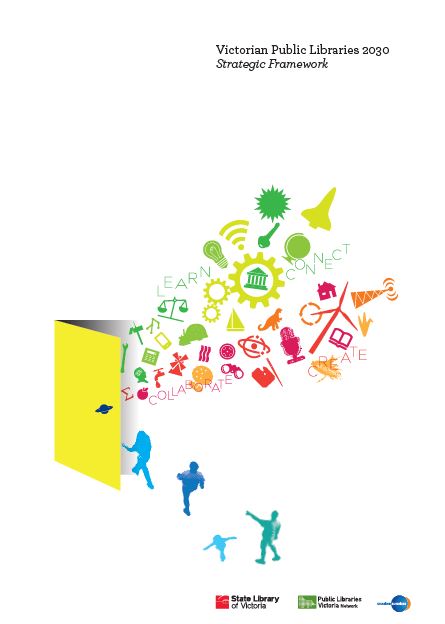
In Australia, the report on a major workforce planning study has been published by the project partners, State Library Victoria (SLV) and Public Libraries Victoria (PLV), the peak body for the state’s 47 public library services. Public library services in Victoria are guided by the strategic framework, Victorian Public Libraries 2030, which includes the visions of the Creative Library and the Community Library.

It was recognised that the achievement of the strategic objectives for the sector would depend on a workforce of well trained, experienced and valued public library staff’.  The need to have a clear understanding of the range of skills required for the two scenarios of the Creative Libary and the Community Library was the stimulus for an initial research study undertaken in 2013. Public library staff were surveyed to determine the perceived value of specific skillsets, the anticipated importance of the skills five years’ hence, and the respondents’ confidence levels in applying the skills in their work.

Managers were invited to consider the competencies required across the whole library service in order to identify potential skills gaps. The research findings, presented in the report Victorian Public Libraries: Our Future, Our Skills (SLV, 2014)subsequently guided a program of workforce and leadership development activities coordinated by SLV and PLV.

A stakeholder review of the framework undertaken in 2019 confirmed the continued relevance of the strategic directions for the sector: digital developments drive opportunities for creativity, innovation and collaborative processes in ‘creative libraries’, while technological, social, demographic, economic and environmental trends underpin the concept of ‘community libraries’. A fresh investigation was proposed to comprehensively review the skills, knowledge and confidence levels of public library staff.

The replication of the 2013 skills audit not only sought to update the skills data, but also to facilitate the comparison of datasets to measure the extent of skills improvements made over the six years and to identify any skill areas requiring further development.

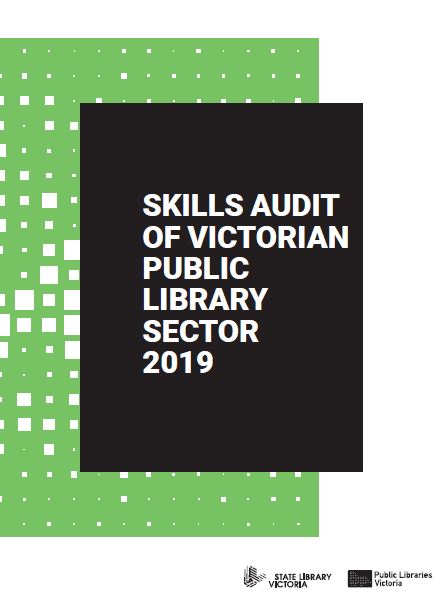
The new report, Skills Audit of Victorian Public Library Sector 2019, reviews the research data provided by 1,388 Individual respondents and 34 Management respondents. The questions covered three categories of skills: Foundation skills, Professional skills and Behavioural skills.  The analysis of the quantitative data focuses on the participants’ responses to the five-point Likert scale questions and considers their views of the most important skills, now and in five years’ time, as well as the least important skills.

The qualitative data provide insights into the participants’ views about the value of the different skillsets in the context of public library services, as well as the most valued areas of professional development. The priority skills for the future are viewed through several different lenses: the current strengths of library staff, the skills required for the technology environment and the skills to underpin programs and services in the Creative Library and in the Community Library. Improvements in staff confidence levels are contextualised within the training and development activities coordinated by SLV and PLV in recent years and strategies for future learning programs are considered.

The analysis of the areas where confidence levels were high painted an encouraging picture: public library staff demonstrated their commitment to the core values of the profession and had a mature understanding of the mission and purpose of public libraries in society. There was no room
for complacency, however: library staff were very conscious of the changing world around them. The theme of change was woven through the many comments provided in the 2019 skills audit, revealing that respondents’ thoughts were aligned with the sector’s insights into societal trends, characterised by the rapidly changing technological, social and economic landscape.

Undoubtedly, public library staff represent the sector’s most valuable resource. In a rapidly changing world, community dynamics are pressing library staff to reflect on their current professional responsibilities and challenging them to redefine their future. In Victoria, the approach has been to think broadly about what changes might take place in society so that public libraries might not only stay relevant but also play a transformative role within the community.

State Library of Victoria (2013). Victorian Public Libraries 2030: Strategic framework.

State Libary of Victoria (2014). Victorian Public Libraries: Our Future, Our Skills.

State Library Victoria (2020).  Skills Audit of Victorian Public Library Sector 2019.


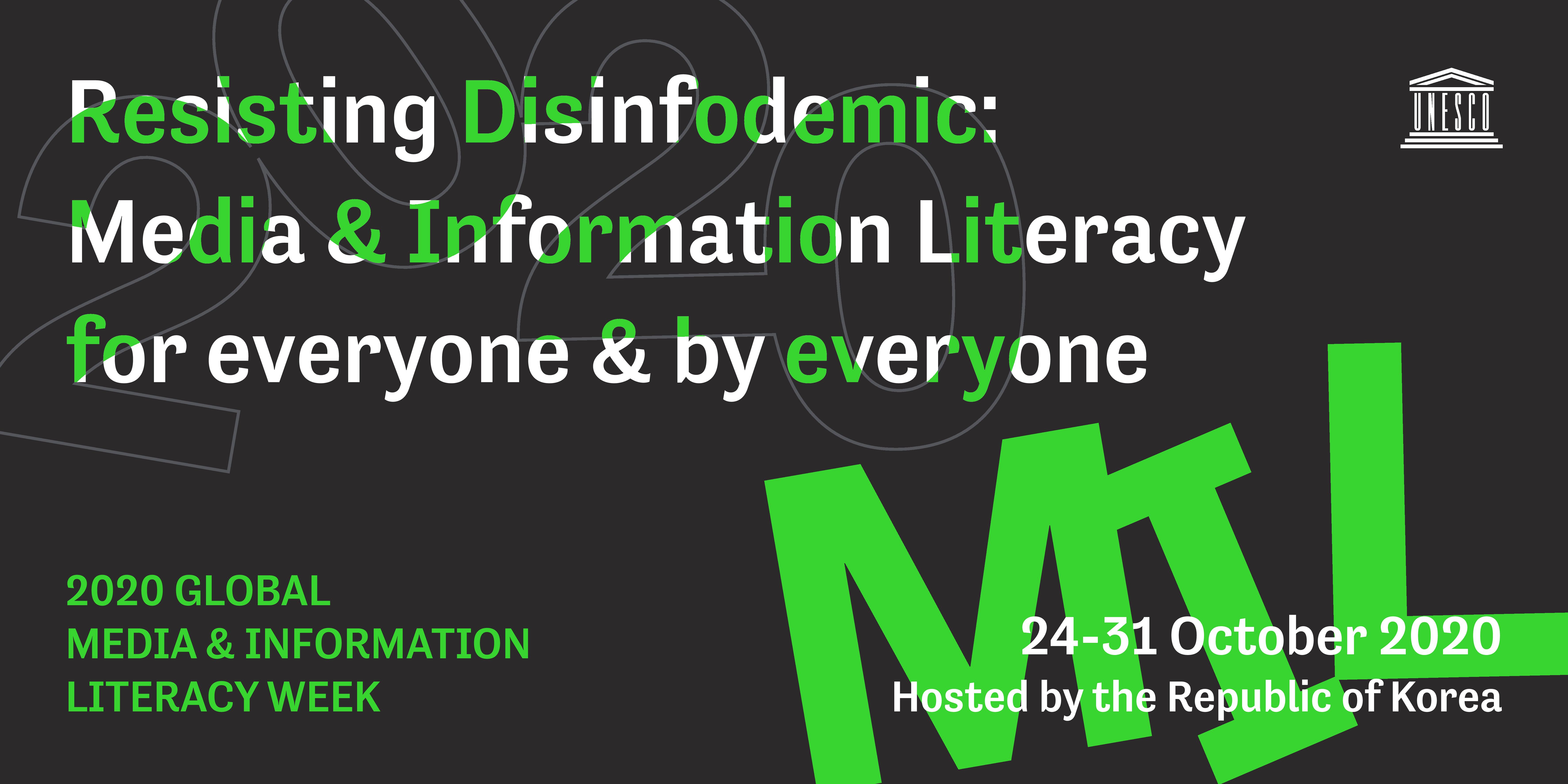
UNESCO Global Media and Information Literacy: Singapore style


Singapore celebrates UNESCO’s Global Media and Information Literacy (GMIL) Day on 30th October 2020

The Council of Chief Librarian’s Information Literacy Interest Group (CCL IL-IG), with the support of the Library Association of Singapore (LAS), is organising an online conference:

Information Literacy – The Singapore Way
Friday, 30 October 2020
2pm – 5pm (SGT)

The conference will feature a PechKucha event, with CCL IL-IG member institutions sharing case studies on how the COVID-19 pandemic has pivoted online teaching including instruction. The keynote address will be given by Dr Alton Grizzle, Program Specialist – Section for Media and Information Literacy and Media Development. Communication and Information Sector, UNESCO, Paris.

Don’t miss this opportunity to learn more about media and information literacy initiatives in Singapore.
For further details and to register for the event, please visit https://library76.wixsite.com/singaporemil

The CCL IL-IG is chaired by Rajen Munoo, Head of Learning and Information Services at Singapore Management University, and member of the CPDWL Standing Committee.


Australian librarians go above and beyond to promote children’s literacy!

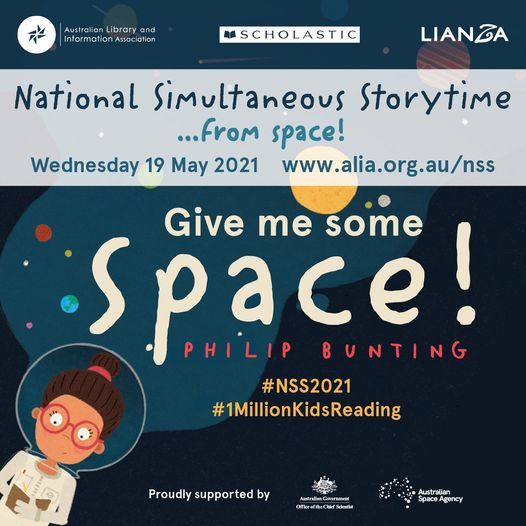
As part of Library and Information Week each year, the Australian Library and Information Association (ALIA) hosts National Simultaneous Storytime (NSS). In 2020, over 1.25 million participants simultaneously read the same picture book in libraries, schools, pre-schools, family homes, bookshops and many other places around the country. The success of this annual event has challenged the Australian LIS profession to come up with innovative ideas for future NSS events.

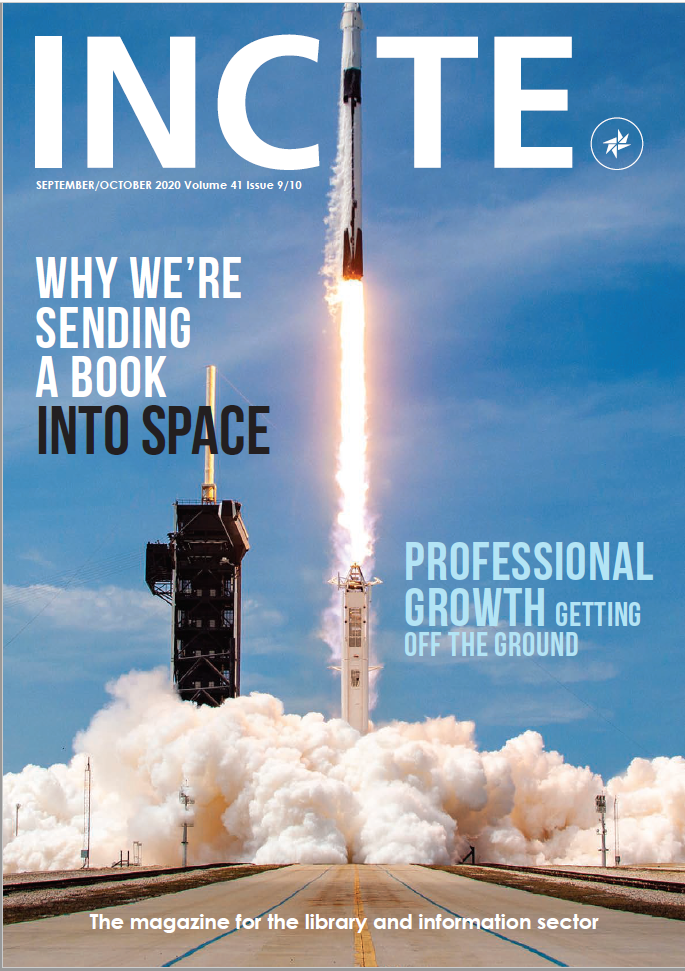
When thinking about the biggest thing that could happen for NSS, a suggestion was made to do it from space. There was already a science education program with stories read aloud by astronauts on board the International Space Station (ISS), so the idea was really not too outlandish…

So when ALIA approached the Australian Space Agency and the Office of the Chief Scientist, they received a very positive response.  And the planning for NSS 2021 began and work commenced on sending a book into space.

Today, the selected picture book, with a single copy especially created to meet the precise physical requirements for space travel, lifted off from NASA’s flight facility at Wallops Island, Virginia, USA, heading for the ISS.

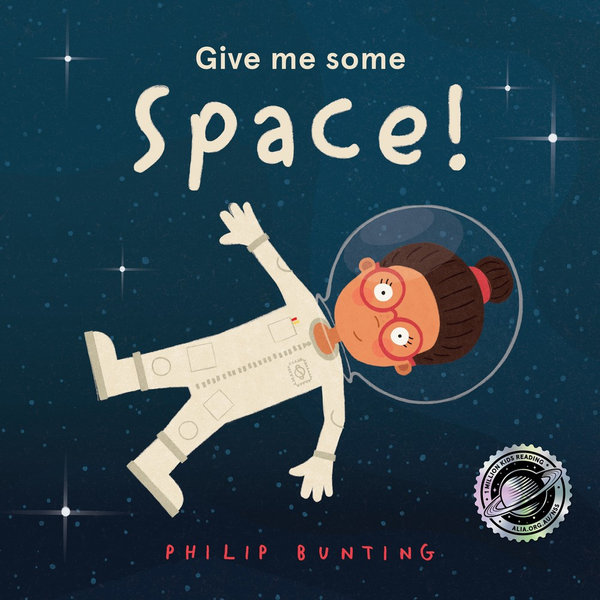
The book is entitled Give me some space! written and illustrated by Australian author Philip Bunting. It tells the story of Una, who dreams of a life in Space. She thinks that life on Earth is just so so-so. But how will she get there? And will she complete her mission to discover life in Space?


The story actually had to be fact-checked to ensure that the ideas were scientifically accurate.  As part of the project, there will also be a citizen science experiment where school children across Australia will record the temperature in their location. The data they collect will be combined with ISS data to map specific climate details of the vast continent.

NSS 2021 is scheduled for Wednesday 19 May 2021 at 11:00 AEST – which seems light-years away from now! However, do pop the event in your diary, so that you can all make the most of the opportunity to join millions of children around the world as they listen to an astronaut read their special story aloud to them.


Further resources

ALIA National Simultaneous Storytime https://www.alia.org.au/nss
Scroll down the webpage to ‘Resources’ to find heaps of creative ideas to support the NSS activities

Story Time from Space https://storytimefromspace.com/

Philip Bunting: Give me some space! https://philipbunting.com/books/give-me-some-space/

NASA Antares rocket launch from Wallops Island, Virginia, USA  https://www.youtube.com/watch?v=wRhgcY-yaf4

The worldwide reach of CPDWL

In these challenging times where we see many people in self-isolation across the globe, the value of meaningful connection has become increasingly important. The CPDWL Standing Committee (SC) is a great example of professional connection, with members sharing their deep interest in and commitment to the opportunities for ongoing learning and development for all LIS professionals. The CPDWL SC family encompasses the elected SC members, invited corresponding members and former SC members who continue to contribute to the work of the section as consultants.

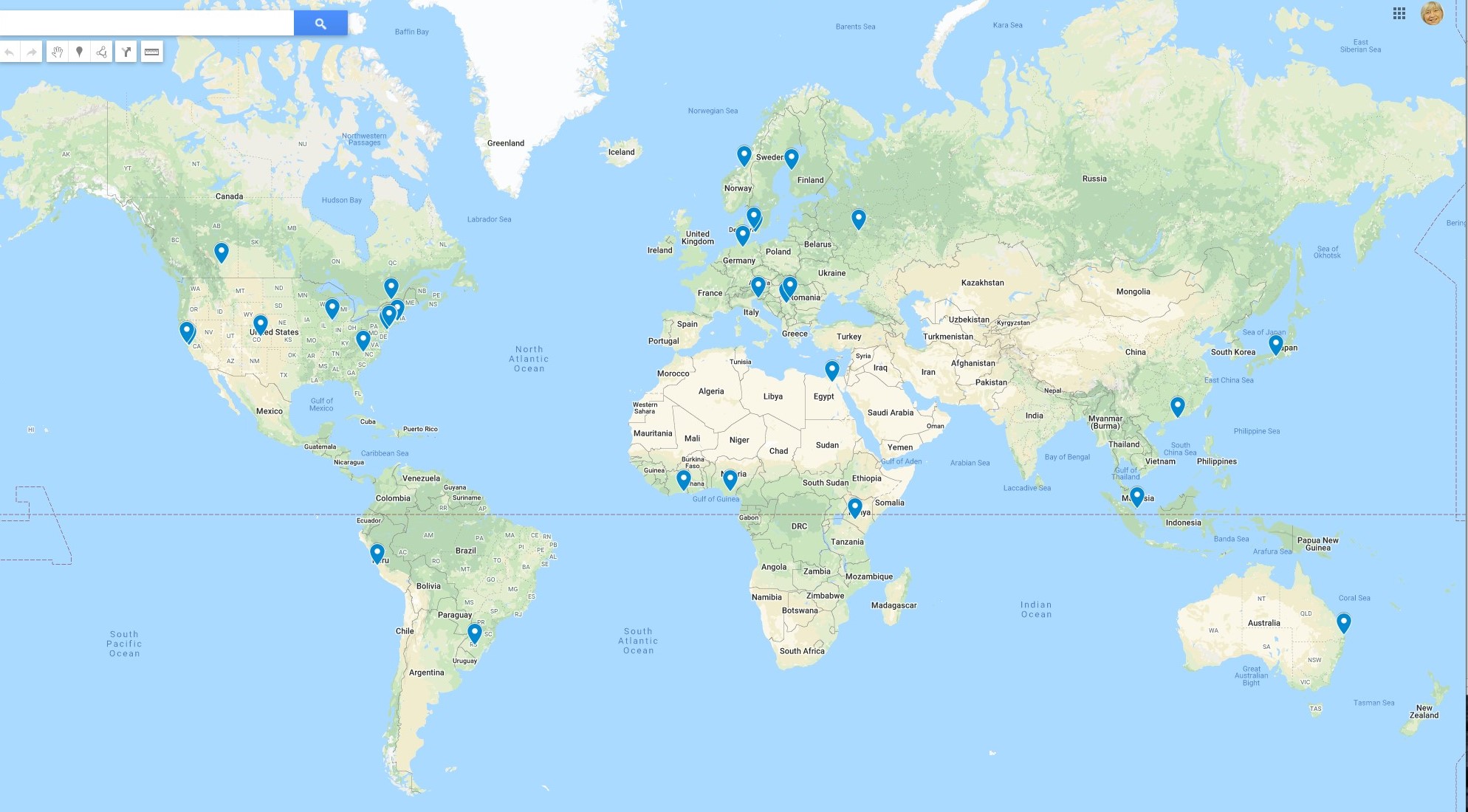
In 2019, our goal was to extend the reach of the SC to ensure that we had representatives from all continents of the world. To highlight the success of this initiative, we have created a map which documents the current distribution of our members: North America, South America, Africa, Europe, Asia and Australasia. We are spread across twenty different countries, we speak a multitude of languages, and we work in all sectors of the library profession: national and state libraries, public libraries, academic libraries, school libraries, cultural institutions, government agencies, professional associations and university faculties.


So, at a time when people may be feeling very alone and isolated, we are inspired by the rich diversity of this wonderful group of colleagues and friends who are connected, engaged and keen to build the capacity of LIS professionals, wherever they might be.

Stay in touch with CPDWL:
Web: www.ifla.org/cpdwl
Facebook: IFLA CPDWL
Blog: IFLA CPDWL blog
Twitter: @IFLACPDWL
Instagram: ifla_cpdwl