Category Archives: General

Black Lives Matter: Statements & Resources

By Loida Garcia-Febo, International Library Consultant, CPDWL Consultant, ALA Immediate Past President
Since the killing of George Floyd at the hands of the Minneapolis Police Department, people around the globe have rallied urging the world to fight against racism, racial prejudice, intolerant attitudes, and police brutality.

Library associations in the USA and internationally have released statements condemning violence and racism towards Black people and all People of Color. They have also compiled resources for action and for continuing education including terminology, action plans, and LibGuides. This blog post includes a compilation of current and past statements by library associations and organizations working closely with libraries and resources. It also includes resources for anti-racist work. This is not an exhaustive list. Each one of us must research, read and educate ourselves about these human rights matters.

Statements and websites with resources are a significant step in fighting racism. Actions reflecting anti-racism impacting institutions’ systems holding down Black people and People of Color are the ultimate goal. The work that will truly help us to dismantle the systems of oppression includes institutions’ hiring data, discrimination claim statistics, salary tables, retention numbers, diversity policies, institutions leaders’ public actions against racism (@DrMonicaCox, 6/4/20).

Statements

Black Caucus of the American Library Association (BCALA)

Statement Condemning Increased Violence and Racism Towards BlackAmericans and People of Color

The University of the West Indies at Mona, Jamaica

Statement from the Vice-Chancellor: Marcus, Martin, and Minneapolis

Society of American Archivists

SAA Council Statement on Black Lives and Archives

American Library Association (ALA)

ALA Executive Board stands with BCALA in condemning violence and racism towards Black people and all People of Color

ALA statement condemning police violence against BIPOC, protesters and journalists

ALA president reminds members of professional EDI tools to address microaggressions, quash racial profiling

ALA and US library associations affirm commitment to Equity, Diversity and Inclusion

ALA condemns racism and violence in Charlottesville

Asian Pacific American Librarians Association (APALA)

APALA stands with BCALA and Black Lives Matter

REFORMA, The National Library Association to Promote Library and Information Services to Latinos & the Spanish Speaking

REFORMA Statement on Solidarity with BCALA

International Federation of Library Associations and Institutions (IFLA)

Statement by the IFLA President and Secretary General: Racism Has No Place in the Society Libraries are Working to Build

The University of North Carolina, Chapel Hill Libraries

The University Libraries’ Role in Reckoning with Systemic Racism and Oppression
Resources

University of Denver, University Libraries

Where do I begin? – Anti-racist Resources – LibGuides at University of Denver

OCLC’s Skip Prichard’s

Remembering George Floyd with Reflection and Action

Trevor A. Dawes, Librarian, Educator & Consultant

Leadership and (Racial) Crisis

A Personal Message (about race in America)

Statements and Accountability

ALA

Reflections on Race and Racism: ALA affiliate and division leaders speak out

Libraries Respond: Black Lives Matter

The Plan for Action featured on this resource includes detailed sections on Everyday Actions, Center and Support voices in LIS, Staff development, Library Programming, Evaluate Policies, and Terminology:

Anti-Racism: Anti-racism is “the work of actively opposing racism by advocating for changes in political, economic, and social life. Anti-racism tends to be an individualized approach and set up in opposition to individual racist behaviors and impacts.” (National Education Association – Racial Justice in Education)

BIPOC: “Black, Indigenous, and People of Color. The term BIPOC is used to highlight the unique relationship to whiteness that Indigenous and Black (African Americans) people have, which shapes the experiences of and relationship to white supremacy for all people of color within a U.S. context.” (BIPOC Project) We use the term BIPOC in this resource to identify opportunities that are not specifically for Black people, but Black, Indigenous, and People of Color.

Black Lives Matter: #BlackLivesMatter was founded in 2013 in response to the acquittal of Trayvon Martin’s murderer. Black Lives Matter Foundation, Inc is a global organization in the US, UK, and Canada, whose mission is to eradicate white supremacy and build local power to intervene in violence inflicted on Black communities by the state and vigilantes. By combating and countering acts of violence, creating space for Black imagination and innovation, and centering Black joy, they are winning immediate improvements in their lives. (Black Lives Matter)

Racial Justice: “The systematic fair treatment of people of all races, resulting in equitable opportunities and outcomes for all. Racial justice—or racial equity—goes beyond “anti-racism.” It is not just the absence of discrimination and inequities, but also the presence of deliberate systems and supports to achieve and sustain racial equity through proactive and preventative measures.” (Race Forward)

White Supremacy: White supremacy is “the belief system that rationalizes and reproduces white advantage in the political, social, and cultural institutions of society. This belief system holds that white people, white culture, and things associated with whiteness are superior to those of other racial groups.” (Teaching for Diversity and Social Justice, p. 138)
CPDWL Newsletter June 2020 Issue Now Ready

Greetings to you all:

You can now access our June Newsletter at https://www.ifla.org/publications/cpdwl-section-newsletter

You will find a totally new design, thanks to our most recent Newsletter team member Sara Ulloa.

Besides the regular columns and information about the CPDWL Section activities, two main topics dominate the content.

The first topic provides updated information on the WLIC 2021 programme that is being prepared by the various working groups. The second topic is an international report of the support provided library staff in times of COVID-19 in six countries around the world, compiled by Ulrike Lang. This report is complemented by an in-depth article about Italy written by Matilde Fontanin,

I hope you’ll enjoy reading this issue and will find its information relevant, inviting, and worth sharing with your networks.

Please continue taking good care of yourselves. All the best,

Juanita

Juanita Jara de Súmar
Liaison Librarian (retired)
McGill University Library

“WE ARE TOGETHER: Interaction with Library Users as Instrument to Ensure Audience Growth. Inostranka Case”: continued.

By Alexandr Parshin in cooperation with Svetlana Gorokhova and Daria Belyakova. All Russia State Library for Foreign Literature, Moscow, Russia

On the 18th of May we posted material on the series of online professional webinars examining methodological principles and practical aspects of how to: conduct surveys, study customer behavior pattern, involve users into various library projects, make a system of feedback analysis, develop strategic plan, etc.

This post contains data on the next three webinars and the results of the whole series.

The conception was to present the experience of LFL (Library for Foreign Literature) in management approaches regarding the matter of communication in different forms with the library users. So that libraries and other cultural institutions interested in their patrons loyalty could learn techniques in getting maximum feedback about the services, quality, and potential areas of the institution operations and projects. We were very close to strategic management issues at the webinars as well. The speakers showed how data collected from surveys, users suggestions, different feedback forms, influence the way we work out the strategy. Finally we live in the dramatic conditions and remain in high voltage uncertainty: restrictions in the industry, oversaturated online environment – top concentration of online educational events given by cultural and library institutions in .ru-domain. When every library is in the same condition, time is to overcome trouble sharing the successful experience.

The series is suggestive and usefulness for the libraries to focus on the main questions. First, ask your client (library user): How do you see the shift of our work and what online services are you looking for? The second one – ask yourselves: Do we need to adjust the strategy and make more reasonable decisions to improve our work taking into account the crisis. The answers give us a chance to be more prepared for all sorts of problems in the industry. So the library strategy and the patrons (library users) – two rails that guide us in our endeavor to pass the crisis with minimum losses. We went from the interaction with the audience, getting maximum from the manner of enabling them in our projects, then – propositions for the strategy and services. Certainly, the significant part of our techniques were adapted for the pre-quarantine times. Nevertheless recommendations give us food for thought on how to interact with online audience and prove that its critical to regularly conduct patron behaviour research (plus the audience involvement in library projects), research of the services quality and stimulating the feedback system in the organisation.

These were as a matter of fact the main goals which we set when brainstorming the conception of the webinars.

Now let’s see what we argued about. The following are the theses, results and thoughts we came to during the series.

1. Explore the audience, analyze the results and decide what to focus on in the strategy. The rule is to immediately make a questionnaire and launch it on the Web site or offline whatsoever but the outcome should be: you efficiently adjust the current library projects according to patrons’ opinion just like we did on our first “online week” when the conditions changed dramatically.

2. Getting the profile of the library user cause us to center on the projects matching user interests and preferences. The half of the audience of LFL include students and academic community. This fact pushes us so that we will be able to expand the online resources and scientific services in the library otherwise we are about to lose the substantial part of the audience in the prospect.

3. What is the involvement of the audience with respect to the library? LFL has got the triune formula for the interaction and communication with the library users – so called Involvement. We state: the library users can give us an assessment (feedback). Usually we conduct surveys to make that real. Then the users might give us an advice or even a professional recommendation. This happens on the focus groups and over the period of the big interviews with users. After that another possibility is open for our patrons. They could embody the authentic ideas and launch their projects in the library, starting from the development phase and ending with the defense or implementation.

4. Volunteers in the library projects – not the assistants but the active participants in pitching ideas and making the breakthrough. They bring new ideas to improve our Customer Services – we share experience, give professional references and discover new talents. Library internship and the social role of the libraries in parallel could develop the library and our users significantly.

The series raised some meaningful points indicating the position we face in Russian regions libraries.

About 90% of representatives of the Russian regions libraries which participated in the live discussion at the webinar (up to 30 respondents – executives and librarians) conduct audience surveys. And mainly in order to discover how to improve services (53%), define the volume of demand (18%) and to be acquainted with the audience (16%). The regularity of using the data from the surveys is encouraging enough. 52% of our colleagues use the results repeatedly. This shows a good implementation of the survey-method. We conclude that the industry understands the correlation between the library users feedback and the pace of growth.

But the point is that the need to convert the collected data from surveys into strategic planning ideas is misjudged – our respondents think (the figure – “How regularly the audience survey results are used when developing the strategy of the library?”). It means that there is an impression that the importance of the data is not obvious for the executives or perhaps there are other fair obstacles, for instance, low budgets for big ideas or patrons’ unconcern in the destiny of the organisation.

Up to 65% of the respondents (25 executives and librarians) confirm that they organise the volunteer programmes in their organisations. Those who say “no” emphasize an array of difficulties such as the complicated process of volunteer recruitment (“volunteers are hard to motivate”), lack of experience. Thereby this part of involvement (volunteering) is not so common. But probably the usage of such an important technique and a generic feature of the library social function will rise in the nearest future. The good news is that our colleagues see the sense in high degree engagement of library users in organisation’s projects. Almost 50% of the respondents deem volunteers make contribution to their organisations (the figure – “What benefits do you see in engaging volunteers in library projects?”).

The result of the discussion proves the right choice we made. Starting sharing our methods of work throughout the industry hopefully could bring inspiration to proactive and motivated librarian commands.

Video of the webinars (in Russian) is available.

The materials are also presented at the LFL website.

We would be delighted to provide the summary of the findings in English, German or French by request. Please contact us at [email protected]

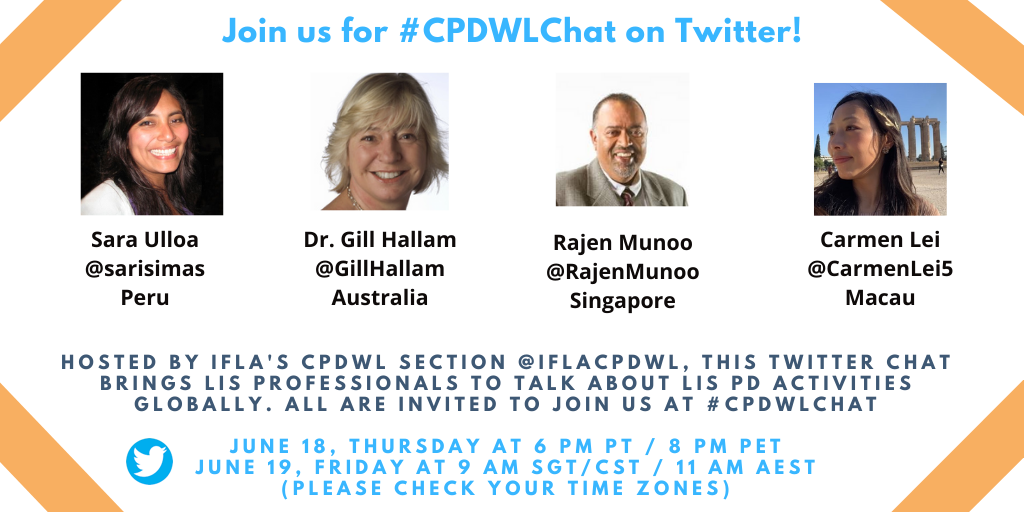
Save the date for Twitter #CPDWLChat on June 18/19, 2020

Please save the date/time to join CPDWL members for our Twitter chat on June 18 Thursday (Americas) at 6 pm PT/8 pm PET, and June 19th, Friday (Asia/Australasia) at 9 am SGT/CST and 11 am AEST (please check your local time.)

In this Twitter chat, we have Dr. Gill Hallam @GillHallam (co-chair from Australia), Carmen Lei @CarmenLei5, Rajen Munoo @RajenMunoo and Sara Ulloa @Sarisimas (CPDWL members from Macau, Singapore and Peru respectively) as participants of the chat.

We will be using the hashtag #CPDWLChat for this conversation and the Twitter handle @IFLACPDWL will moderate the discussion. All interested folks can participate in this online forum with their Twitter accounts and respond to our questions too using #CPDWLChat.

New to Twitter chat? You can read here for more information about it. In addition, here is an example of a past #CPDWL Twitter chat.

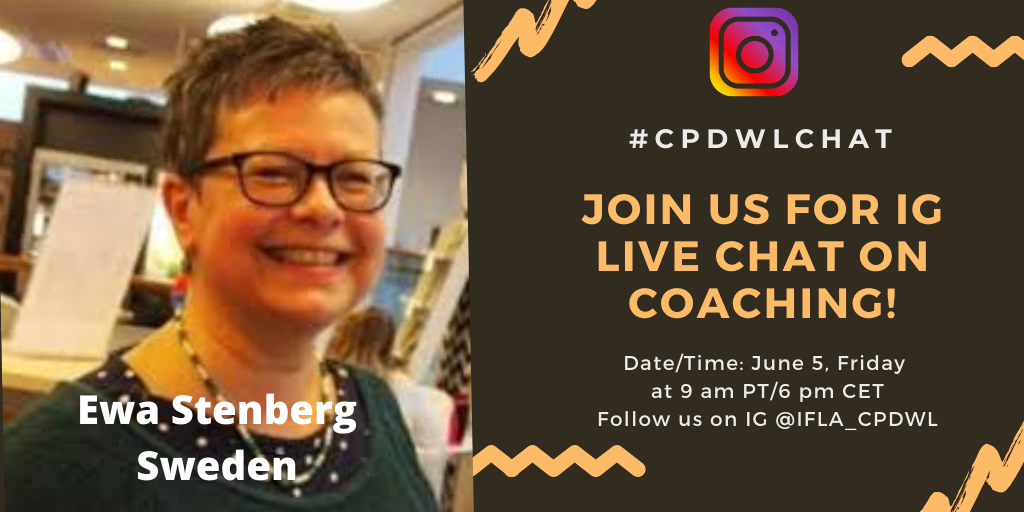
#CPDWLChat on Instagram Live with Ewa Stenberg

If you are an Instagram user or follower of @IFLA_CPDWL – you can find the live conversation that CPDWL will be hosting with Ewa Stenberg about coaching and CPDWL’s work in that area. You’ll need to download the Instagram app and have an account to join the conversation. A recording will be posted here too!

Date/Time: Friday, June 5 at 9-9:30 am PT (Pacific Time) / 6-6:30 pm CET (Central European Time).

Public libraries in Egypt during covid-19

Public libraries in Egypt supported its employees during covid – 19 and according to the regulations related to work that have been adhered based on the decision of the Prime Minister and the instructions of Ministry of Health and Population as :

  1. Employees who have chronic diseases has been given an absence leave.
  2. Pregnant women and mothers who have children under 18 years old were given an absence leave until further notice.

Public libraries are not open for the public until now. To ensure the flow of information during this period and in an effort to protect the staff and prevent all employees from falling ill at the same time, rotating shifts were implemented between staff to allow the work to continue despite a reduced workforce.

Examples of activities on Public libraries in Egypt:

Egypt’s Society for Culture and Development:

Egypt’s Society for Culture & Development (ESCD) is registered as a Non-Governmental Organization on October 18th, 1978, it has branched out in 14 different locations in the Arab Republic of Egypt providing a varied scope of activities and community services. ESCD has 10 public and children libraries across 4 Governorates. ESCD took many steps to engage our users and beneficiaries online through social media networks.

  • Launching the campaign “Our library at your home”. The campaign includes the following:
    • Provide links to resources in various fields such as science, virtual touring of museums and tourist attractions in the world, educational and recreational areas….etc.
    • Storytelling workshops for children on its library pages on Facebook.
    • Free training workshops to prepare school students in conducting their researches as the exams were replaced in most education years of education by researches.
    • Reading Club Seminars.
    • Contest for the best poster on Facebook that supports the White Army (Doctors & Nurses……).
    • Musical talent competition.
    • Online Handicraft workshop for children.
    • Show data on corona’s disease, its symptoms and some guidelines for the library audience

Misr Public library (1)

In Misr Public library (MPL), one of the greatest library system in Egypt, MPL permitted the public to deliver the loaned materials to the library Security and add them in a special box to return the borrowed books. Books are placed in the sun on the same day they return for disinfection, materials will returned on shelves on the next day with a commitment from the staff to wear gloves and mask on their faces, many activities were conducted such as:

  • Online training services have been provided through the library page on Facebook, English Language, Computer Skills…)
  • Accounts have been activated on WhatsApp to communicate with the library community to reserve training courses.
  • Storytelling workshops were offered to children through the library page on Facebook.
  • A daily cultural competition was presented on the page with prizes to be presented at the end of the crisis to the participants.
  • Some recorded events were shown for some scientific activities.
  • Show data on corona’s disease, its symptoms and some guidelines for the library audience.
  • Viewing some videos of handicrafts, drawings and origami workshops for children and mothers.
  • Viewing a meeting for the youngest child in the library, who introduces to children to how to deal with the Corona virus.
  • Announcing a national initiative to train and qualify youth for the labor market online, in cooperation with the Faculty of Home Economics, Helwan University and the AFRO ASIAN BOARD institution.
  • Conducting online courses in cooperation with civil society institutions such as the Arab Women Association.
  • Publishing articles to introduce MPL system history since its inauguration on the library’s Facebook page.

Misr Public Library is on its way to purchase disinfection gate in case the library opens after the crisis ends.

The Misr Public Library follows up the construction work under way in the libraries planned to open this year virtually and by telephone, for example, Faqous Library in Sharkia Governorate, Izbat Al-Burj Library in Damietta, the Quseir Library in the Red Sea, and the Qena Library in Qena.

Besides preparing the mobile libraries in Ismailia and El Sharkia.


  1. Information about MPL provided by Mr. Ahmed Amman,
    Deputy Director of Misr Public Library.

CPDWL/NPSIG Webinar: “Mindfulness to Manage Workplace Stress and Microaggressions”

Save the date! IFLA Continuing Professional Development and Workplace Learning, IFLA New Professionals Special Interest Group, and the American Library Association invite of all you to take part in a free webinar “Mindfulness to Manage Workplace Stress and Microaggressions”. This meeting is a part of the webinar series “New Librarians Global Connection: best practices, models and recommendations“.

Date/time: Tuesday, July 14th at 8 am PT, 10 am CT, 11 am ET (check your time zones here: https://www.timeanddate.com/)

Registration Here!

Description: Navigating workplace stress and microaggressions—verbal and non-verbal messages that are invalidating or demeaning—can be difficult in any profession, but is especially challenging in service-oriented professions like librarianship. In addition to identifying and naming stressors and microaggressions, various tools can be employed to mitigate the negative effects of these encounters. This session will provide attendees with a framework—mindfulness—that can be used to help process the often-fraught interactions that may take place in our libraries. The webinar will be recorded.

What will you find out on the webinar?

You will understand the roles of microaggressions and workplace stressors.
You will know how mindfulness can be used in workplaces in libraries.

Speakers:
Chippewa M. Thomas is a Professor of Counselor Education in the Department of Special Education, Rehabilitation, and Counseling and Director of the Office of Faculty Engagement at Auburn University. Thomas has published in journals such as the Journal of Counseling and Development, The Family Journal, Educational Gerontology, Journal of Specialists in Group Work, International, Journal of Thought Journal of Progressive Education and collaborated on book chapters in edited books. Thomas’ scholarship focuses on culturally competent counseling practice, social justice in action, community engagement/publicly-engaged scholarship, and wellness/vitality in higher education. She is active with several professional national and international counseling, education and outreach-scholarship affinity groups and organizations, and currently roster-listed as a Fulbright Specialist in Counselor Education.

Pambanisha Whaley is the Collections, Assessment, and Resource Management Coordinator at Alabama State University. Whaley has been an academic librarian for 15 years. Her research interests include: the role of minority library residencies in career advancement, the relationship between psychosocial factors and the success of library mentoring programs, and retention strategies for librarians from underrepresented groups.

Jaena Alabi is a Research and Instruction Services Librarian for the areas of English, psychology, and Africana Studies at Auburn University’s Ralph Brown Draughon Library. Her research interests include peer review of teaching for academic librarians, library collaborations with writing centers, and the effect of racial microaggressions on librarians and profession.