
Tag Archives: Artificial Intelligence

Dr. Jessica BrodeFrank to present “Digital Literacy & Crowdsourcing: Tackling Bias” | Blog by Helen Chan, CPDWL Section Chair

IFLA CPDWL | WLIC 2025, Astana

Dr. Jessica BrodeFrank, Clinical Assistant Professor and Digital Librarian at the University of Illinois Chicago, has prepared an insightful presentation titled “Digital Literacy & Crowdsourcing: Tackling Descriptive and Algorithmic Bias through Doing” for the upcoming IFLA CPDWL Open Session: “Navigating Opportunities and Challenges of Digital Transformation”, which will take place this August during WLIC 2025 in Astana. Her presentation focuses on addressing the intersections of digital literacy, crowdsourcing, and ethical artificial intelligence (AI), offering actionable strategies to mitigate bias and promote inclusivity in digital spaces.

Libraries and museums, as trusted sources of knowledge and community engagement, are uniquely positioned to advance digital literacy. Dr. BrodeFrank highlights their key role in educating the public about the opportunities, challenges, and ethical implications of digital technologies. By fostering lifelong learning, these institutions can empower individuals to navigate the digital world responsibly and effectively.
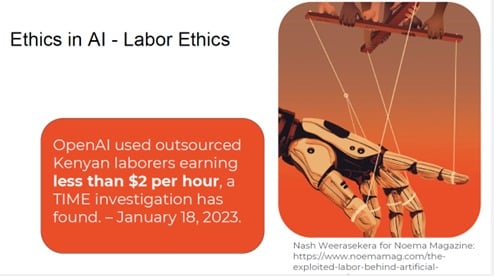
Ethics in AI-Labor Ethics image of wooden hand with puppet strings including text about AI paying Kenyan laborers less than $2 an hour.


Figure 1. Presentation slide from Dr. Jessica BrodeFrank on AI labor ethics, focusing on outsourced labor and wage disparities in the AI industry.

One of the core aspects of her presentation is the importance of metadata. Dr. BrodeFrank emphasizes that metadata, described by Tammy Lee as “the connective tissue of the internet”, is essential for shaping discoverability and amplifying diversity. Without accurate and inclusive metadata, underrepresented voices remain invisible in digital environments, making metadata creation a critical tool for equity and inclusion.

Dr. BrodeFrank also highlights the potential of crowdsourcing as a participatory method to engage the public. By involving communities in metadata creation and cataloging, projects like Zooniverse and the Smithsonian Transcription Center show how libraries and museums can transform passive users into active contributors. Crowdsourcing enhances the discoverability of collections while fostering a sense of ownership and connection among participants.
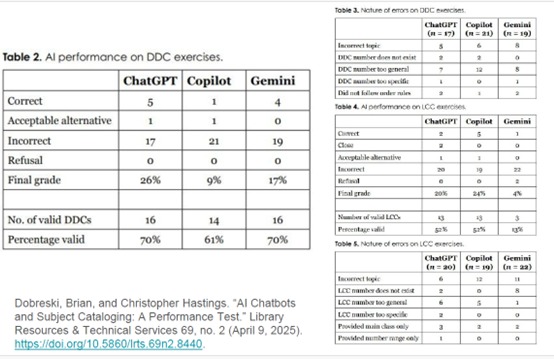
AI Performance onDDC Exercises for ChatGPT, CoPilot, and Gemini categories: correct, acceptable alternative, incorrect, refusal, final grade, no. of valid DDCs, Percentage Valid.

Figure 2. Presentation slide from Dr. Jessica BrodeFrank comparing the performance of AI chatbots (ChatGPT, Copilot, and Gemini) in DDC and LCC exercises.

Her presentation further addresses the ethical challenges of AI, including algorithmic bias, labor exploitation, and environmental concerns. Dr. BrodeFrank explains how AI models trained on biased data can perpetuate systemic discrimination. She also highlights the environmental cost of these systems, noting that a single ChatGPT query generates 4.32 grams of CO2 emissions, underscoring the need for a sustainable approach to AI use.

To tackle these challenges, Dr. BrodeFrank proposes actionable strategies, such as using crowdsourced metadata to surface underrepresented voices, ensuring transparency in cataloging practices, and raising awareness of the ethical and environmental implications of AI. These strategies reinforce the role of libraries and museums as leaders in fostering inclusive and equitable digital spaces.

For those interested in exploring her work further, Dr. BrodeFrank’s materials are available:

Paper: Download “Digital Literacy & Crowdsourcing: Tackling Descriptive and Algorithmic Bias through Doing”

Presentation Slides: Download PPT File

Recording: Watch the Presentation

Dr. BrodeFrank’s contribution to the IFLA CPDWL Open Session, “Navigating Opportunities and Challenges of Digital Transformation” offers valuable insights for library and information professionals. By addressing digital literacy, combating algorithmic bias, and utilizing innovative tools like crowdsourcing, her work inspires cultural institutions to take meaningful steps toward creating a more inclusive and equitable digital future.

Call for Papers – CPDWL Open Session (WLIC 2025)

Title:

Reimagine Continuing Professional Development for SustAInable Futures

Overview:

The IFLA Continuing Professional Development and Workplace Learning (CPDWL) Section, in collaboration with the Six IFLA’s Regional Divisions (Asia-Oceania, Europe, Latin America and the Caribbean, Middle East and North Africa, North America, Sub-Saharan Africa), invites submissions for its exciting session at WLIC 2025.

This session will explore the transformative potential of Artificial Intelligence (AI) in advancing continuing professional development (CPD) within the library and information sector. With the increasing integration of AI in library operations and professional development, this session will focus on how these emerging technologies can foster sustainability, inclusivity, and innovation.

As libraries and library professionals navigate the rapidly evolving landscape of AI-driven tools and practices, CPD initiatives play a critical role in equipping them with the knowledge and skills to lead meaningful change. This session aligns with the WLIC 2025 theme, Uniting Knowledge – Building the Future, by addressing the intersection of AI, sustainability, and professional growth.

Call for Submissions:

We welcome submissions that explore challenges, opportunities, and innovative strategies addressing one or more of the following themes:

  • Harnessing AI for Green Libraries:
    • Exploring how AI can optimize library operations (e.g., energy use, resource management) to reduce environmental footprints.
    • Training library professionals to adopt AI tools for sustainability planning.
  • AI-Powered Learning Ecosystems:
    • Utilizing AI-based platforms for personalized and continuous learning in the library and information sector.
    • Case studies on AI-driven virtual mentorship and skill development for sustainable library practices.
  • AI Ethics and the Librarian’s Role in Building Sustainable Knowledge Societies:
    • Addressing ethical considerations of AI in libraries and its impact on sustainable development.
    • CPD programs to equip librarians with ethical AI literacy.
  • Bridging the Digital Divide:
    • Using AI to democratize professional development opportunities for librarians in underserved regions.
    • Strategies to ensure equitable access to AI-driven CPD resources.
  • AI and the Future of Work in Libraries:
    • Preparing library professionals for the changing nature of work with AI integration.
    • CPD initiatives to foster adaptability, creativity, and collaboration in AI-enhanced workflows.
  • Reskilling for Resilience:
    • Building resilience in library professionals to navigate AI-driven transformations.
    • Training librarians to engage in AI-facilitated partnerships.
  • AI Innovations for Knowledge Equity:
    • Examining AI tools that promote knowledge equity and sustainable access to information.
    • Training librarians to use AI to support open access, digital preservation, and inclusive education.

Formats:

We encourage submissions that focus on a variety of presentation formats to engage and inspire the audience, particularly for the Regular Presentations of the Open Session:

  • Regular Presentations: 5-minute in-depth sessions with presentation slides, followed by
  • Panel Discussions: Collaborative and interactive discussions with IFLA Regional Division Committee Chairs on key themes.
  • Roundtable Discussions: Small-group, focused discussions among audience before the Wrap up

Important Dates & Notes

  • Proposal Submission
    • Submit a proposal of 500 words or fewer in one of the accepted IFLA languages by midnight on April 4, 2025.
    • Send your proposal to the IFLA CPDWL Section Chair, Helen Chan, at [email protected].
    • Use the following subject line for your email: “Submission for IFLA CPDWL Open Session – WLIC 2025.”
  • Proposal Format
    Please include the following in your proposal:

    • Title of Proposal:
      [Provide a clear and concise title for your proposal.]
    • Author(s):
      [Full name(s), affiliation(s), and contact details of the author(s).]
    • Abstract:
      [Summarize your proposal in 2-3 sentences.]
    • Proposal Content (500 words or fewer):
      [Provide the main content of your proposal. Ensure it is clear, concise, and relevant to the theme of the CPDWL Open Session.]
    • Keywords:
      [List 3-5 keywords related to your proposal.]
    • Language of Submission:
      [Indicate the IFLA language used in the proposal.]
    • Biographical Information:
      [Provide a brief biography of the author(s), including relevant professional background and experience (maximum 100 words).]
  • Notification and Communication
    • Contributors will be notified of the status of their proposal by April 27, 2025.
    • Proposals not submitted in English will be translated for review purposes. All communication between authors and the committee will be conducted in English.
    • The CPDWL Open Session at WLIC 2025 will follow an interactive and engaging format designed to foster collaboration and knowledge sharing. Please note that all selected speakers must be available to present in person on stage at the CPDWL Open Session during WLIC 2025 in Astana, Kazakhstan. No online presentations or pre-recorded presentations will be arranged. This ensures a dynamic and engaging experience for participants, encouraging active dialogue and in-person networking opportunities.
  • Contact Information
    • If you have any questions, please contact the IFLA CPDWL Section Chair, Helen Chan, at [email protected].

This session will take place at WLIC 2025 in Astana and aims to foster engagement, knowledge-sharing, and collaboration among library professionals worldwide.

We Look Forward to Your Contributions and Innovative Ideas!